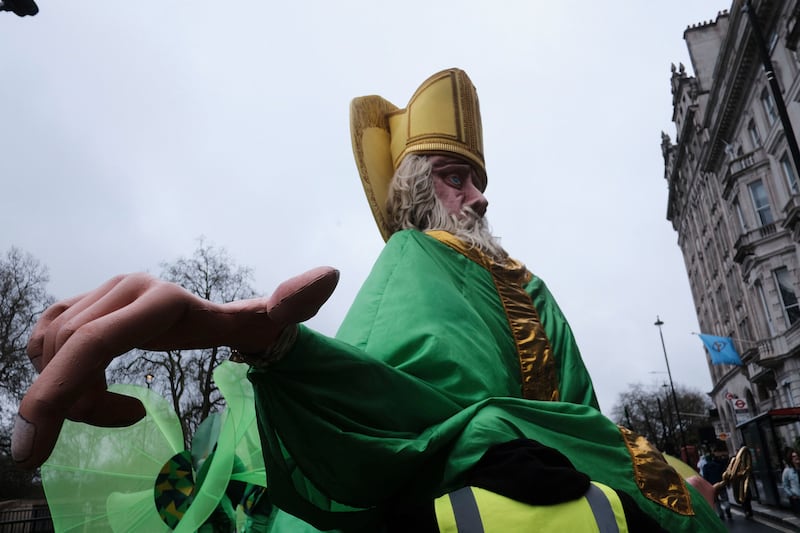

Many people tend to think “green,” “clovers” and “leprechauns” each year St. Patrick’s Day rolls around on March 17.
Yet, what appears to be less generally recognized is the story behind the holiday’s namesake St. Patrick, who went from being a self-described “sinner without learning” to a faithful witness of the gospel of Jesus Christ and the primary patron saint of Ireland.
“I did not then believe in the living God, not even when I was a child,” the famous patron saint is quoted as writing in a more modern translation of his “Confessio” or declaration of faith, which was originally written in Latin around 450 A.D.
“In fact, I remained in death and unbelief until I was reproved strongly and actually brought low by hunger and nakedness daily…,” he wrote. “However, it was very good for me, since God straightened me out, and he prepared me for what I would be today.
“I was far different then from what I am now.”
Here’s a summary of St. Patrick’s journey from “sinner” to believer, as drawn from his “Confessio”:
- Born in Britain around 390 A.D., St. Patrick grew up as a “simple country person” in a Christian family.
- His father Calpornius was deacon and his paternal grandfather Potitus was a priest.
- St. Patrick, however, would not listen and was not interested in God or religion as a young boy.
- At about age 16, St. Patrick was captured and taken to Ireland as a slave, along with thousands of others.
- Enslaved, St. Patrick worked for six years as a shepherd, oftentimes facing “hunger and nakedness.”
- It was during his enslavement, however, that St. Patrick was awakened to his “lack of faith” and decidedly turned to God, oftentimes praying up to 100 times daily.
- As his faith grew, St. Patrick’s “spirit was moved” and one night a voice came to him saying: “You have fasted well. Very soon you will return to your native country.”
- A short while later, St. Patrick heard the voice say to him: “Look — your ship is ready.”
- St. Patrick soon after escaped his enslavement “in the strength of God” by running away to a ship located about 200 miles away from where he had worked for six years.
- The ship’s captain initially rejected St. Patrick and sent him away. But before St. Patrick could even finish praying as he walked away, one person aboard the ship called to him, saying: “Come quickly – those men are calling you.”
- St. Patrick thus turned back and boarded the ship, and the crew set sail.
- St. Patrick then faced a journey of trial and temptation before he was finally reunited with his family in Britain.
- His family welcomed him, beckoning him to never to leave them again, and St. Patrick stayed with them for more than a decade, using his time to study to become a priest.
- In time, St. Patrick became a bishop and prospered in his work until God directed him in a vision towards a different path.
- In this vision, St. Patrick dreamed of a man named Victoricus carrying letters from Ireland. St. Patrick took one of the letters and, as he began reading, heard the “voice of the Irish people” and his enslavers calling him, saying: “We beg you, holy boy, to come and walk again among us.”
- Their voices touched St. Patrick’s heart, and so he arose and strived to heed his new call.
- St. Patrick once again faced opposition, betrayal, imprisonment and backlash from those he tried to serve as a missionary bishop in Ireland. But he continued, proclaiming his faith and witness of the gospel, and saw success.
- Throughout his ministry, St. Patrick baptized thousands of people, ordained clergy throughout Ireland, helped convert nobility and common people alike, and established churches and religious communities.
- He died March 17, according to legend, around 461 A.D. and is now recognized as the primary patron saint of Ireland.
What is a patron saint?
Patron saints are canonized saints in the Catholic, Orthodox and Anglican traditions.
They are believed to act as special protectors or advocates over specific places, professions or groups of people, and are chosen to serve as role models, with their patronage often linked to their life story or cause of death.
See quotes from St. Patrick’s ‘Confessio’ and testimony below
- “Even though it came about late, I recognized my failings. So I turned with all my heart to the Lord my God, and he looked down on my lowliness and had mercy on my youthful ignorance. He guarded me before I knew him…, (and) protected me and consoled me as a father does for his son. That is why I cannot be silent.”
- “How has this happened in Ireland? Never before did they know of God except to serve idols and unclean things. But now, they have become the people of the Lord, and are called children of God.”
- “I must take care not to hide the gift of God which he has generously given us in the land of my captivity. It was then that I looked for him with all my strength, and there I found him, and he protected me from all evils.”
- “Whatever comes about for me, good or bad, I ought to accept them equally and give thanks to God. He has shown me that I can put my faith in him without wavering and without end. However ignorant I am, he has heard me, so that in these late days I can dare to undertake such a holy and wonderful work.”
- “Those who wish may laugh and insult. But I will not be silent, nor will I hide the signs and wonders which the Lord has shown me even many years before they came about. He knows all things even before the beginning of time.”
- “Every day there is the chance that I will be killed or surrounded, or be taken into slavery or some other such happening. But I fear none of these things, because of the promises of heaven. I have cast myself into the hands of almighty God.”
- “I testify in truth and in great joy of heart before God and his holy angels that I never had any other reason for returning to that nation from which I had earlier escaped, except the gospel and God’s promises. I pray for those who believe in and have reverence for God. Some of them may happen to inspect or come upon this writing which Patrick, a sinner without learning, wrote in Ireland. May none of them ever say that whatever little I did or made known to please God was done through ignorance. Instead, you can judge and believe in all truth that it was a gift of God. This is my confession before I die.”