

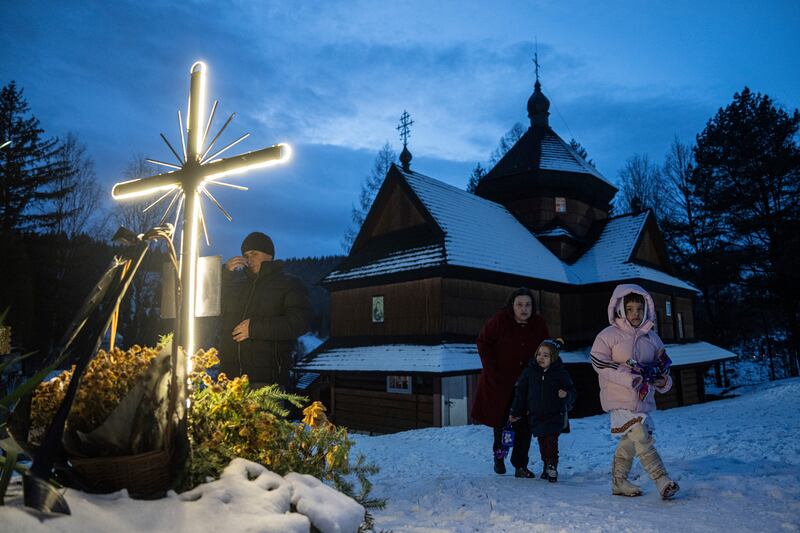

If a church — or any building of cultural significance — is damaged by a missile or drone strike, Kateryna Goncharova likens the damage to a soldier wounded on the battlefield.
“Would you leave a person dying on the battlefield?” asks Goncharova, who is a Ukraine-based country director at the World Monuments Fund, an international organization that works to safeguard cultural heritage. “No. You would take every possible emergency medical measure to keep that person alive until help arrives.”
The same reasoning applies to the churches and other structures of cultural and historical value that have been damaged by Russian aggression in the war in Ukraine, she says. You assess the condition of the building, stabilize it and protect it until it can be fully restored again.
These needs are widespread in Ukraine.
Ukraine’s churches and houses of worship have been among the war’s less-discussed casualties. Since the start of the full-scale invasion, 643 have been damaged, according to a report from Religion on Fire, a Ukrainian organization that documents the destruction of religious sites. The total includes nearly 400 Orthodox churches, 176 Protestant churches, 17 synagogues and other Jewish religious structures, and eight buildings from the Islamic tradition, including mosques.
It’s hard to get precise numbers, experts note, because many sites are too dangerous to access if they are located in the occupied territories.
“The erasure of our cultural heritage is the erasure of our identity,” Goncharova told me. “During the war, this is what we’re holding on to.”
I’m currently reporting on some of this destruction and how communities continue to worship, even under threat, at buildings that, to many, are sources of strength and symbols of their national identity.
I grew up in Kyiv, where my parents still live. It’s been about a decade since I last visited the city.
For this project, I’ve been speaking with Ukrainian conservationists and nonprofit leaders who are working, often as volunteers, to document the vast damage to the country’s religious heritage, including its churches.
I was especially struck by one story. Nelia Kukovalska, director of the St. Sophia of Kyiv National Reserve, an 11th-century religious complex and UNESCO site considered the heart of Ukraine’s spiritual tradition, told me how every air raid jolts her awake. She calls her team to check on the site. Only after confirming it is safe is she able to return to sleep. In the summer of 2025, the cathedral sustained its first direct wartime damage when a blast wave struck the cornice of its main apse. She describes the constant threat as “a wound on her heart.”
Around the country, the churches are storing valuable artifacts in secret storage locations, sending some abroad, and creating 3D models of churches. One of the World Monuments Fund’s projects to preserve unique wooden churches is equipping Ukraine’s unique wooden churches with fire extinguishers.
For a country at war, restoration is a costly endeavor that often doesn’t rise to the top as a priority. But some of the work to bring these churches back to life is underway. Italy joined the UNESCO team in Ukraine to help restore the Transfiguration Cathedral, which was severely damaged in 2023. The restoration process includes rebuilding a wall and part of the roof. It’s working on repairing the heating system.
For many Ukrainian believers, these churches embody divine inspiration through the hands of their architects and builders, who brought these sacred structures into being. In this sense, their creation is inseparable from the work God is doing on Earth.
These churches and cathedrals are also places where grief, pain and hope converge, binding a nation that’s resisting despair and fighting for victory every day.
Fresh off the press
- Author and conservationist Terry Tempest Williams talked to the Deseret News about returning to Utah from her teaching stint at Harvard, her new book, “The Glorians,” and saving the Great Salt Lake.
- Arthur Brooks continues to explore the most ambitious questions of existence. His new book, “The Meaning of Your Life,” comes out later this month. Jennifer Graham asked Brooks some questions about it.
- Women can now lead and serve in Sunday School presidencies, according to last week’s announcement from The Church of Jesus Christ of Latter-day Saints.
Barrier to evangelism
A Lifeway Research study on the “state of discipleship” found that more than a quarter of Protestant churchgoers hadn’t shared their faith with anyone in the past six months. Fewer than half say they intentionally build friendships with non-Christians for the purpose of evangelism.
Researchers suggest that a lack of intentional relationship-building with non-Christians is a key barrier to evangelism, since personal relationships make faith conversations more meaningful and harder to dismiss.
Despite these gaps in action, churchgoers report good intentions. The majority say they are eager to talk about Jesus with people different from themselves, and 4 in 5 pray at least occasionally for opportunities to share their faith.
“In a time when many Americans are more interested in hearing your truth rather than listening to the truth, Christians can share both by sharing how Jesus Christ saved them and its impact on their life,” said Scott McConnell, executive director of Lifeway Research. “People with no context for faith in Jesus Christ need to hear why he matters to them before hearing how to become a Christian themselves.”
Faith in news
- An Orthodox Christian priest who led the creation of Ukraine’s independent Orthodox Church, separate from Moscow’s Orthodox jurisdiction, died last week at 97 years old. — The New York Times
- The Washington Post now has a religion newsletter. It’s called “Awakenings” and is led by Matthew Schmitz, editor of Compact magazine. The project’s invitation is enticing: “Encounter the new face of faith.” I’m looking forward to following along. — The Washington Post
- The fight between AI company Anthropic and the Pentagon took a religious twist when 14 Catholic theologians and ethicists filed court briefs in support of Anthropic to limit its use by the military. — The Washington Post
- Several Islamic private schools in Texas have been accepted into the state’s voucher program after suing for exclusion and alleging religious discrimination. The consolidated federal lawsuits have extended the voucher application deadline to March 31, with the next hearing set for April 24. — AP via Texas Tribune
- ABC canceled “The Bachelorette” after the emergence of a disturbing video featuring Taylor Frankie Paul. And the costs are massive. — The Deseret News.
End notes
Reading about the death of Chuck Norris, I came across this touching clip of him speaking about his mother nurturing his faith when he was a child.
“Unfortunately, in periods of my life, I did drift from the Lord, but the Lord never drifted from me. He stayed with me the whole time,” he said.