



What are people “getting wrong about your faith?” asked the host of PragerU’s “Theological” podcast, Shabbos Kestenbaum in a conversation with a local leader of The Church of Jesus Christ of Latter-day Saints.
Speaking to Michael Stanley, president of the Santa Clarita California Stake, and referencing some polls asking Americans their perceptions of different faiths, Kestenbaum said he found it “really bizarre” how poorly some Americans view Latter-day Saints.
“A lot of that has to do with misinformation or deliberate disinformation,” the Jewish podcast host suggested. “All my interactions” with the church and Latter-day Saint individuals “have been nothing but positive,” he added.
‘Letting us speak for ourselves’
“I can’t control what other people think,” the Latter-day Saint leader said, before emphasizing what he did have power over. “For me and my family, we want to be the best neighbor someone ever had.”
“To be the leavening in the loaf,” Stanley said — adding, “sorry to use that analogy with my good Jewish friend” prompting a laugh from the host — “but to be a light in the darkness.”
Public misperceptions, Stanley suggested, often arise when people “let social media tell our story rather than what you’re doing here and letting us speak for ourselves.”
The interview was void of gotcha questions. Instead, the young podcaster showed genuine curiosity — something many of the 2,500+ commentators (among 120,000 viewers) expressed appreciation for:
- “You hear so many crazy things about Mormons. It’s kinda nice to hear from them for a change.”
- “Whenever I see ‘what Mormons believe’ videos it’s never members of the Church explaining our beliefs.”
- “Thank you, Shabbos, for talking TO an actual, active, believing Latter-day Saint instead of just talking about us.”
- “Great to watch people of different faiths have such a positive and respectful conversation. A model for us all!”
What in the world was Jesus doing in the Americas?
Kestenbaum became “fascinated” by the Church of Jesus Christ when studying religion at Harvard and Latter-day Saint missionaries would come to his house “every Friday afternoon before Shabbat” — even though, he said, “I was very clear with them, I wasn’t really interested in converting.”
“One of the things that I find most fascinating about the Book of Mormon,” he said, is the claim that “Jesus after his resurrection in Jerusalem came to the Americas … and he spoke with the Native Americans.”
“I don’t think enough Americans today know that is a core tenet of your belief,” Kestenbaum said. “What in the world was Jesus doing in the Americas? Who was he talking to? What were they talking about? Just educate me.”
Stanley talked about the ancient prophet Lehi coming to America, and later Jesus Christ, who had said in Jerusalem: “Other sheep I have that are not of this fold. Them also I must bring, and there’ll be one fold and one shepherd.”
A living, walking, breathing prophet
“Judaism believes that after the destruction of the second temple in 70 CE, we just lost prophecy,” Kestenbaum recapped — contrasting that with Latter-day Saint belief that their leader is “not just the president. He’s an actual prophet. He is a living, walking, breathing prophet who can give prophecy.”
“Yeah, we sustain [President Dallin H. Oaks] today as prophet,” Stanley affirmed. “The same kind of a prophet as we would talk about in the Hebrew Bible — Abraham, Moses.”
“Can a young student at BYU go to the prophet and ask for guidance?” the host asked. “There was a day that a person could literally walk into the office and say, ‘Brigham, I’ve got a problem,’” Stanley said — but with millions of members now, male and female leaders share their guidance every six months in a worldwide conference. “We welcome all the world to view those proceedings to hear what a living prophet might say and do.”
Latter-day Saint and Jewish commonalities
Kestenbaum noted his own people “have a “very similar history” as Latter-day Saints in terms of oppression and discrimination. “In fact, you quite literally have to find your land of Zion,” he said, describing the 19th century expulsion of Latter-day Saints from the United States.
“We, of course, have the land of Zion, which is the modern state of Israel. So, I just find the similarities historically, culturally, religiously to be overwhelming and really obvious.”
Doctrinally, Kestenbaum said the Talmud is replete with examples of how no one’s blood is more red than the others. “We are commanded to treat everyone in what’s called betzelem Elohim, literally in the divine image.”
“We believe they’re all we’re all brothers and sisters, fellow travelers on this globe spinning through space,” Stanley likewise said.
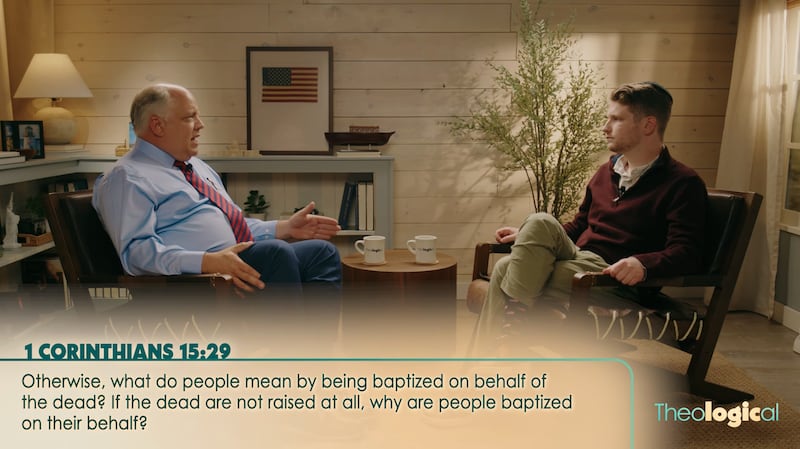
Kestenbaum noted an earlier controversy over Latter-day Saints performing proxy baptisms for victims of the Holocaust. “Many leaders of the Jewish community were outraged by it,” he said. “I’ll say something that might sound a little controversial … I actually find that incredibly compassionate and sweet.”
The host recounted telling a Latter-day Saint friend recently, “when I eventually die, I would actually take it as a true act of kindness and friendship if you did, in fact, perform a baptism by proxy. Not because I believe in the divinity of what you’re doing … but because it’s to me just a tremendous act of … ‘I care about you so much even though your physical body is no longer here, I care about your eternal soul.’”
Why so eager to share?
In a recent conversation with sister missionaries in Los Angeles, Kestenbaum said, “I don’t get it. You haven’t been to college. You’re in the prime of your life. Why are you doing this … spreading your religion to strangers?”
“If you knew what the cure to cancer was,” they responded, “you have an obligation to tell people about it.… You would not be able to fall asleep at night until every person on planet Earth knew what this cure was.”
Kestenbaum called this “a tremendous paradigm shift.” In fact, during a visit to Jerusalem he asked his old rabbi: “How come we Jews who believe that we also have truth, how come we don’t proselytize? … How come we’re not as enthusiastic as these young (Latter-day Saints)?”
Jesus said, “Go ye into all the world, and preach the gospel to every creature” Stanley said. “We take that literally as a commandment.”
After describing the process of receiving a call to one of the 450 different missions, Stanley pointed out that it’s a “great act of faith to say, ‘I’ll go wherever in the world you want me to go. I’ll speak whatever language they speak there. I’ll be a companion with whoever I’m assigned for the next couple of years of my life.”
“They learn to love the people wherever they are. They start seeing the good in the people.”
Heaven, hell and happiness
Referencing the South Park cartoon about people finding out Latter-day Saints were the “correct answer,” Kestenbaum asked, “What does Mormon hell look like?”
“Hell is a state of being,” Stanley said. “If you’ve ever done something wrong and you’re afraid someone’s going to catch on to what you’ve done, that’s a hell, right?”
“Do we believe in a literal hell with flames and pitchforks? No,” he continued. “We believe that our loving God loves all of his children and he wants them to have a glory. He wants them to do better.”
“Our message to the world is bring what you’ve got. Bring the knowledge you have.… Bring what you have from experiences of life and see if we can’t add to it.”
A little better each day
“We believe that we existed before we came to earth,” Stanley said, citing Jeremiah (“before I formed thee in the belly, I knew thee”).
“We believe that we continue after this life. That this life is just a short little glimpse of a kindergarten of our eternal existence, maybe first grade, right?”
“We believe that the gospel of Jesus Christ can create more joy, happiness, unity within families, and that there is great eternal relief that comes from that.”
“We have members of the church that are all in different phases of growth and learning. We hope they’ll continue to grow and progress and be a little bit better each day.”
“I get to repent each day. I get to do a little bit better and try things over again.”
So many misconceptions
“There’s so many misconceptions about your faith,” Kestenbaum said near the end of the interview. “I don’t really have skin in the game … but I would say that the media depictions of the Mormon faith have been really based upon lies.”
“I feel so blessed to have so many friends and leaders in the Mormon faith who’ve, you know, elevated my understanding of my own religion. And I think Americans would do themselves a tremendous service if you know they got to know a (Latter-day Saint).”