

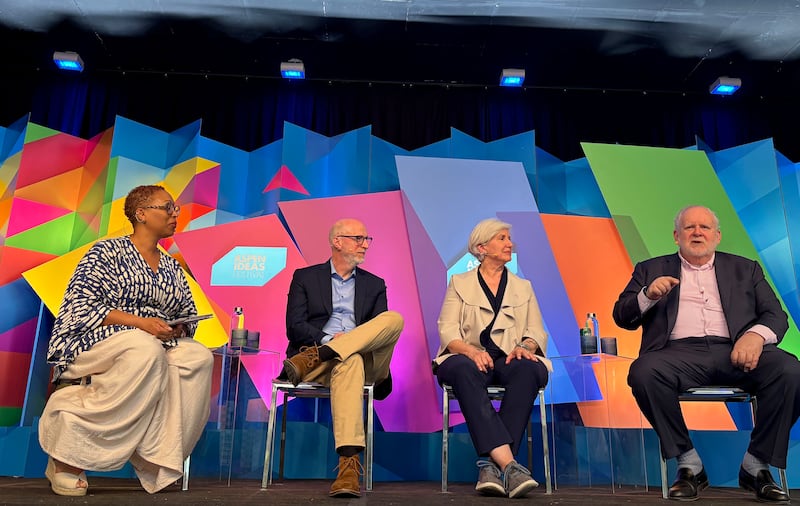

On the cusp of America’s 250th anniversary, the question animating the festivities is both familiar and urgent: What defines America, and what is the shared vision that its citizens are being called to renew?
That moral and civic vision is encapsulated in the Declaration of Independence, according to Jane Kamensky, president and CEO of Thomas Jefferson’s Monticello. She called the founding document the nation’s “civic gospel” — the national creed that outlines the core principles Americans vow to affirm and live out.
Kamensky spoke on a panel at the Aspen Ideas Festival on Saturday, alongside New York Times columnist David French and Walter Russell Mead, professor of strategy and statecraft at the University of Florida. Leading up to the 250th, Monticello and Arion Press released a new collection about the declaration titled “Declare: a Civic Gospel.”
As Americans reexamine the core beliefs set out in the founding document — “all men are created equal, that they are endowed by their Creator with certain unalienable Rights, that among these are Life, Liberty and the pursuit of Happiness”— the challenge remains how those ideals are to be applied in practice today.
“We ‘hold these truths,’” said Kamensky, referencing the founding text. “What does it mean to hold them? I think that proposition and then asking that question and finding collectively those practices is what it means to infuse a new century with the declaration as a civic gospel again.”
Is America a creedal nation?
The idea that America is a “creedal nation” means that it’s based not on ethnic or religious identity, but on a shared set of beliefs and ideals. Kamensky compared the declaration to the Old Testament and the Constitution to the New Testament, noting that it’s important to have a “constitutive idea” before a “political people.”
“I love the idea, that key language from the Declaration of Independence as being a kind of civic gospel,” said French, the New York Times columnist. “I also think of it as just a beautiful idea.”
This creed especially matters when it’s used to define who belongs in the American community and what values define the membership in that community: “Without this beautiful idea, I think America would be a less just country, dramatically less just country.”
American citizens are not morally superior to other nations anywhere in the world, French clarified, and have committed a long list of injustices throughout history, including slavery and the displacement of Native Americans.
“However, one thing that we’ve had since 1776 was the beautiful idea with which to contrast the actions of the people,” French said.
Mead, the University of Florida professor, expressed some skepticism regarding the view of America as a creedal nation and the term “civic gospel.” While some Americans see the United States as a nation unified by a common creed, he’s come to believe that American identity is more diverse and can be rooted in birthplace, home, history, as well as shared ideals, without a single understanding of what it means to be an American.
In Mead’s view, the ideals proclaimed in the declaration may not come directly from the document itself, but from broader cultural sentiments that the document reflected. “ I love the declaration, but I wouldn’t want to say that there’s a magic in some ways in that document,” he said. “Rather, the document was capturing something that was already there in the American view.”
Faith and the nation’s founding
The conversation about the role of faith in the American founding story tends to get politically heated, according to French, and the positive view of faith is often interpreted as right-coded.
“We’re in this moment where we’re trying to yank history into our side,” French said, noting the Supreme Court’s deliberations over gun laws. “One thing that is very important is we absolutely cannot be afraid … to deeply dive into the role of faith in the American founding and how it played a role. A naked public square devoid of religious discourse would be utterly alien to the founders.”
While faith was a “critical aspect” of the debate in the American founding, he argued, it bears little resemblance to contemporary debates about faith in civic life today. He cautioned against reducing the founders to a single religious perspective — faith looked different for each founder at different points of their lives. “They were their own thing, and they were different things,” he said.
Still, understanding the founding is inseparable from understanding the faith-based arguments behind it.
Mead added that what he calls “ethical Christianity,” a form of moral reasoning that blends easily with secular ethics and even other religious traditions, once functioned as a kind of civic glue in American life.
In the 1950s and 1960s, he said, this ethical framework helped bind the country together, particularly as Catholics and Jews were being integrated into positions of national leadership after long periods of exclusion. During that era, Mead says, there was also a much broader consensus about what counted as moral behavior and social norms.
Today, however, that consensus has broken down. Disagreements over shared morals and ethics make it difficult to identify a shared “ethical bond” to unify the country. “This is one of our big problems today,” he said.
Kamensky noted that Jefferson is famously credited for the phrase “wall between church and state” and he is known for compiling his own version of the New Testament by focusing on the moral teachings of Jesus and removing passages that dealt with miracles and theological teachings. Although Kamensky said she wouldn’t call Jefferson “a man of faith” — only in a vague way — every founder possessed a small “f” faith.
“And that faith was moral,” Kamensky said. The reason civics largely disappeared from classrooms in the late 1960s was because many educators on the left came to view it as a form of religion. Civics offers a “value-laden” language, she said, because it affirms “a virtue of belonging to a nation.”
“I think it’s a serious problem for the left in civics, for the center in civics to avoid the language of virtue and values,” Kamensky said.
Imperfect people
Moderator and journalist Jenn White asked panelists how they explained the tension between the founders’ concern for equality and their simultaneous endorsement of slavery. Mead responded that slavery was a widespread and long-standing part of human civilizations, and that the world of the founders should be understood within that broader historical context.
He suggested that studying this history can help illuminate how moral progress unfolds amid complex and imperfect conditions. It can also prompt a close look on present-day ethical contradictions like consuming goods produced in sweatshop labor.
“I think we can and must enrich our understanding of the past to see how many of its dilemmas are actually much closer to our own experience than we might like to acknowledge,” Mead said.
Kamensky noted that the founders, Jefferson in particular, understood the flawed nature of their lives and contributions. “I think it’s important for us to live in the tension of imperfect men,” she said.
French agreed that the founders were morally complex, capable of both conjuring up ideals and committing serious injustices and that they should be understood critically rather than being idolized or altogether dismissed.
Creating a shared civic gospel
With nearly 30% of Americans identifying as religiously unaffiliated, should the shared “gospel” of national ideals be religious or should it be fully secular?
“I don’t think it will last long as a purely secular thing,” said Mead. People, he argued, tend to seek connection to something transcendent and often want to link political order to a higher power, even outside formal religious institutions.
One of the obstacles to a wider acceptance of a shared civic gospel, according to French, is a misconception that small “l” liberal democratic principles are a departure from “authentic” Christianity. Many members of his own evangelical faith hold the view that modern liberalism weakens traditional institutions like the family and church through excessive individualism, and that ultimately leads to social breakdown.
“This is something that is very important for my friends and fellow travelers in the evangelical church to understand — the argument for small ‘l’ liberalism by the founders was shot through with Christianity,” French said. The founders’ writings — George Washington’s correspondence with a Jewish congregation is one example — contain Christian faith-based arguments for pluralism.
For Kamensky, the central question of a civic gospel is how to cultivate virtue and a sense of transcendence in public life without requiring religious belief — “how do we find our better angels without asking people to believe in angels?” The answer may be found in schools, historic sites and faith-based institutions, she noted.
At the closing, Kamensky invited the audience to consider the question: “As you mark this moment on July 4, what is the nature of your patriotism? Because ‘none’ is not an answer. ‘None’ just means somebody else will define it for you.”