



Vincent Golden Goodwin — all 7 pounds, 7 ounces and 20.5 inches of him — is swaddled in a colorful blanket on the floor next to his sister, 9-year-old Murphy, who is reading the book “You Can” to the newborn.
She is obsessed with her baby brother, which isn’t surprising, because she took part in the years-long journey that made him real. Along the way, at a very young age, she lost a little brother and a little sister, who each lived just hours.
Vincent’s name captures the story of his very short life so far and speaks as well to the future his mom and dad want for him. It’s also the story of a family that simply would not give up.
Vincent means victor or overcomer, said his dad, Jeff Goodwin. And Golden is mom Bre Goodwin’s grandfather’s first name. But the name fits even without the family connection. This baby makes them feel like they won gold.
It’s pretty safe to say that no baby was ever more wanted or had parents willing to do more to ensure his arrival and well-being.

An unexpected journey
The Goodwins, who live in Bountiful, Utah, married in 2013. Jeff is a telecommunications engineer and Bre works for a wealth management firm on the admin side. She also “treasure hunts,” finding interesting items and reselling them to make extra cash. They had Murphy three years after they wed — a healthy pregnancy and birth that in no way foreshadowed the challenges or sorrow heading their way.
When Bre was carrying their second baby, the 20-week ultrasound showed he had no kidneys, a condition called bilateral renal agenesis, which is rare, severe and usually not survivable. Without any kidneys, there’s little amniotic fluid and lungs don’t develop right.
They chose to carry the baby to term, although there was a real possibility he would die in the womb. They wanted to know him however briefly, to name him and love him and kiss him goodbye. Little Jeff, or JR as they sometimes also call him, was born Jan. 30, 2019, and lived six hours. Murphy was 2-½ and didn’t understand what was happening at the time.
Doctors assured the Goodwins that the loss, while so painful, was an anomaly and very unlikely to be genetic. They’d hoped to have four children, so they continued to grow their family.
At the beginning of COVID, Bre was pregnant again and they had an ultrasound a bit earlier this time, at 16 weeks, the shadow of a worry in the back of their minds. The test showed the baby, a girl, was also missing both kidneys and, like JR, all the needed connections that might have allowed dialysis or transplant or some other treatment after birth.
Bre carried that pregnancy to 36 weeks and Amber Rae Goodwin, born Nov. 15, 2020, lived just 90 minutes. By this time, they had to find ways to explain to Murphy what was happening. The little girl has been a key part of their journey ever since.
The family buried Amber Rae in a newly purchased family plot that’s a five-minute walk from their home and moved JR, who’d been in a baby section of the cemetery, next to his sister. “We go there all the time,” Bre Goodwin said.
Then they set out to unravel the mystery behind the deaths.

Searching for a gene mutation
By then, Bre and Jeff were sure the lack of kidneys had to be a genetic issue, so they’d had blood saved from Amber Rae’s umbilical cord. They also got their own blood sampled to see if anything could be identified. The test called out a SALL1 gene mutation, with the note that it “may or may not” be responsible.
“It gave us gray answers, but when you look up SALL1, a lot of what is noted has to do with kidneys,” Bre said. And testing showed she had a SALL1 gene mutation.
They wanted more kids and didn’t want Murphy to grow up alone. But they decided they couldn’t chance that this would be the story of another child’s hours-long life. They looked for an embryo donor and found one, but when they went in for the transfer, there were technical problems and the experience was hard on everyone.
They found themselves wondering what to do. Give up? Find another donor? “We basically did nothing; we decided let’s just live our lives,” Bre said.

A familiar stranger appears
One day, on social media, Bre saw that a fertility doctor they’d originally wanted to consult was coming out of retirement.
That doctor, Matt Peterson, had lived across the street when Jeff Goodwin was a little boy. They were years apart in age so Jeff didn’t really know him well, but the Goodwins wanted to tap his expertise. They made an appointment and the doctor jumped directly into questions about genetic testing and what they’d learned. They told him they didn’t get any real answers about the SALL1 gene. The couple said he also asked a lot of questions about JR, the first baby they lost and who they didn’t do any genetic testing with. Later, Bre remembered she’d signed a document that let doctors as part of a clinical trial give her some kind of medication if she started to bleed a lot during labor.
Peterson said he was going to look into that and he did. They learned a tissue sample had been stored and Peterson arranged to send it overseas to have DNA extracted and tested. Results showed JR also had the faulty SALL1 gene. They tested Murphy, too. She didn’t have it.
It was looking like that gene held answers.
SALL1 provides instructions for a protein that is very important in embryonic development, affecting different things, including the kidneys, so a SALL1 malfunction seemed likely.
A SALL1 mutation was certainly the best clue they had. Peterson found companies that could test embryos for a SALL1 mutation.
“He was on the hunt and went above and beyond,” the Goodwins said.

Peterson told them he felt inspired to help them and that he really wanted to do so. They still wonder if his prompting to come out of retirement and that inspiration to help them were related.
Months were a blur of medical procedures, with egg retrievals and genetic testing, starting in October 2024. They were looking for the SALL1 mutation and what was happening on the chromosome side. Of 15 eggs, just one was probably OK; it was recommended they do it again. Murphy helped her mom prep each time; she wanted a little sibling and they wanted her to feel included.
As Bre got ready for the procedure a third time, she made it a point to use red light therapy on her ovaries; she’d heard claims that it would help have robust eggs. She is not certain that’s why, but she said the last egg retrieval provided much better results. They ended up with “five embryos and a maybe.”
A wow moment
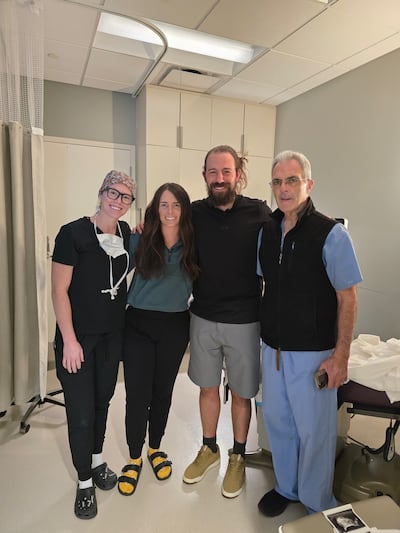
So in April 2025 she was pregnant again and they held their breaths until the 15-week appointment to see if the baby had kidneys. The obstetrician they loved, Dr. Mike Draper, had been with them through the previous pregnancies, but he’d moved to St. George. They wanted a “full-circle moment” with him, so they made the trip to southern Utah to have him perform the ultrasound.
The baby — Vincent Golden Goodwin — did have both kidneys.
“It was a wow moment,” Bre said, “and we all started crying.”
Vincent is still just days old, a fuzzy, dark-haired little slice of heaven surrounded by people who dote on him.
The baby’s parents tell their story, they said, for a couple of reasons. Bre wants to warn people that when you’re told something devastating probably won’t happen again, you should consider gene testing if it’s an option.

Jeff wants people to never give up on a dream. “Try not to take gray answers as a loss,” he said, crediting his wife with pushing forward. “It’s easy to say, ‘That’s it. This is our family.’ Bre doesn’t take gray answers. She needs concrete answers.”
The Goodwins agree that the other reason they tell their story is the most important. It’s because “God is great.” They see his presence in every step of their journey, from the grace to bear the unbearable to the return of the doctor they’d longed to consult and the extraordinary steps that he took to help them grow their family.
