


WASHINGTON — Congressman Ben McAdams didn’t look forward to voting “yea” Thursday on a resolution that establishes the next phase of the House impeachment inquiry into President Donald Trump and promises to bring the political drama onto America’s screens.
“I always hoped we would never get here,” the freshman Democrat from Utah told the Deseret News before heading to the House to cast his vote. “I don’t think this process is in any way good for the country, though it may be necessary.”
The measure passed on a party-line vote, 232-196, with the exception of two Democratic defectors who voted with Republicans against the resolution.
The resolution laid down rules for lawmakers transitioning from closed-door depositions to public hearings and ultimately to a likely vote on impeachment. If the House impeaches Trump, the Senate will hold a trial to determine whether to remove him from office.
Closed-door sessions are expected to continue, at least into next week, but today’s vote ensures that the inquiry will be televised, informing water cooler conversations for the foreseeable future. A parade of diplomats and civil servants who have already testified behind closed doors could be asked to testify publicly. More prominent figures, such as former national security adviser John Bolton, could also land in the spotlight.
The inquiry is centered on a whistleblower complaint about a July 25 phone conversation between Trump and Ukrainian President Volodymyr Zelenskiy. A transcript of the call shows Trump asking for a “favor” — an investigation of political rival Joe Biden and his family. It is alleged that Trump withheld military aid and dangled a White House visit as a quid pro quo.
McAdams said his support for the resolution isn’t a vote for impeachment, but a vote “to gather facts and create a fair process.” He is among more than two dozen House Democrats from districts that voted for Trump in 2016, who are considered vulnerable in 2020.
“I’m putting partisanship aside and will engage in the way that I think is best for the country,” he said. “I don’t know where that’ll take me at this point. But my duties are to the Constitution and to the people of Utah.”
But Utah’s Republican House members blasted the resolution as a partisan scheme skewed to railroad a president Democrats have never liked.
“Let’s be honest — it seems to me that a combination of the president’s style and a predetermined goal to remove him from office set this impeachment in motion on the day after the election,” 3rd District Rep. John Curtis said in a statement. “The American people want to know the truth, and so do I. I will support a process that leads to more transparency, without the influence of politics, but today’s vote does the opposite.”
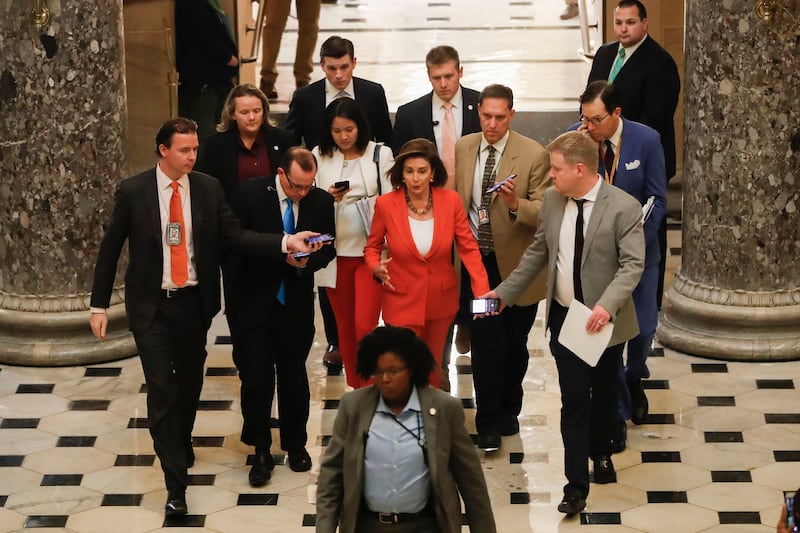
During Thursday morning’s House debate, Democrats stayed on message about a lawmaker’s duty to defend the Constitution and Congress’ role as a check on executive power. House Speaker Nancy Pelosi recited the preamble to the Constitution and described the impeachment process as “solemn” and “prayerful.”
“What is at stake in all this is nothing less than our democracy,” the California Democrat said, addressing the House with a poster of the American flag beside her.
She said the procedures spelled out in the resolution would let lawmakers decide whether to impeach Trump “based on the truth. I don’t know why the Republicans are afraid of the truth.”
Republicans likewise stuck to their talking points, characterizing the closed-door process as a sham and political ploy by Democrats to oust the president without an election.
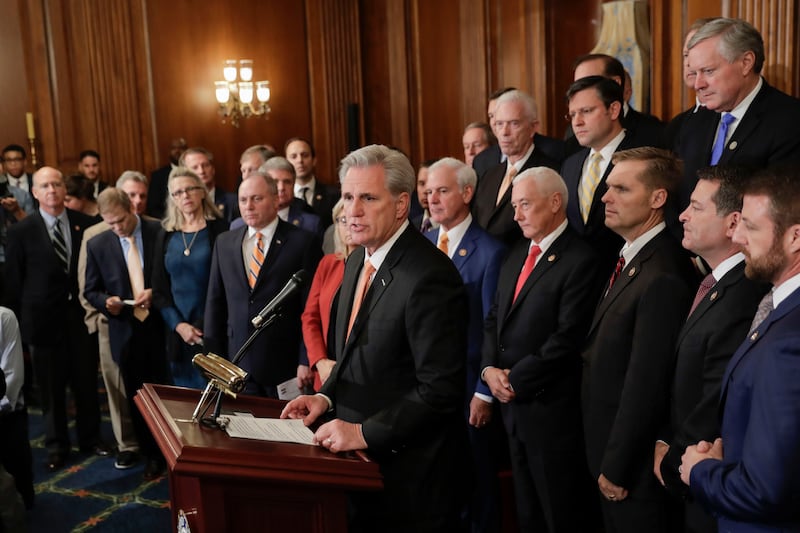
House Minority Leader Kevin McCarthy, R-Calif., said Trump had done nothing impeachable and accused Democrats of trying to remove him “because they are scared they cannot defeat him at the ballot box.”
He said it was appropriate the vote took place on Halloween, echoing a familiar criticism the president repeated in his tweet about the vote: “The greatest Witch Hunt in American History!”
The White House said in a statement following the vote: “The Democrats are choosing every day to waste time on a sham impeachment — a blatantly partisan attempt to destroy the President.”
McAdams said Democrats have hurt their credibility to this point by clamoring for impeachment “for every reason under the sun” since Trump took office. But he faults Republicans for dismissing the president’s conduct when, he contends, it warranted investigation.
McAdams was against launching an impeachment inquiry until the administration declared it would not cooperate with House investigators.
“We need to fix this process and go forward in a very solemn manner and make sure that the public knows that we are doing this in a transparent way, let them see the facts for themselves and let them judge for themselves without Democratic or Republican spin,” he said.
The rules approved Thursday lay out how the House Intelligence Committee — now leading the investigation by deposing diplomats and other officials behind closed doors — would transition to public hearings, according to the Associated Press.
That committee will issue a report and release to the public transcripts of the closed-door interviews it has been conducting. The Judiciary Committee will then decide whether to recommend that the House impeach Trump.
According to the rules for hearings, Republicans can only issue subpoenas for witnesses to appear if the entire panel approved them — in effect giving Democrats, who outnumber Republicans on committees, veto power.
Attorneys for Trump could participate in the Judiciary Committee proceedings. But panel Chairman Jerrold Nadler, D-N.Y., would be allowed to deny “specific requests” by Trump representatives if the White House continued refusing to provide documents or witnesses sought by Democratic investigators.
Utah GOP Congressman Chris Stewart, who sits on the House Intelligence Committee, said the resolution gives majority Democrats too much control to sideline Republicans.
“Only through a bipartisan process, in which both sides are given the opportunity to investigate, can we reach a conclusion that will be broadly accepted and factually sustained,” Stewart said in a statement. “This resolution fails to meet this standard and doesn’t follow the precedent of past impeachment investigations.”
Curtis, who sits on the House Foreign Affairs Committee, which has some jurisdiction over the inquiry, said the resolution disallows him from continuing to attend and participate in impeachment-related depositions and hearings.
“This new impeachment inquiry is out of harmony with normal justice and impeachment precedents that protect against political and personal bias,” he said.
Democrats contend the procedures are similar to those used during the impeachment proceedings of Presidents Richard Nixon and Bill Clinton.
Rep. Rob Bishop, R-Utah, urged Democratic leaders to drop the impeachment “circus” and focus on issues such as trade, drug prices and border security. The former high school history and government teacher said, “Alexander Hamilton warned us of this day when he said, ‘The greatest danger (is) that the decision (on impeachment) will be regulated more by the comparative strength of parties, than by the real demonstrations of innocence or guilt.’”