


SALT LAKE CITY — I watched the Heat beat the Celtics Sunday night. And I felt guilty.
A win would have sent Miami, my hometown team, to the NBA finals, where the fifth seed would face the favored Los Angeles Lakers and LeBron James, who won his first league championship with the Heat.
I’d checked out of the playoffs since the Jazz were eliminated; I’ve never been much of a basketball fan anyway. But the storylines were too good to resist. So I tuned in.
Why I felt guilty is hard to say, but some context might help. When the NBA first reopened play in the Orlando bubble, the Deseret News wanted to send me there, if we could settle on a story. My pitch — “Is this supposed to be fun?” — contradicted my own editorial board, who wrote in July that the NBA’s return would “buoy morale.” I felt very little in the way of lifted morale when I saw the games.
All the workarounds, from cardboard cutouts in the stands to announcers introducing players to empty stadiums, just underscored the weirdness. Instead of escaping, I felt more shackled to reality: We remained far from normal indeed.
Yes, there were certain moments, like Donovan Mitchell’s 50-point playoff games or a diving catch by any major league fielder, when it felt right. Like pulling a blanket over your head when you’re a kid, paring down the world and shutting out a deadly pandemic and unrest over racial justice. A moment to disconnect from yourself, your struggles and a world you can’t control.
But “for (the trick) to work right, it has to start with the players believing that the outcome really matters, then spread out over the crowd and the viewers at home and cover them too, get them screaming and jumping and throwing pillows at the screen,” Gary Smith wrote for Sports Illustrated back in 2001. “Only a few athletes, or maybe a handful of fans, not losing themselves in the game can start lifting the edge of the blanket, start making everyone see that the game doesn’t mean a thing.”
I couldn’t even get the blanket down past the crown of my head. This summer, before the NBA and MLB started up, a cousin told me something like, “At least we have the NFL to look forward to,” and I couldn’t relate. How can you look forward to the NFL, I thought, when we have so many problems to fix? That feeling didn’t go away.
Particularly watching the NBA, where players wear league-approved social justice messages on their jerseys that force a nightly confrontation with reality. Perhaps that’s the point. But Sunday night, I tried to look past that, to pull down that blanket for as long as I could, even if I’d told my editor it seemed impossible.
Because another game in another sport had left me feeling inspired.
Partying like it’s ‘03
I was 7 when the then-Florida Marlins won their second World Series in 2003. I wasn’t into sports and barely remember that playoff run beyond my dad watching the NLCS against the Cubs one afternoon. I don’t even recall the Bartman incident. But my dad got swept up in the moment and bought a 20-game season ticket plan for 2004.
My first game was their second in 2004, against the now-extinct Montreal Expos. I don’t recall how badly the Marlins lost, but I do remember walking into the bright-orange seats of what was then called Pro Player Stadium and enjoying the ballpark food. The actual game didn’t matter to me — a trend that, for better and worse, continued for the next 17 years.
To paraphrase TV’s Hank Hill, I’ve always been a fan of the Marlins, no matter what — and there has been a lot of “what” over the years. The great fire sales of 2005 and 2007; a manager of the year fired after one season; the taxpayer-funded stadium that opened in 2012 and was supposed to change everything but, before the season was over, led only to another fire sale and a $2.5 million kinetic home run sculpture dubbed “The Tremenda M****a Fountain” (let’s not get into the translation).
Even when longtime owner Jeffrey Loria sold the team in 2017, new part-owner Derek Jeter’s first moves were to trade away the team’s three star outfielders. But despite the team’s many — again, many — shortcomings, being a Marlins fan has enriched my life in profound ways. That’s no exaggeration.
I met my fiancee because of the Marlins. I met my best man because of the Marlins. And even the misery is almost part of the fun: Marlins fans are defined by irrational hope and collective suffering, a monastic existence.
This year, the Marlins faced long odds that plummeted even further when the team became a living illustration of how quickly the coronavirus can spread. But by season’s end, Miami had somehow weathered COVID-19 and overcome a frankly not-too-talented roster to put themselves in contention for a playoff spot.
It hardly mattered to me that this year’s pandemic playoffs feature eight teams per league rather than the usual five. For the first time in 17 years of miserable fandom, the Marlins had a shot. And that was enough to make me watch.
Their first chance to clinch came on Friday, Sept. 25 — an important date in franchise history. Four years earlier, Jose Fernandez, the team’s star pitcher, a Cuban immigrant in a city of Cuban immigrants who ESPN personality Dan LeBatard labeled “a symbol of strength and pride for our people,” died in an early morning boating accident. He was only 24.
Toxicology reports revealed he was drunk and had cocaine in his system when it happened, which stung. But he was still a transcendent talent with a personal magnetism I’ve never seen in another athlete, and for someone outside of Miami, it’s hard to understand his complicated legacy. I wrote about it as an intern at the Miami Herald a few years ago. His death was the hardest time to be a Marlins fan, yet one of the most meaningful, almost a reminder of what makes games and fandom worthwhile. A reminder of how they make us feel.
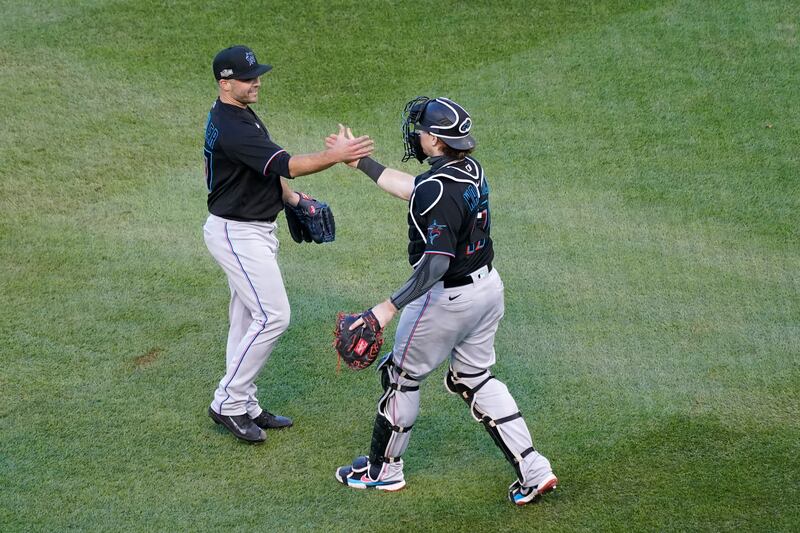
Fernandez was on manager Don Mattingly’s mind in the bottom of Friday’s 10th inning, with his Marlins up 4-3, needing two more outs to clinch a playoff spot. The Yankees had the bases loaded, but shortstop Miguel Rojas gloved a chopper up the middle, slid his foot across second base and threw to first to complete the double play. Game over. My fiancee screamed while I waited to make sure he didn’t miss the base.
“One of the first things I thought about was Jose, four years ago, and what we went through,” Mattingly said, his voice cracking, during his post-game interview. “That’s kind of the other end of the emotions.”
Even though I watched the players celebrate in an empty stadium, all wearing masks, this finally felt like something worth celebrating despite the weirdness — perhaps even because of it.
But something still gnawed at me. As the players (understandably) screamed, hugged and slapped five, I felt the guilt. For the first time since the pandemic started, I’d managed to pull the blanket all the way down. Yet at this precarious moment in history, even time under the blanket, I realized later, felt different.
The good and the bad
The next morning, the Florida Gators — my alma mater — opened their season at Ole Miss. What I saw when I tuned in at 10 a.m. Utah time was both exciting and horrifying.
The stands were packed with an indiscernible mixture of living fans and cardboard cutouts; close-ups showed folks not wearing masks, not social distancing; and, of course, there were empty seats during the first SEC football game of the season. All of it combined to create a discomforting portrait of real and fake, of something like manufactured normality.
The game, however, was a delight. UF quarterback Kyle Trask threw for six (!) touchdowns and over 400 yards, Florida trounced the Rebels, and I was enthralled. I wasn’t alone. “There may not have been packed stadiums or festive tailgates or a full slate of games that spread across the entire nation,” Los Angeles Times college football reporter J. Brady McCollough wrote Saturday night. “But this was a college football Saturday after all, and I’m hooked once again.”
When it comes to the pandemic, I see college football as both treatment and symptom. The fact that schools are piling people into stadiums and trusting them to follow unenforceable rules is the worst of manufactured normality. Rather than fighting the virus, college football — like sports in general — reminds us that our nation’s collective response to a generational tragedy amounts to, “Eh, let’s just live with it.”
But college football — like Marlins baseball or Heat basketball or whatever sport you care about — is still a joy, a “healing tonic,” to quote the headline on McCollough’s story. And this contrast brings us back to Sunday night.
From the couch, with love
As the Heat cruised to a confetti-free victory, I teetered between focus — as when the Heat were falling behind or, later on, building their game-winning lead — and guilt. After the game, I sat back in my recliner and started formulating what I wanted to say about the experience here, in these pages. My first thought was to explore these conflicting emotions, which I’ve already laid out. My second was to try and find some way to rationalize one or the other, to pick a side. To say that either all of it makes sense and is perfectly appropriate, or none of it does, or is.
I changed my mind.
Gary Smith first proposed the blanket metaphor in the aftermath of 9/11, after he took his son to a high school football game. On the way home, he wondered what his son would take away from the spectacle they’d just watched — a power outage made some in the stands fear the game was under attack. “How can we possibly expect the pretense (that sports are important) to hold up three days after a mass murder, and why would we even ask it to?” he wrote later.
The same could be said today. How can we expect to go under our blankets as hundreds — sometimes over 1,000 — of Americans die every day from a pandemic that remains uncontrolled? And why would we want to?
“But,” he continued, “I said, when it does work, it’s a thing of such beauty that I want him always to treasure the trick.”
It isn’t working for me right now — not to that extent. But it is working on some level.
If sports is a microcosm of society, then what playing games during a viral pandemic says about us is, I reckon, not very flattering. But sports philosopher Jan Boxill suggests sports may also serve as what moral philosopher John Rawls called a “social union” — a community cooperating in a way that lets everybody flourish. Maybe, in unusual moments like this, sports can be both.
Maybe sometimes we need to get under the blanket, if only for a little while. Even if it feels trivial, even if it’s not as soothing as it could be. It’s still wholesome and fun. And right now, that feels like enough.
On Friday afternoon, I was on the phone with my editor to wrap up this story when the Marlins beat the Cubs to advance to the second round of the playoffs. My fiancee screamed from her S-shaped position on our couch while I fist-pumped silently and asked my editor to repeat himself. Our border collie, Bo, who had been asleep on her knee, shot awake, confused. Or so I imagine; my fiancee doesn’t remember.
“Ethan,” she admitted, “I blacked out.”
She was lost in that blanket. I soon would be, too.