
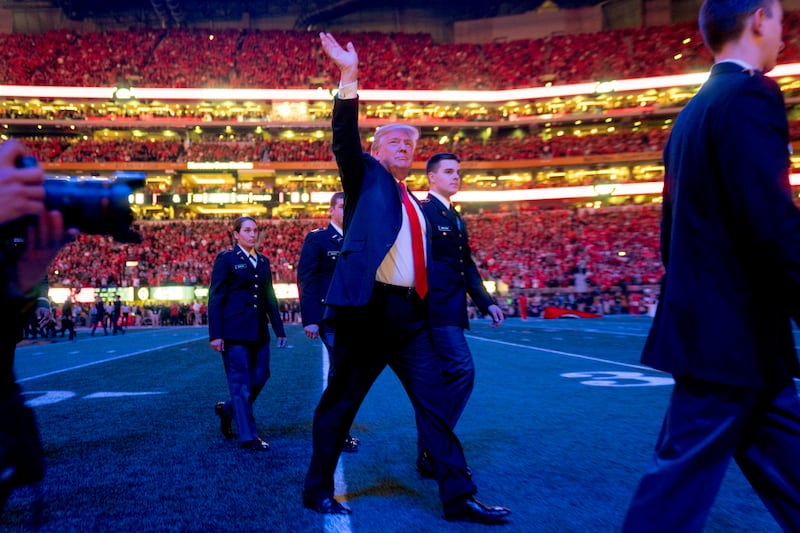

At the beginning of September, with the Big Ten football season postponed, President Donald Trump got in touch with conference commissioner Kevin Warren.
The presidential election was two months away, and polls consistently showed Trump trailing in Michigan, Wisconsin and Pennsylvania — three states he narrowly won in 2016, all with Big Ten universities. Along with Ohio and Iowa, Big Ten country would be key in deciding who wins in November. Perhaps that’s why Trump reached out to Warren, rather than commissioners in the Pac-12, Mountain West and other conferences.
College football fans skew to the right more than most sports fans, save for NASCAR and the PGA Tour, so perhaps Trump thought he could leverage the weight of the presidency toward resuming Big Ten football, Republican strategist Alex Conant told The Associated Press, wooing some football fan voters who may not like Trump personally but do like when he takes “a controversial position they agree with and delivers.”
His opponent, former Vice President Joe Biden, also tried to seize the moment. In ads targeting voters in four swing states, a video montage of empty stadiums ended with two text flashes: “Trump put America on the sidelines,” followed by, “Let’s get back in the game.”
Those ads are moot now, with the Big Ten scheduled to resume play this weekend. Regardless, both presidential candidates, it seems, recognized a fact obvious to anyone who follows college football: In some communities, it’s central.
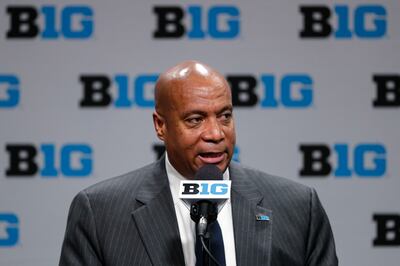
So much so that on Sept. 16, roughly two weeks after Trump first spoke with Warren and “made it very clear that he would help in any way that he possibly could to help us return to competition,” per The New York Times, he was quick to take partial credit for the league opting to restart in late October. He’d planted the seeds shortly after the call on Sept. 1, tweeting, “Had a very productive conversation with Kevin Warren, commissioner of the Big Ten Conference, about immediately starting up Big Ten football.” He pounced on his harvest after thanking the decision makers. “It is my great honor to have helped!!!” he wrote.
Will Trump’s perceived victory actually offer an electoral edge? That’s hard to say. It’s a pivotal issue to some. A reporter for the Daily Caller — a right-wing news and opinion site co-founded by Fox News host Tucker Carlson — even compared Trump’s personal crusade to save Big Ten football to the Navy SEAL raid that killed Osama Bin-Laden and the D-Day invasion of Normandy. “You never know when your number will be called to serve,” he wrote.
But that’s only anecdotal. So why did both presidential candidates — as fires charred the West, with the pandemic’s national death toll approaching 200,000 (it now exceeds 220,000), with racial justice movements and protests continuing, with hurricanes battering the Gulf Coast — feel compelled to try and sway voters using college football?
Perhaps it’s the void college football fills in certain segments of American society — especially in moments of darkness and pain.
College football’s regional roots
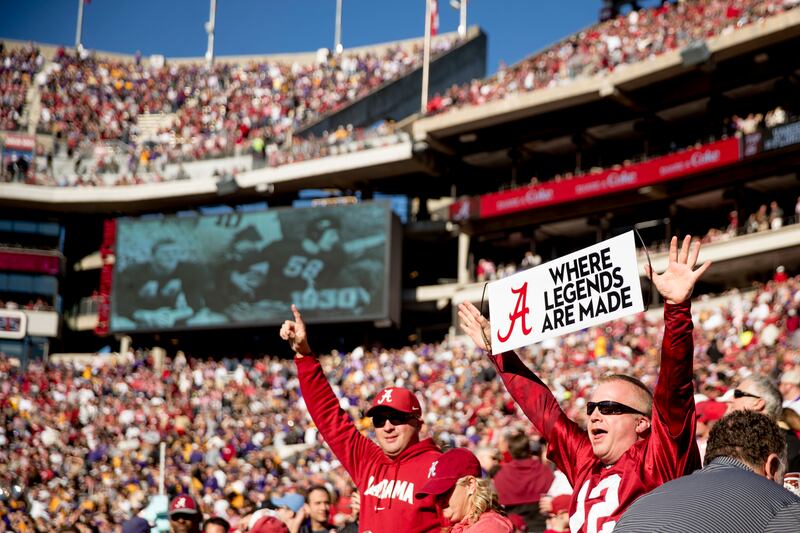
To understand the communal power and sway of college football, let’s take a brief detour to the South. Football was founded in the Northeast, but its influence spread across the country, and by 1926, established programs existed in the Northeast, the Midwest and the West Coast — but not in the South. Undefeated Alabama, however, with a date against Washington in the Rose Bowl, changed that.
The Crimson Tide’s stunning 20-19 victory provided, in the words of one Georgia newspaper columnist, “the greatest victory for the South since the Battle of Bull Run.” It also gave the South something to take pride in, and that pride evolved over the next century to make the South the nation’s football epicenter.
“It’s both historical and cultural,” said Alabama professor emeritus of history George Rable, with economies springing up around games and schools erecting massive stadiums, some of them seating more fans than their host city’s entire population. “This was something to really take pride in,” he continued.
That pride isn’t unique to the South, as Rable knows well. He’s originally from Ohio, and although his parents didn’t care about sports when he was growing up, they still always tuned in for Ohio State-Michigan. “That’s part of Midwestern culture,” he said. “Don’t underestimate it.”
The New York Times tried to find out where college football is most important in 2014. Using Facebook data, it compiled an interactive map that tabulated the percentage of Facebook members in every county in America who “like” a college football team. The counties with the highest percentages appear in red, while the counties with the lowest appear in dull yellow. Alabama, perhaps unsurprisingly, overwhelms the competition, with 34% of Facebook users in the state “liking” a team. It’s followed by Nebraska (28%) and Oklahoma (27%).
Like Alabama, Nebraska and Oklahoma feature historically dominant teams in the Cornhuskers and Sooners, tend to be more rural and feature few, if any, professional sports teams. Tradition also seems to play a role in football passions, which bring us back to the Big Ten and the Midwest. Ohio, home to the NHL’s Blue Jackets, two MLB teams, two NFL teams and the NBA’s Cleveland Cavaliers, still shows a high density of college football fans.
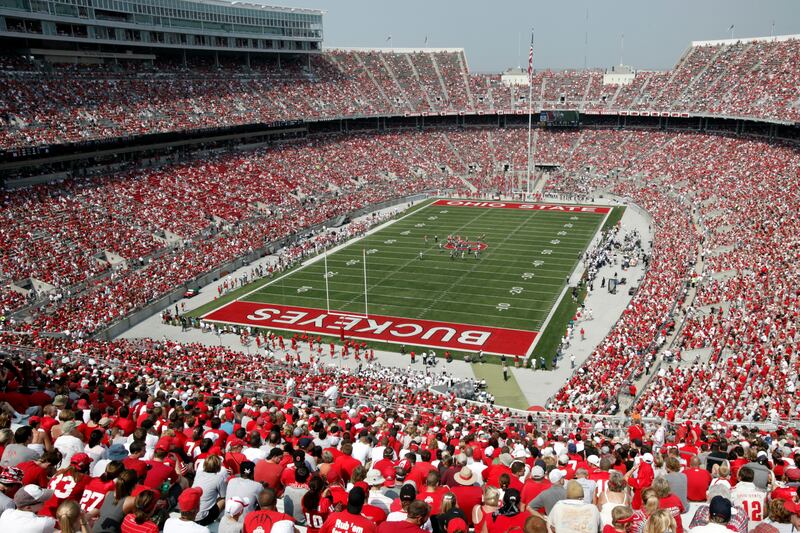
The interest is more fragmented in the Midwest compared to the South, with states like Minnesota and Illinois almost entirely yellow, but the importance is noticeable. “Big Ten country makes an impressive showing as well — at least the areas that have a Big Ten college with a strong football tradition,” the Times wrote. “Nebraska, Iowa and Ohio also make the top 10 states for fan concentration, with Wisconsin and Michigan close behind.”
But more than tradition, history, culture or region, college football’s grip on the South and Midwest — and, potentially, on electoral politics in those areas — starts with something more fundamental.
Sports as identity
Daniel Wann has studied the psychology of sports fandom for 30 years. His understanding of the subject, which he teaches and researches at Murray State University in Kentucky, starts with the Murray State men’s basketball team, where NBA rookie of the year Ja Morant played before going pro. The Racers program provides a focal point for the community. “It’s this common bond that we share,” Wann explained in a 2019 ESPN mini-documentary, “this language we can speak.”
That community forged by sports can create physiological and psychological benefits, from “extreme arousal” to higher self-esteem. It starts with something called “social identity theory.” It’s a psychological theory that asserts people derive their sense of who they are via group membership. Whether fans of the Beatles, Venezuelan heritage or the Republican Party, being part of some in-group offers emotional benefits. And, per Wann, sports in particular, by virtue of their frequency, event-based nature and community presence, offer “a reason for waking up in the morning.”
“It’s a voluntary activity where half of what happens, you’re not going to like,” he added. “Only in sport fandom is that the case.”
This understanding of sports fandom goes beyond the oft-quoted explanation of offering an escape from the mundanity of everyday life, though that’s part of the equation, too. Gary Smith, writing in Sports Illustrated shortly after the attacks of Sept. 11, 2001, explained that sports, when done right, are “like pulling a blanket over your head when you’re a kid.” You’re transported to your own dimension, where the only thing that matters is the outcome. When sports are at their best, he wrote, everyone from the players to all the fans in the arena and at home believe the score really means something — about their community, and therefore, about themselves.
Which is why the urge to rush back to normal, whether after 9/11 or in the midst of a pandemic, is so potent. When the world feels like it’s burning, the temptation to throw a blanket over one’s head will always be strong, at least in small moments. Sports — and college football in particular — allow this temporary transportation to a problem-free dimension more than most other activities, and both Trump and Biden know this.
As for whether the middle of a pandemic, among many other national problems, is the proper time to pull a blanket over our heads and to commit resources to making it possible, well, those are questions worth asking, too. Like New York Daily News columnist Jane McManus wrote, “Sports are the result of a healthy and functioning society. We just aren’t there right now, as much as some want to ignore that reality.”
Many do wish to “ignore that reality,” opting for manufactured normality amid troubling times. College football can provide that, which explains why Trump used — and continues to use — it as motivation for his constituency, while Biden used its absence/alteration to blame Trump. Both seized on the sport’s unique community power and on our collective desire to feel like a part of something again.
Whether it’ll work is less clear, but early indications say probably not.
A poll released Friday by Arizona State’s Global Sport Institute proposed that Trump’s claim of bringing back Big Ten football “does not move the needle.” It surveyed “undecided voters who identify as college football fans and live in closely contested Midwest swing states with Big Ten schools or other key states,” per Time, and found that 84% of respondents weren’t effected. And while some were more likely to vote for Trump because of the perception that he brought back Big Ten football, a similar percentage of voters was less likely to do so.