



SALT LAKE CITY — Field generals. Captains. Gunslingers. Blitzes and bullets and bombs. From winning the battle in the trenches to protecting your territory to defending the home field, football drips with references to war. And the NFL has taken full advantage.
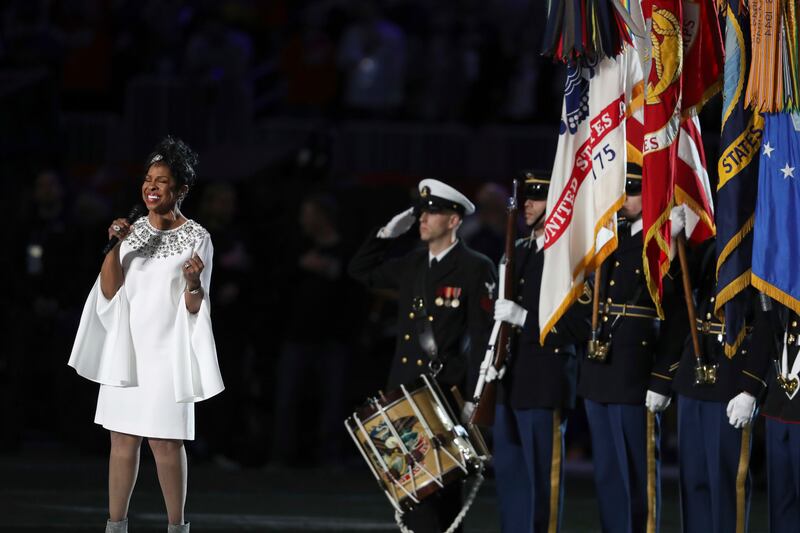
In addition to military vocabulary, the league has also embraced patriotic iconography like flyovers, elaborate national anthems and field-sized flags. The NFL isn’t alone, to be sure, but it’s been the most successful at equating support for the league with support for the nation.
Especially in the age of protest initiated by former 49ers quarterback Colin Kaepernick, the NFL’s relationship with patriotism and militarism has prompted questions about what it means to take pride in one’s country.
“Football was way ahead of the other leagues in the way that it promoted itself,” said Robert Gudmestad, a history professor at Colorado State University, “and it’s using patriotism — and specifically militarism — as a way to connect with its fans.”
Patriotism, Gudmestad explained, means respect and veneration for the country, specifically its ideals. Militarism involves displays of military power.
“The two are often linked because many people see militarism as an expression of patriotism. So the idea of ‘support the troops’ — is that militarism or is that patriotism?” he wondered. “I think you could argue it’s both.”
This overlap is obvious in the NFL. Military terminology fits football, after all, because it is a violent, hyper-masculine sport, built around strategies for controlling and taking territory. It’s (usually) played outside, which allows for more flyovers than traditionally domed sports, like basketball and hockey. The NFL also plays fewer games, so each one is magnified, making each Sunday a community event and, therefore, a chance to gather in unity, both behind team and country.
And Super Bowl Sunday occupies the pinnacle of the symbiosis.

How’d we get here?
The NFL’s connection to America goes back to the 1950s, Gudmestad wrote. Office jobs were booming. The Cold War was a constant menace. Americans feared men were becoming too weak at the wrong time. Recognizing the game’s potential to fill this niche in the social fabric, the league standardized the playing of the national anthem, introduced flyovers and featured patriotic halftime shows at early Super Bowls. “It was a conscious effort on our part to bring the element of patriotism into the Super Bowl,” former NFL Commissioner Pete Rozelle told The New York Times in 1991.
Even in the ’90s, the game was so saturated in Americana the Times labeled it “the Star-Spangled Super Bowl.” In large part because, as the story’s author Ira Berkow observed, “the N.F.L. found that wrapping itself in the flag, or whatever else was politically convenient, doesn’t hurt at the box office.”
The events of Sept. 11, 2001, and the resulting “Global War on Terror” solidified the connection. The Washington Post called the first post-9/11 Super Bowl a “midwinter version of the Fourth of July, a national pep rally wrapped in red, white and blue.” The New England Patriots even won that year (by luck or by tuck).
But this strategy has also brought its problems, perhaps best illustrated by former Arizona Cardinals safety Pat Tillman. Inspired to enlist by the events of 9/11, Tillman paused his football career and joined the Army in 2002. He was killed in combat in 2004, becoming a national emblem for patriotic sacrifice. The NFL milked it in full, ordering teams to wear a “40” — Tillman’s number — on their helmets and dedicating a Hall of Fame exhibit to him, while the Cardinals retired his number and built a statue of him outside University of Phoenix Stadium. The nature of his death, however, in the words of prominent sports culture critic Dave Zirin, “turned out to be an obscene hoax.”
Yes, he died in combat, but at the hands of friendly fire from his fellow Army Rangers. In a 2008 interview with Zirin, Tillman’s mother criticized the NFL’s response, saying that the league “exploited” him for the patriotic resonance his sacrifice would have with fans while offering little assistance or interest in figuring out what actually happened to him.
Because the NFL had become so intertwined with the military, the scandals went both ways. The NFL wasn’t the only entity building its brand. The military also decided to use its association with the NFL and other leagues for marketing of its own, culminating in a phenomenon dubbed “paid patriotism.”
A 2015 report by Republican Arizona Sens. John McCain and Jeff Flake showed the Pentagon spent more than $10 million over four years on recruiting at sporting events as well as enticing teams to honor service members.
“It is time to allow major sports teams’ legitimate tributes to our soldiers to shine with national pride,” the senators wrote, “rather than being cast under the pallor of marketing gimmicks paid for by American taxpayers.”
The NFL quickly banned such deals, and the Pentagon announced it would cease payment for patriotic displays at sporting events. Nevertheless, it’s hard to argue the “marketing gimmick” has ended in full.
Consumerism as patriotism
Consider the NFL’s annual “Salute to Service” weekend, as well as the accompanying line of gear. Deadspin’s Drew Magary, in criticizing the program for sanitizing the realities of war, wrote, “The league and the military have achieved such perfect symbiosis at this point that we don’t even bat an eye at promotions like this.” Indeed, does anything seem off about the Men’s Miami Dolphins New Era Olive 2019 Salute to Service Sideline Adventure Bucket Hat?
Probably not, because even though it’s somewhat absurd that a green bucket hat with the Dolphins logo could be viewed as patriotism, it’s broadly accepted. The NFL says it doesn’t profit on its Salute to Service gear sales, donating the profits to “the NFL’s military nonprofit partners.” But it still gets something from the deal.
“That’s the league doing its best to imbue itself with moral authority on a national scale,” Magary wrote. “It helps portray the league as some kind of noble civic endeavor when it’s actually just an entertainment venture and moneymaking apparatus designed to rake in billions of dollars.”
Gudmestad called this phenomenon “consumerism as a proxy for patriotism” — a fancy way of saying buying military-branded NFL products becomes an act of patriotism because it shows support of the troops.
Gudmestad explains the dangers of such a view in his military history class through the example of Gary Sinise, the actor who played Lt. Dan in Forrest Gump. Sinise has since formed a foundation and a band — the Lt. Dan Band — that plays benefit concerts for soldiers and donates profits to veteran’s charities.
“This guy cares about veterans,” he’ll tell his students, “because he’s being inconvenienced.”
The NFL’s patriotism by convenience, meanwhile, is no scandal — the NFL has donated $34 million to military causes since 2011, and buying a camouflage Chiefs sweatshirt contributes. But the proxy relationship is clear — the buyer is getting more than they’re giving — which can dilute the intent.
“It’s a convenient form of patriotism — or faux patriotism — that doesn’t do much to alter that person’s life,” Gudmestad said. “They don’t have any skin in the game.”
The connection has, nevertheless, helped enshrine football as the quintessential American game regardless of baseball’s standing as the so-called “national pastime.” Writing in the Los Angeles Times, University of Virginia English professor Mark Edmundson quoted Washington Post columnist Mary McGrory, who observed, “Baseball is what we were. Football is what we have become.”
He used her assertion to bolster his argument that football is a uniquely American game, “that it reflects our national identity and national values,” and that unlike baseball, which is hugely popular in Japan and the Caribbean, football will never spread outside America (and to a far lesser extent, Canada). Why?
“The best answers are sometimes the simplest,” Edmundson wrote. “Football is a warlike game and we are a warlike nation. Our love for football is a love, however self-aware, of ourselves as a fighting and (we hope) victorious people.”
He also approached the question philosophically. Aristotle, he said, would see football as an outlet — a place to discharge a buildup of negative emotions. But Plato would view it as a reflection — that “we become what we behold.”
If Plato was right, what happens when we behold not just the warlike nature of the game, but the entanglement of the game with military support and a sense of patriotic identity?
The answer — or, at the very least, the question — exploded into the national consciousness in 2016.
The Kaepernick question
Former 49ers quarterback Colin Kaepernick emerged at the center of a national debate about what it really means to be patriotic when he sat for the national anthem during a 2016 preseason game. He did so to protest racial inequality and police brutality and said he’d keep doing it until the American flag “represents what it’s supposed to represent,” though the next week he knelt rather than sat on the advice of a veteran, who told him doing so would be more respectful.
The reactions poured in from the very top, starting with President Donald Trump, who said Kaepernick “should find a country that works better for him” — a sentiment shared by many football fans who bristled at the form his protest took.
“Kaepernick becomes unpatriotic because he criticized the United States,” Gudmestad said. “That’s not my position, but if you don’t like him, that’s the position you’d take.”
He wasn’t the first to do so. For example, then-Denver Nuggets point guard Mahmoud Abdul-Rauf refused to participate in national anthem festivities in 1996 because the flag was “a symbol of oppression, of tyranny.” Running back Marshawn Lynch hasn’t always stood for the anthem but told his Oakland Raiders coach “it’s not a form of anything other than me being myself.”
But Kaepernick became the first to do so as protest in the age of social media, which amplified both detractors and supporters.
But the fact that he played football also contributed to the substantial backlash. For so long, fans were used to the NFL practicing a type of coerced patriotism: Not only does everyone stand for the anthem, salute the flag and appreciate the might of a flyover, but coaches sometimes wear camo gear and soldiers parachute onto the field and coaches and players visit the troops. Patriotism becomes reverential, and obligatory.
It’s worth noting that standing for the national anthem was not always the norm for NFL players, and, per Snopes, players stayed in the locker room during the anthem ahead of primetime games until 2009. Starting then, teams were required to include players in pregame festivities, joining the collective pause that overtakes a stadium when — especially during the Super Bowl — a massive flag is unfurled and the national anthem plays and the NFL reminds fans that country (namely respect of country) should come before football in a ceremony that can rival a religious spectacle.
The NFL is surely not the only driving force behind patriotism as product placement, but the reaction to Kaepernick among NFL fans shows its importance in the league.
“(NFL fans are) so used to the promotion of patriotism and militarism at football games that to have someone come up and say, ‘No, the United States needs to reconsider the way that African-Americans are treated,’ and talk about a different social issue, that’s like doing something terrible inside a Catholic Church,” Gudmestad said. “Kaepernick goes against the way the NFL has positioned itself for 20, 25 years to market patriotism.”
Kaepernick’s vision of patriotism places reform above reverence, focusing on perfecting ideals rather than venerating them. However, this brand of patriotism, because it’s not what the NFL has aligned itself with, is a tough sell to fans.
“Today’s NFL cannot afford to offend half of its potential audience in order to please the other half,” Michael Oriard wrote 10 years ago in Slate, almost prophesying what would happen should someone like Kaepernick come along. “Patriotic displays will continue, but in forms ... calculated to unite rather than divide.”
Gudmestad was clear that this isn’t the NFL’s fault — the league is just reinforcing something that’s already there.
“Mainstream America likes its history sort of convenient, simple and nostalgic, and a lot of people don’t really want to think about the messy parts of American history and the ways that America hasn’t lived up to the ideals in the Declaration of Independence,” he said.
For the NFL’s part, that manifests via sanitized portrayals of war — as humanitarian aid and brave sacrifice. But in the era of Trump and Kaepernick, it might be worth applying a principle posed by Zirin in a column about Tiger Woods.
At the time, Woods remained notoriously apolitical. Zirin argued that such a position was no longer possible. “To say you have no opinion in this climate is in effect to have an opinion,” he wrote. “Or as Dr. King said, ‘A time comes when silence is betrayal.’”
The NFL is not silent about its appeals to patriotism, but is patriotism itself also political? Is unifying patriotism still possible? It seems more difficult. Consider the fact that Trump will be interviewed during the Super Bowl pregame show by noted supporter and conservative pundit Sean Hannity. In 2017, he appeared with then-Fox News commentator Bill O’Reilly. His predecessor President Barack Obama was interviewed each year before the Super Bowl, too.
In theory, there doesn’t have to be anything political about interviewing the president before a national pep rally. Nor does anything need be political about the national anthem. But in the age of Trump and Kaepernick, regardless of political persuasion, it’s difficult not watch and stumble into that realm.
Perhaps that’s what’s most American about the Super Bowl, at least this year’s: It challenges Americans to define for themselves what it means to be American, rather than letting the NFL or anyone else define it for them.