


Data has become a battleground in the political skirmishes surrounding the pandemic, as states around the country deal with increased cases as they reopen their economies. Today that conflict has surfaced in relation to the firing of a Florida health department manager who objected to deleting records from a public database.
According to emails obtained by the Tampa Bay Times, Rebekah Jones objected to an order from Florida Department of Health staff to remove certain records of symptoms and positive tests from the state coronavirus database, which she built and managed.
That order came shortly after media requested the data on May 5, the Tampa Bay Times reported. The emails show that Jones did change the data in “Florida’s COVID-19 Data and Surveillance Dashboard” under protest, telling her supervisors it was the “wrong call.” Other employees were put in charge of the dashboard by the next morning.
In a publicly distributed email Friday, Jones said she was no longer answering questions about the dashboard and implied it was because she was being punished. On Tuesday, Jones said she had been given an opportunity to resign and was offered a settlement before being fired.
Republican Gov. Ron DeSantis confirmed through a spokeswoman on Tuesday that Jones had been fired, and wrote in an email to reporters that she had “exhibited a repeated course of insubordination during her time with the department, including her unilateral decisions to modify the department’s COVID-19 dashboard without input or approval from the epidemiological team or her supervisors,” according to the Tampa Bay Times.

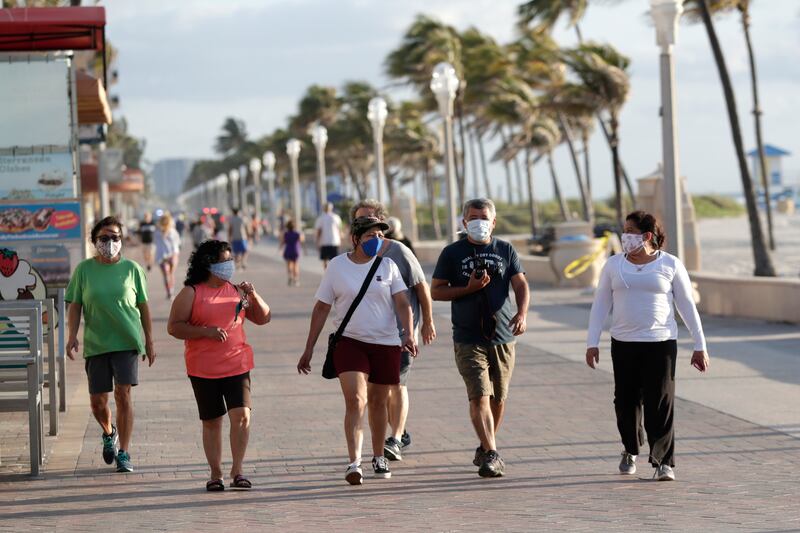
Florida has been at the forefront of states reopening for business following shutdowns to slow the spread of the pandemic. In April, Dr. Deborah Birx of the White House coronavirus task force praised Florida’s health department for its informative coronavirus website.
“This is how we have to inform the American public, and this is where the American public will develop confidence in each of their counties and local governments,” Brix told White House reporters, according to The Washington Post.
Florida has not seen a new spike in cases as safe-at-home restrictions have relaxed, but it could be too early to tell, The Hill reported.
A New York Times tally shows that seven-day national averages in newly reported cases are generally improving, but Texas and Arizona have both seen recent spikes.
After opening restaurants and barbershops, Texas is reporting its highest daily increase in coronavirus cases, while Arizona is also near its peak.
North Carolina — where retails shops are allowed to open, with precautions — also reported its greatest single-day number of cases with 853 on Saturday, according to The Hill.
Mandy Cohen, North Carolina’s Health and Human Services Secretary, said at a press conference Monday that more cases were to be expected because of additional testing, The Hill reported.
Cohen called the spike “concerning,” nothing that, “when we see this kind of an increase in case counts, we also know that we are easing restrictions and folks are moving around more.” She also encouraged the use of masks and social distancing.
Texas, Arizona and North Carolina have increased testing, which is part of the reason why the numbers of COVID-19 cases have increased, according to The Hill, and none of the states have reported fears of hospitals reaching capacity.
Dr. Anthony Fauci, director of the National Institute of Allergy and Infectious Diseases, warned Congress last week that opening the national economy could lead to serious consequences.
“There is no doubt, even under the best of circumstances, when you pull back on mitigation you will see some cases appear,” the White House coronavirus task force member said.