
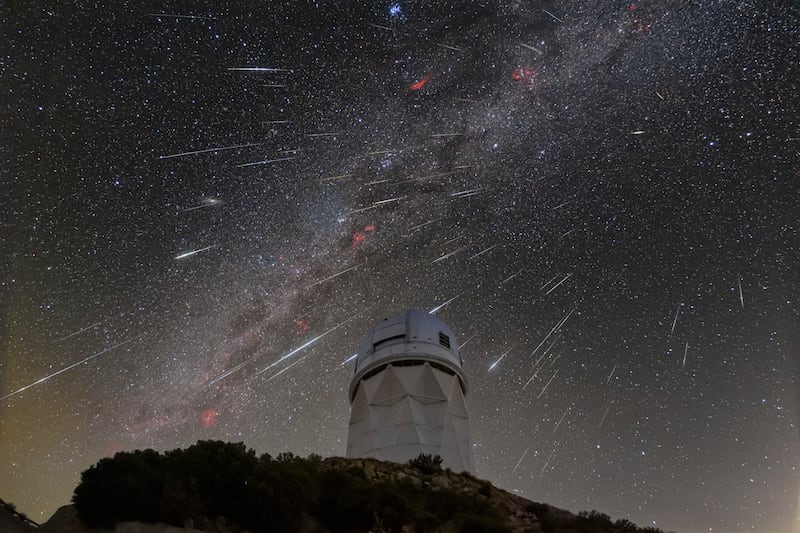

The last major meteor shower of the year will peak over the next week, lighting up the night sky just before Christmas.
The Ursids are more subdued than other meteor showers, but experts say it’s still worth catching a glimpse, according to The Associated Press.
Meteor showers occur when space rocks impact Earth’s atmosphere at high speeds and burn up, gaining fiery tails. On any given night, random meteors are visible, but there are a number of more predictable meteor showers that happen each year.
These major meteor showers happen when Earth passes through streams of cosmic leftovers from asteroids or comets, per the AP.
When will the Ursids be visible?
As the last major meteor shower of the year, the Ursids will be visible until Dec. 26. The peak of the Ursids will be Sunday night into Monday morning, per the AP.
During the Ursids, skygazers typically see five to 10 meteors per hour with bursts of up to 25 meteors per hour. The meteor shower is only seen in the Northern Hemisphere, and because of the new moon, there will be no interference from moonlight, according to the American Meteor Society.
No special equipment is needed to view the meteor shower.
The Ursids come right on the heels of the Geminid meteor shower, which peaked the night of Dec. 13, per Space.com.
Major meteor showers coming in 2026
Quadrantids
Period of activity: Dec. 28, 2025, to Jan. 12, 2026
Peak: The Quadrantids will peak Jan. 2-3 2026
The Quadrantids have the potential to be the strongest shower of the year but sometimes fall short because of poor weather, per the American Meteor Society.
The shower has an average hourly rate of 25 meteors under a dark sky but moonlight can interfere with that.
Lyrids
Period of activity: April 14, 2026, to April 30, 2026
Peak: The Lyrids will peak on April 21-22
The Lyrids are a medium-strength shower that typically has three good nights of visibility, per the American Meteor Society.
These meteors don’t have persistent trails, but can produce fireballs. They are best seen from the Northern Hemisphere.
Eta Aquariids
Period of activity: April 19, 2026, to May 28, 2026
Peak: The Eta Aquariids will peak on May 5-6 2026
The Eta Aquariids are a strong shower best viewed from the southern tropics. North of the equator the shower usually produces medium rates of 10 to 30 meteors per hour.
According to the American Meteor Society, the best visibility of the meteor shower, with lots of persistent trails, is just before dawn.
Southern Delta Aquariids
Period of activity: July 12, 2026, to Aug. 23, 2026
Peak: The Southern Delta Aquariids will peak on July 30-31
The Delta Aquariids are a strong shower best seen from the southern tropics; it is still visible north of the equator but at lower rates, per the American Meteor Society.
These meteors produce strong rates; they are usually faint, without persistent trails or fireballs. The shower comes right after a full moon, so the light will interfere with visibility.
Perseids
Period of activity: July 17, 2026, to Aug. 24, 2026
Peak: The Perseids will peak on Aug. 12-13, 2026
The Perseids are typically the most popular meteor shower. Normal hourly rates are 30 to 50 meteors, according to the American Meteor Society. Because it occurs at the same time as the new moon, conditions are optimal for viewing the meteor shower.
Orionids
Period of activity: Oct. 2, 2026, to Nov. 7, 2026
Peak: The Orionids will peak on Oct. 21-22, 2026
The Orionids are a medium strength shower that can reach high strength activity, according to the American Meteor Society. With hourly rates typically around 10 to 20 meteors, it can reach peak rates of 50 to 75 per hour.
There will be no moonlight interference because of a new moon.
Southern Taurids
Period of activity: Sept. 20, 2026, to Nov. 20, 2026
Peak: The Southern Taurids will peak on Nov. 4-5, 2026
The Southern Taurids are made up of two components: the typical annual component and a fireball swarm. The shower is rich in fireballs.
According to the American Meteor Society, Taurids typically move slowly across the sky and appear at a rate of about five per hour.
Northern Taurids
Period of activity: Oct. 20, 2026, to Dec. 10, 2026
Peak: The Northern Taurids will peak on Nov. 11-12, 2026
The Northern Taurids are similar to the Southern Taurids but are active later in the year, per the American Meteor Society.
During late October and early November, the two showers are simultaneously active and cause a notable increase in fireball activity.
Leonids
Period of activity: Nov. 6, 2026, to Nov. 30, 2026
Peak: The Leonids will peak on Nov. 16-17, 2026
The Leonids are best known for producing meteor storms a few times throughout history, most recently in 2001 and 2002, according to the American Meteor Society.
The meteors are typically fast-moving and bright. The moon will be 45% full and the light will likely interfere with the visibility of the meteor shower.
Geminids
Period of activity: Dec. 4, 2026, to Dec. 17, 2026
Peak: The Geminids will peak on Dec. 13-14, 2026
The Geminids tend to be the strongest meteor shower of the year. It is also the one major shower that provides good activity before midnight, per yhe American Meteor Society. These meteors also tend to be bright and intensely colored and have medium-slow velocity that don’t typically have persistent trains.
While they are viewed better in the Northern Hemisphere, the Geminids can also be seen in the Southern Hemisphere but not as strongly and only during the middle of the night.