

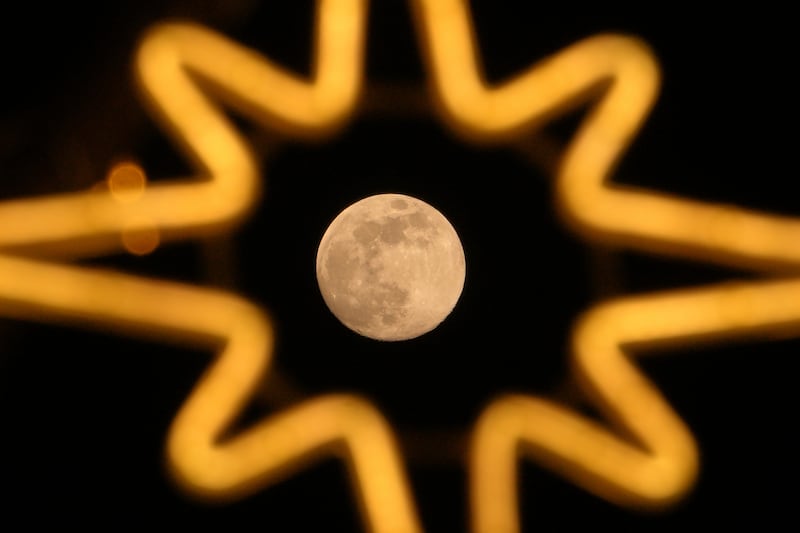

A rare wolf supermoon, the first full moon of the year, will illuminate the night sky Friday into the small hours of Saturday — but it might have to compete with the Quadrantid meteor shower for attention.
The large glimmering orb is the first of three supermoons in 2026, and will reach peak illumination on Saturday at roughly 3 a.m. MST, according to The Old Farmer’s Almanac. Because it is a supermoon, it will appear strikingly bigger and brighter than regular full moons because it is in its closest approach to Earth.
January’s full moon, the wolf supermoon, earned its name because wolves are more likely to be howling during wintertime, a method the animals use to “locate pack members, reinforce social bonds, define territory, and coordinate hunting,” per The Old Farmer’s Almanac.
Alternative names for the wolf supermoon reflect the harsh coldness of January, such as frost exploding moon, freeze up moon, severe moon, Canada goose moon and greetings moon.
The brilliant light from the wolf supermoon will make it a tough rival to the Quadrantids meteor shower, which peaks Saturday night into early Sunday morning — though it may be difficult to see with the naked eye through the strong moonlight.
“The biggest enemy of enjoying a meteor shower is the full moon,” said Mike Shanahan, planetarium director at Liberty Science Center in New Jersey, per The Associated Press.
The Quadrantids are known for showers of bright fireballs and large, explosive meteors, per the Scientific American. This meteor shower is typically best seen during the predawn hours of the morning, away from all light sources like street lamps and buildings.
Other viewing tips for the Quadrantids, according to NASA, include:
- Laying flat on your back with your feet pointed northeast, taking in as much sky as possible
- Prepare for winter temperatures with sleeping bags, blankets and other warm gear
- Be patient, it takes about 30 mins for our eyes to adjust to the night sky
If the wolf moon floods the sky with too much light to view the Quadrantids this month, there are several opportunities to see meteor showers throughout 2026.
Meteor showers 2026
The next meteor shower is the Lyrids, which peaks in mid-April, followed by several more meteor showers in 2026.
Here are the peak dates for 2026 meteor showers.
- Lyrids: April 21-22
- Eta Aquariids: May 5-6
- Southern Delta Aquariids: July 30-31
- Alpha Capricornids: July 30-31
- Perseids: Aug. 12-13
- Orionids: Oct. 21-22
- Southern Taurids: Nov. 4-5
- Northern Taurids: Nov. 11-12
- Leonids: Nov. 16-17
- Geminids: Dec. 13-14
- Ursids: Dec. 21-22
Full moons 2026
There will be 13 full moons in 2026. Here are the dates for the remaining 2026 full moons.
- Feb. 1: Snow moon
- March 3: Worm moon
- April 1: Pink moon
- May 1: Flower moon
- May 31: Blue moon
- June 29: Strawberry moon
- July 29: Buck moon
- Aug. 28: Sturgeon moon
- Sept. 26: Harvest moon
- Oct. 26: Hunter’s moon
- Nov. 24: Beaver moon
- Dec. 23: Cold moon