

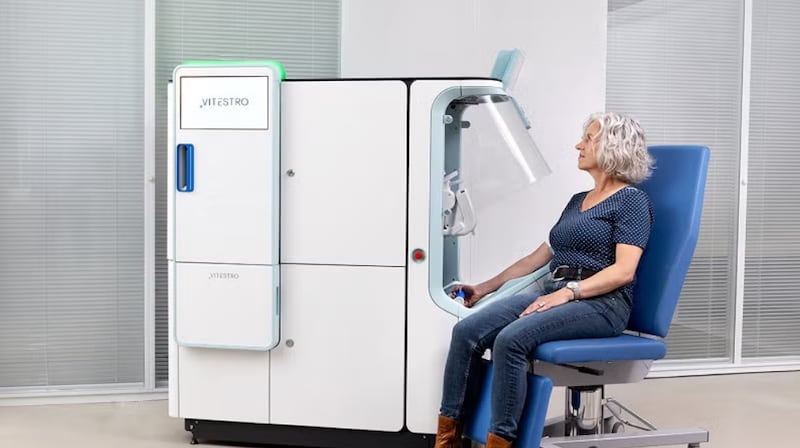

- A company in the Netherlands has developed a robot to draw blood.
- The robotic device achieved a 95% first-stick success rate in clinical trials.
- More than 8 in 10 participants said it was less painful than traditional blood draws.
Folks who’ve experienced a painful blood draw or can’t bear to watch the needle go in might be interested to hear that a new phlebotomist could soon be making the rounds. More than one, in fact.
Bolstered by artificial intelligence and advanced imaging — but no chitchat — Netherlands-based Vitestro’s new blood drawing robot has, according to a clinical trial, hit all the desired endpoints.
Working on drawing blood from 609 study participants, the device had a 95% first-stick success rate and 83% of the participants said having their blood taken was comparable to or less painful than regular human hand blood draws, according to a news release from the company. That first-stick success rate is comparable to humans drawing blood.
Vitestro claims the device could “help ease nursing workload and help alleviate staffing shortages.”
Robots that collect blood are being tested all over the world, including at Northwestern Medicine. And the technology’s gaining wide interest in part because there’s a shortage of phlebotomists, according to Medical Xpress.
Phlebotomists are people who are trained to collect blood samples.
Company highlights benefits
As for Aletta, which is what the company named the robot, “This all ensures high accuracy and high reliability, and with such precision it reduces any pain and discomfort associated with a normal blood draw,” Bob Gerberich, chief commercial officer for North America for Vitestro, told Medical Xpress.
It’s also possible it could relieve some of the pain of blood draws because it uses infrared light to find the veins.
It’s also fast.
“The device had a median procedure time of 1 minute 49 seconds, with manual phlebotomy reporting a service time of 5 minutes including time for accessing the test order and time required for specimen draw. There were no reported serious or moderate adverse events. Mild adverse events occurred in 1.3% of the participants,” according to an article on the technology in clinicaltrialsarena.com
A patient goes to Aletta, which is a stocky 5 feet tall, sits in a chair and extends his or her arm onto the machine’s armrest. With a push of a start button, the tourniquet tightens and the device sprays the patient’s arm with alcohol. The robotic arm has a Doppler ultrasound probe that uses AI to figure out where the needle goes in. The blood is collected in tubes and Aletta applies a bandage.
For squeamish patients, it’s worth noting that the positioning of everything blocks seeing the needle go in.
Medical Xpress reported that the device has been approved in Europe for patients 16 and older. And the U.S. Food and Drug Administration will soon be asked to give it U.S. approval.
Three sites in the U.S., including Northwestern, are testing the device. The other two sites have not been named.
Other blood-draw devices being tested
Amid the nationwide shortage of phlebotomists, there’s been a lot of interest in robotic technology to help with blood draws, which are a routine need in the health care world.
For instance, in 2020, the National Institute of Biomedical Imaging and Bioengineering reported on a hand-held blood draw device. Created by Rutgers University researchers, it used ultrasound images to guide the needle to the center of the desired vein. The release said a processing module could be hooked to the robot that handles samples.
“With nearly 1.4 billion blood draws performed annually in the United States, the system is being designed for use in ambulances, emergency rooms, clinics, and hospitals to obtain blood samples safely and reliably, while avoiding multiple needle insertion attempts that cause pain and complications.”
The journal Nature Portfolio has reported on an automated collection and transport robot for hospitals being tested at Fujita Health University Hospital at Toyoake in Japan.
Researchers tested a device that obtains blood from the fingertip that can collect up to 400 microliters using a tourniquet that pressures and releases to get enough blood. They reported a good correlation between venous blood collection in the upper arm and peripheral blood from the fingertip in healthy patients.
The device has a companion piece that transports patient samples to the destination a nurse chooses, using collision-avoidance technology because the hospital is often very busy. A person is still needed at each end of the journey, though, to send it on its way, loaded, and to remove the sample and put it in the testing equipment.
There could be others in testing phases, as well.