
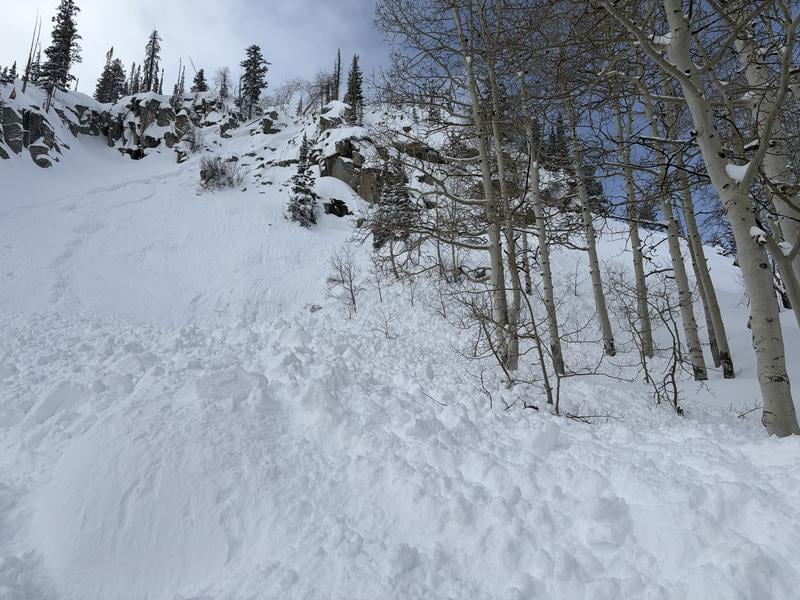

- A dry January followed by heavy snowfall created dangerous avalanche conditions in the West.
- Nine people in California and two in Utah died in snowslides this past week.
- Dangerous and life-threatening avalanche conditions remains high in the mountains.
A spate of backcountry avalanches following heavy snowfall have claimed 11 lives in what until the past week has been a down year for precipitation in the West.
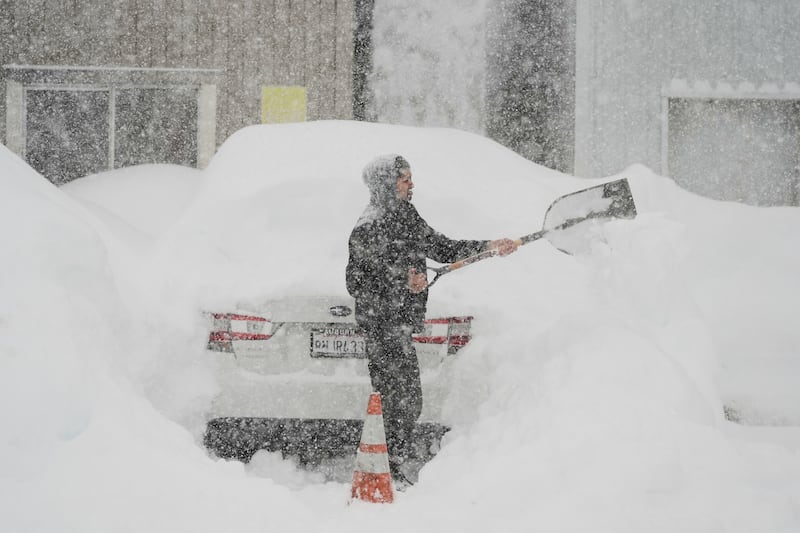
The wave of storms dumped not inches but feet of snow in Utah’s Wasatch Mountains and on the Sierra Nevada spanning California and Nevada. But the allure of fresh powder on top of crusty snow comes with danger below.
And avalanche experts saw it coming, issuing backcountry warnings amid the pounding.
“It’s not kind of like out of nowhere. We knew as soon as we got a large loading event in the form of snow or wind we were going to see a lot of avalanches,” said Nikki Champion, a Utah Avalanche Center forecaster.
The big issue, she said, was the dry January, the third driest ever in Utah. All the snow that fell and stayed in the mountains before that dry spell became sugary, the kind that’s so grainy that you can’t form it into a snowball no matter what you do. The 20 to 50 inches that fell on top made for prime avalanche conditions.
“We created the pretty standard setup, which is having a strong slab on top of a weak structure. What you don’t want is strong over weak. Ideally, you’d want weak over strong or a big storm that comes in a little bit warmer and gets lower density. We had the opposite situation,” Champion said.
The Utah Avalanche Center has already recorded more than 200 avalanches this year, ranging in depth from 2 inches to 5 feet and in width from 15 feet to 1,000 feet. Many of them were natural but a good share were caused by skiers, snowboarders and snowmobilers. Several close calls were reported to the center.
The heavy snowfall and strong winds this week overloaded the widespread weak layers in the snowpack, creating a high avalanche danger in Utah and elsewhere.
“The same thing is going on across the West,” Champion said.
But none of those slides turned deadly until this week.
Avalanche deaths in California and Utah
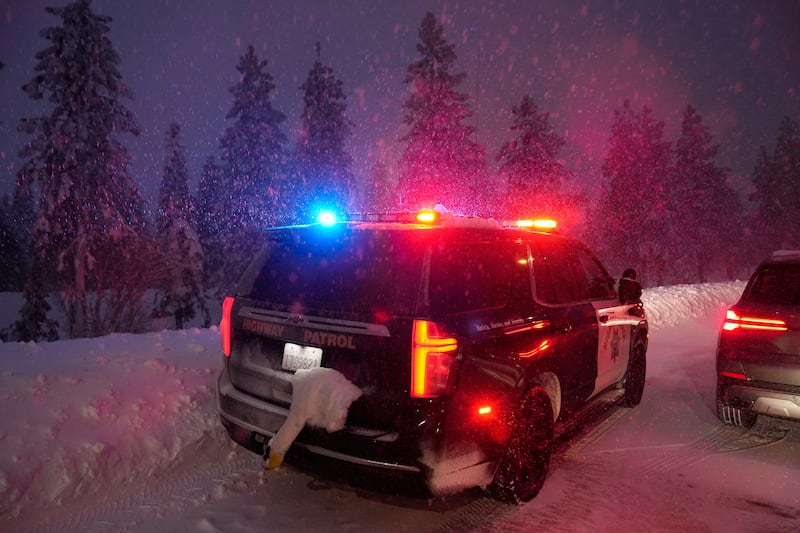
Nine people died in an avalanche during a guided backcountry skiing expedition Tuesday on the California side of Lake Tahoe near Castle Peak. All of them were experienced backcountry skiers equipped with avalanche safety gear. They ranged in age from 30 to 55. Six of them were wives and moms.
In a statement, the families of six of the victims said they are “devastated beyond words.”
“Our focus right now is supporting our children through this incredible tragedy and honoring the lives of these extraordinary women. They were all mothers, wives and friends, all of whom connected through the love of the outdoors. They were passionate, skilled skiers who cherished time together in the mountains. They lived in the Bay Area, Idaho, and the Truckee–Tahoe region,” the statement reads.
“We have many unanswered questions, but here is what we know at this time: Eight close friends planned a professionally guided, two-night backcountry hut trip to Frog Lake Huts outside Truckee, California. The trip had been organized well in advance. They were experienced backcountry skiers who deeply respected the mountains. They were trained and prepared for backcountry travel and trusted their professional guides on this trip. They were fully equipped with avalanche safety equipment.”
In Utah, two separate avalanches claimed a father and young girl.
The man was killed while riding snowmobiles with his son in the Snake Creek area west of Midway in Wasatch County on Wednesday. The son was able to locate his father through his avalanche beacon and dug him out of the snow, but the man was declared dead at the scene, according to Wasatch County.
On Thursday, a young girl died near Brighton Ski Resort in Big Cottonwood Canyon east of Salt Lake City. The slide occurred outside the resort boundaries. The girl, who was said to be at the resort with her family, did not have an avalanche beacon, according to the Salt Lake County Sheriff’s Search and Rescue team that located the girl and rendered first aid.
Avalanche warnings remain in effect
Dangerous and life-threatening avalanche conditions remain across all mountains in Utah and southeastern Idaho, according to the Utah Avalanche Center.
Champion issued this warning for the Salt Lake region:
“The avalanche danger is HIGH on upper- and mid-elevation slopes facing northwest through north and east. Recent snowfall and strong winds have created very dangerous conditions. Avalanches triggered in wind-drifted or new snow could step down more than 4 feet into weak-faceted snow, producing large, dangerous, and potentially deadly slides.
“In just two days, we have experienced two devastating avalanche fatalities affecting parents, children, and the broader community. These are huge red flags, and we need to slow down and rethink our choices.
“Most accidents and fatalities happen after peak instability. Let’s not add to that number going into this weekend. Return home safely at the end of the day. Avalanche terrain can be avoided, and excellent riding is available on lower-angled slopes. Remember, once you leave a ski resort boundary, you are in the backcountry.”
Going into the backcountry
Champion said the high danger doesn’t mean people can’t go into the backcountry. A beacon, shovel and probe — and the ability to use them — are essential as is a partner.
But beyond that, she said, the main management tool is going to be terrain.
“You can ski even on high danger days as long as you’re mitigating your terrain. What I mean by that is avoiding avalanche terrain all together. There is excellent riding on lower-angle slopes,” Champion said.
Any slope greater than 30 degrees spells trouble in the current conditions. And how do you know if a slope is 30 degrees? Experienced backcountry enthusiasts can probably eyeball it. But a topographical map, the inclinometer feature on the Utah Avalanche Center app or even the level app on a smartphone work.
“Another avalanche accident is likely so you just want people to take a step back,” Champion said. “Conditions will get better. The avalanche danger will decrease. It’s just going to take time. People are going to have to be patient.”