


- Pet ownership health benefits include less loneliness and more physical activity.
- One-third of older adults who don't own pets say they simply can't afford them.
- A new poll suggests health care providers should ask about patients' pet ownership status.
Caring for a cat or dog can have health and well-being benefits for middle-aged and older adults. They can provide companionship, cuddles, engagement and exercise. Even fish may reduce the risk of loneliness.
But despite the benefits of having pets, there’s a potential downside: the cost, which strains the budget of 31% of pet owners and provides the primary reason a third of those without pets say they don’t have any. They can’t afford it. That’s an increase from 21% who said that in 2018.
Those are key findings from the University of Michigan National Poll on Healthy Aging, which updates a similar poll taken seven years ago involving people ages 50 to 80. The new poll includes people 50 and older, without a cap on age. In comparing numbers, only 50 to 80 were used in each poll.
Nearly 6 in 10 of the middle-aged and older adults nationally say they have a pet, their 57% a bit higher than the 55% in 2018. And more of them say pets provide a “sense of purpose,” at 83% compared to 73% in 2018.
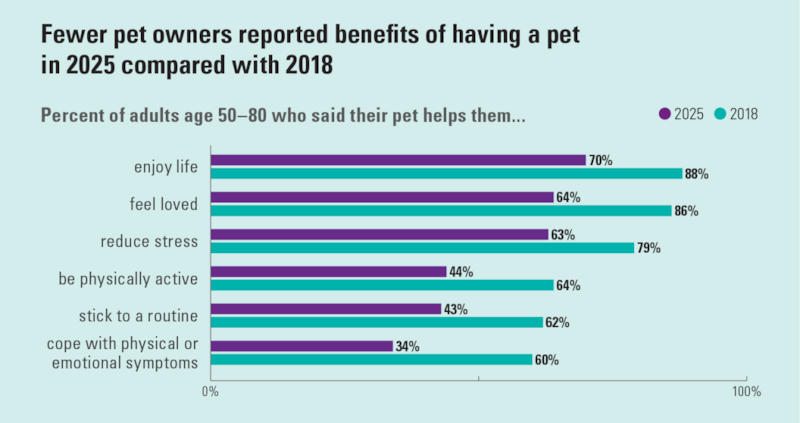
In the poll, most people who do have a pet say the critter connects them to others, a hedge against loneliness and isolation, which are a growing problem among older U.S. adults. Nearly two-thirds say the pet helps reduce stress, while 44% credit a pet with keeping them physically active.
Cost as a pain point
But in a news release, the researchers note the study shows costs have climbed and become harder to manage. The share of pet owners ages 50 to 80 who say that feeding and caring for a pet strains them financially climbed from 18% in 2018 to 31% in the new survey.
Those most stressed by cost were women, those who self-reported poor or fair mental or physical health, those with activity-limiting disabilities and, not surprisingly, those with household incomes below $60,000.
“Our two polls, seven years apart, clearly show that animals can play a key role in the lives of older adults, and bring many benefits that can contribute to healthy aging,” Dr. Preeti Malani, who directed the first poll in 2018 and now advises the new research team, said in the release. “Yet some of the people who could potentially get the most benefit from having a pet may also be the ones who have cost-related challenges to pet ownership.”
A dog owner, she’s a professor of internal medicine who trained in geriatrics and infectious diseases.
Dogs or cats?
As in 2018, 70% of current pet owners over 50 have dogs, half have cats and smaller shares have other pets, including fish (6%), birds (4%), small mammals (3%), large mammals (3%) and reptiles (1%). Three in 10 have more than one type of pet.
But the share who see a benefit has declined. In 2018, 60% said having a pet helped them with mental or physical symptoms, but that has fallen to 34%. The share who say their pet helps keep them physically active fell from 64% to 44% and those crediting a pet with reducing stress fell from 79% to 63% in the survey.
The survey this year also found more people have less time to care for a pet, up to 20% from 15%. And those claiming health too poor to manage having a pet rose from 2% to 6%.
Poll director Dr. Jeffrey Kullgren said health care providers should ask whether patients have pets and put it in the health record. It’s valuable information.
“If we’re encouraging someone to get more physical activity to improve their physical or mental health, knowing if they have a pet they can take for a walk or play with could be very useful. And discussing ahead of time who will help with pet care if they have a planned or unexpected hospitalization could relieve stress.
“We also need to be attuned to the mental health effects of pet loss, which is a very real form of grief that needs to be taken seriously,” said Kullgren, associate professor of internal medicine at the University of Michigan and a primary care doctor at the VA Ann Arbor Healthcare System.
The Michigan Poll on Healthy Aging, a separate poll with responses solely from Michigan older adults, documented on a smaller scale why older people want to have pets. The poll surveyed those 50 and older and found that pets provide a sense of purpose (87%), help the adult enjoy life and connect them with others (both 72%), reduce stress (66%) and “helps them feel loved” (64%), per the release.
But 38% of them said having a pet is a budgetary strain.
According to the ASPCA, fur babies can cost about $300 a year for dog food and $225 a year for cat food.
There are also treats and toys, grooming tools, maintenance items like kitty litter, veterinary costs and more.
On the other hand, the health benefits may yield savings that counter the cost.
What other studies say about pets
Lots of health experts extoll the health benefits of pet ownership for people of all ages. In an article for Mayo Clinic, one of its physicians, Dr. Denise Millstine, said pets can provide companionship, lift moods, amuse, reduce stress, provide comfort, encourage physical activity and provide both a routine and a sense of purpose.
They’re also good for the brain and the heart, per the article. Because pets counteract stress — when you stroke or cuddle a pet, your brain releases oxytocin — they help cut back inflammation, which is bad for the heart. And encouraging you to be active is good for the heart, as well.
There’s also, per the article, the possibility that pet ownership slows cognitive decline, though the 2023 study that was cited couldn’t prove causation.
UC Davis Health reported that “in addition to promoting exercise and reducing stress, pets can also help older adults manage long‑term diseases like Alzheimer’s disease and dementia. Pets can improve the quality of life for people diagnosed with these diseases by decreasing distress, loneliness, and depression."
There are, of course, potential downsides besides financial strain, as the Mayo piece noted. Pets can be disruptive at night, which doesn’t improve and can even bother sleep. As they age, their care may become more expensive. And eventually pets die, which can be heartbreaking. For those who are not so mobile, caring for a pet can be challenging.