

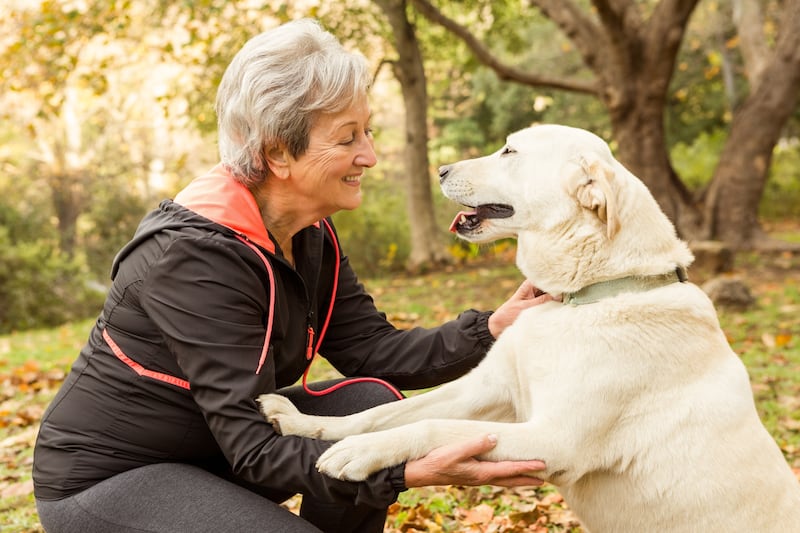

There are pluses and minuses to owning a pet, as any pet owner will tell you. For instance, we can get a real emotional lift when a dog runs to greet us at the door after a particularly harried day or a cat curls up beside us when we just want to relax.
But there are also the demands of pets who need to go outside even in the rain or keep pushing their bowl around looking for their next meal when you forgot to pick up their food before coming home.
“Owning a pet is like having a permanent toddler who never learns to use a microwave or take out the trash,” says Christine Lewis. “And besides, you can’t go anywhere without finding a babysitter or paying a huge kennel fee.”
But not everyone feels that way. Ninety-three-year-old Norm Feinbaugh says his yellow Labrador retriever is truly his best friend. When the dog went missing for several weeks, he endured many sleepless nights until the two of them were reunited. “Without her,” Norm says, “there’s nothing.”
The pet boost
“Numerous studies have been conducted to assess the advantages of pet ownership,” veterinarian Erin Ray said. “Pet owners tend to be more physically active, have a reduced risk of heart disease, and engage in more social interactions with others due to their pets. Consequently, they often experience less loneliness and stress compared to people without pets.”
Having a pet also provides structure to older owners’ days and keeps them busier as they establish and maintain their pet’s daily routine, including regular meals, walks and playtime.
A 2024 study used electroencephalogram tests (EEGs) to measure participants’ brain waves while interacting with their dogs. Researchers found that while playing or walking their dogs, participants showed stronger alpha-band oscillations, which are measures of both reduced stress and enhanced memory. In addition, grooming and massaging pets was shown to strengthen participants’ beta-band oscillations, which are linked to increased attentiveness and concentration.
Cat owners benefit, too
Because cats often roam their neighborhoods independently, there is an old saying that they are never really “owned” — they just let us think we are in charge. But like dogs, cats have been shown to have positive psychological effects on their owners as well.
In an Australian study, cat owners reported feeling more confident and happier when compared to non-pet owners. A major study in the United States showed that cats and dogs were equally beneficial in promoting positive mental health in their owners.
Commenting on the study, Rebecca Brendel, president of the American Psychiatric Association, said, “People recognize that there is something special about the bond between humans and their pets. The animals we bring into our lives and our families play many roles from non-judgmental companions that we love to key partners in reducing our stress and anxiety.”
Comfort, but also grief
The proliferation of emotional support animals in public places speaks to the potential benefits (and what one study noted as their possible misuse) in providing comfort for those who feel stressed or anxious. While there is apparently no substantial scientific support for such comfort animals improving mental health, they nonetheless provide companionship to their owners.
Such companionship can reduce loneliness for almost any pet owner. Researchers at Purdue University found that patients living in nursing care facilities with fish tanks ate better and were less likely to show negative behaviors such as wandering or yelling than others who did not have the same access to watching fish in the facilities’ tanks.
While companionship is a key factor in pet ownership, it comes with a price. Angel Harris described her father as a dog lover all his life. But in his 80s, he told her that he was getting too old to keep up with the everyday demands of having a pet.
“Then, of course, there is the demise of an older animal,” she said. Speaking of her dad, she remarked, “He’s gone through it so many times he just can’t bear to lose another beloved pet.”
When pets disconnect us
While pets can provide desirable companionship, especially in times of loneliness, they also have the potential to interrupt interaction with other people. Who hasn’t gone to a neighbor’s only to be greeted by a barking dog that refuses to stop as long as you are on the doorstep? It’s not exactly an invitation to connect.
Pet companionship can also result in “separation anxiety” among older people who may stay at home with their pets rather than take vacations or even visit family members. In one survey, 47% of pet owners reported feeling like they were abandoning their pets when gone for extended periods. This same survey found that 41% of pet owners declined social invitations because they did not want to leave their dog home alone.
While the bond between pet lovers and their pets is desirable, social interaction with other people is paramount to good mental health and longevity. Increasingly, there is a preponderance of data supporting the importance of social interaction among friends, neighbors and family members as fundamental to longevity and purposeful living. Even interaction with casual strangers can be helpful in promoting both our physical and mental health.
But, of course, it’s precisely the lack of these kinds of opportunities to interact with other human beings that can make pets such a godsend. This is just to highlight an important balance to navigate.
Although the bond between owners and their pets is desirable, overreliance on pets can sometimes lead to social isolation if people prioritize their “four-legged therapists” over meaningful human connections. Engaging with others provides a fundamental level of purposeful living that pet ownership alone cannot replace.