



- A significant bump in Class I food recalls indicates greater safety threats.
- Allergen contamination is the leading cause of food recalls at 45.2%.
- Interconnected supply chains contribute to the broader impact of food contamination issues.
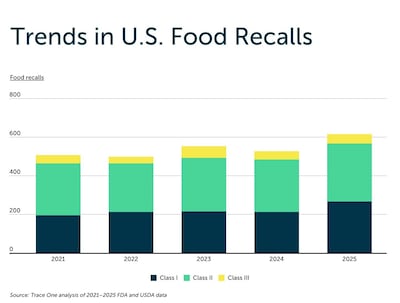
Food safety is not a given. In the last five years, the U.S. has seen at least 500 food recalls every year and in 2025 alone there were 613 food recalls, with Class I recalls — the ones with the greatest potential to cause harm — increasing by 36.4%, according to a study by Trace One.
“Food recall awareness is critical because many recalls involve serious health risks, including those caused by allergens and bacterial contamination,” Erika Redaelli, the study author from Trace One, told Deseret News. Trace One specializes in regulatory compliance and product lifecycle management in the food and beverage industry.
The company wants consumers to take food safety seriously and know what to do when a recall occurs. So do the federal agencies that oversee the issue: The U.S. Food and Drug Administration, which with the U.S. Department of Agriculture shares primary responsibility for food safety in this country. The FDA regulates all foods except agricultural products like meat, poultry and most eggs. USDA does that. Sometimes, they overlap.
Per the FDA, “It is important that consumers be aware of recalls because recalled foods may cause injury or illness, especially for people who are pregnant or have weakened immune systems because of chronic illness or medical treatment. A food may be recalled because of contamination with disease-causing microorganisms, such as bacteria, viruses or parasites; the presence of foreign objects such as broken glass or fragments of metal or plastic; or failure to list a major allergen in the food, such as peanuts or shellfish, on the product label.”
Redaelli said the recent increase in food recalls is “partly due to the growing consumption of processed and packaged foods, which is largely driven by their affordability, convenience and extended shelf life. At the same time, because modern supply chains are so interconnected, a single contamination issue can quickly ripple outward, affecting a broader range of products and triggering much larger recalls than in the past.”
That’s the bad news. But there’s also related good news.
Redaelli noted that even with that ripple effect, “a higher number of recalls doesn’t automatically mean our food system is less safe. Thanks to advances in traceability and oversight, consumers and companies are able to identify food safety hazards earlier and more often, resulting in faster response times.”
Still, both the broad sourcing and distribution of food means most states have seen hundreds of recalls, since faulty food products may reach whole regions or even the entire country. Utah, for instance, has seen 556 food recalls recently.
Hard to measure illness or other harms
Counting recalls is relatively easy. Quantifying how many people become ill because of food is probably impossible.
Centers for Disease Control and Prevention and FDA surveillance say thousands become ill from food, but just a subset are linked to specific recalls or foods. Often, the food-related illness springs from faulty food preparation.
Further complicating efforts to count effects, the FDA reports that illness outbreaks and recalls are tracked separately. And lots of outbreaks don’t lead to recalls, while some recalls result in no reported illnesses.
Anatomy of a recall
We’re talking about the risk of salmonella in fruit salad, and ice cream with metal fragments, mold in dried pasta, plastic and/or paper in baby biscuits and lead in apple sauce. Those are real examples of relatively recent food recalls.
Food can be deemed unsafe for everything from allergens to bacterial contamination, foreign objects to spoilage. Occasionally, the issue is a packaging defect, but usually the issue is more direct and potentially harmful.
The Trace One report said that the leading cause of recalls is allergens (45.2%), such as when a product during manufacturing is cross-contaminated with something that even in trace amounts can cause some consumers potentially serious harm. Common allergens include wheat, dairy and nuts.
Bacterial contamination is at the heart of 22.6% of recalls, featuring pathogens like salmonella, E. coli and listeria, which can make people very sick and in some cases kill.
And 10.8% of recalls occur because foreign objects actually got in the food or might have done so. Rocks, insects, plastic and metal have all been seen in recalled products, with the biggest risk being physical harm like broken teeth, choking or internal injuries. Those are not minor harms.
Lead contamination makes up less than 0.1% of recalls, but is highly concerning, too, especially in products for young children, such as apple sauce or baby food. Lead can create all sorts of health problems, starting with developmental disabilities.
Recalls are assigned severity ranking on a class system, with Class I recalls reserved for the most serious challenges to food safety. The main reason for growth in the number of recalls over the past five years is owed to growth in Class I, though Class II and Class III also saw some growth.
Most of the time, the manufacturer or distributor initiates the recall. But there are times when the federal agencies mandate it.
Food safety in Utah and beyond
Utah is No. 30 on the list of states most impacted by food safety recalls. And 223 of the 556 recalls in the last five years that reached Utah have been Class I. Additionally, per Trace One, 1 in 5 of the Class I, more serious recalls in the country in the past five years concerned products that were distributed or sold within Utah.
But just 31 of those recalls involved products made in Utah, which is 1.3%, the report said.
For perspective, California has been part of 38.3% of the food recalls — 1,010 — which is the highest share. It’s also the most populous state. And 17.5% of the recalls have come from California producers — not surprising because California is also America’s largest producer of food. New York is right behind on both counts, as part of 35.6% of recalls and home to 9.4% of the producers of recalled products.
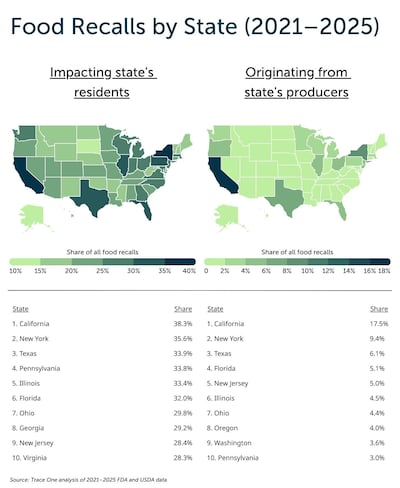
South Dakota comes in dead last in terms of food recalls impacting its residents. Just under 14% of recalled items have reached South Dakota, and it has been part of 365 recalls over the five years, of which 129 were Class I. Just three of the products recalled, 0.1%, came from South Dakota.
Finding recalls and knowing what to do
Retailers, restaurants and others who distribute product typically act fast to pull recalled items so that the potential for harm is curtailed. But on the consumer side, a recall doesn’t do much good if one doesn’t hear of it or act on it.
FDA recall notices routinely remind consumers to check their cupboards, fridges and freezers to make sure the products aren’t used.
One way to track recalls is through the FDA recall subscription service. USDA recalls can be found at https://www.fsis.usda.gov/recalls.
You can also find recalls on the X account @foodsafetygov.
Recalls with the potential for severe consequences are often featured in news reports. And stores that track consumer purchases for rewards and discounts may reach out to the consumers that they know bought a product in those severe cases, as well. Sometimes the retailers post notices near other, similar products warning that there has been a recall.
In some cases, the company that issued the recall may be able to reach customers directly, but that’s certainly not always the case.
Recall notices usually have instructions for product disposal, including whether it can be returned for a refund. If not, toss them, but if it’s contamination, the FDA advises wrapping it securely before putting it in the trash.
Never consume a recalled product. Do not give it to a food bank or pet.
The website Foodsafety.gov adds another bit of advice: Don’t open the food.
Recall notices tell the lot numbers and other identifying information, a purchase date range and perhaps best by dates because recalls often only involve specific batches of a product.
FDA also urges you to clean up anything that may have contacted contaminated food, using a tablespoon of bleach in a gallon of hot water and drying with a fresh paper towel or cloth. Then wash your hands thoroughly.