
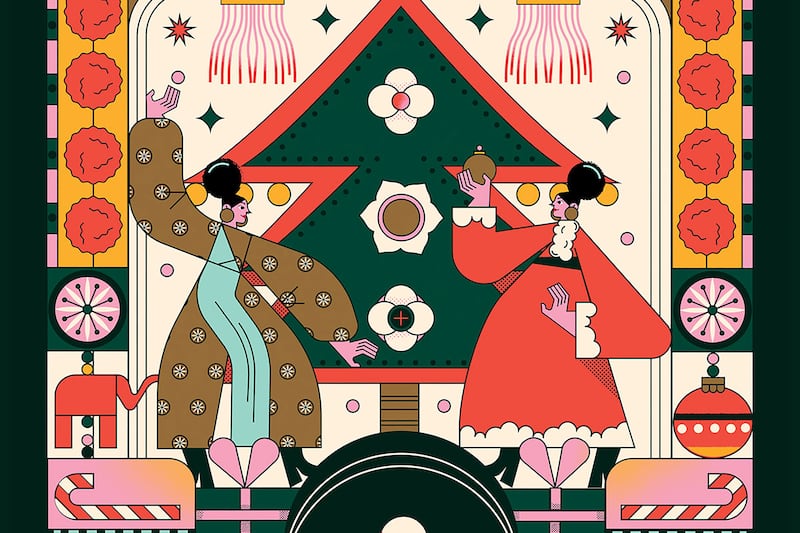
It’s Christmas 1982, the school gym packed with parents and students. I’m six years old, wearing a white dress, draped in a shawl, carrying a bundle shaped to resemble a baby. Next to me, a blond, blue-eyed boy asks if there’s “room at the inn.” We shuffle about the small stage, from innkeeper to innkeeper, until we’re offered a barn.
A few weeks earlier, a teacher had asked to meet me in the cafeteria, and then asked if I’d play the role of the Virgin Mary in the school Nativity play. I could be a shy child, but I was thrilled. Then word got around. It turned out it wasn’t a universally popular casting decision. “You don’t look like Mary!” scoffed one classmate. “My mum says Mary has blond hair. You’re so dark,” said another.
They were right. I looked nothing like the Marys depicted in books, on stained glass in churches, in paintings. That Mary was pale-skinned, often blond and blue-eyed. I was brown, dark-haired, dark-eyed, and, well, Indian. But on that stage, easing my bundle into the manger, my dad’s words of reassurance from earlier in the month came back to me. “You look more like Mary than most,” he’d said, telling me the Virgin Mary, like Joseph, was likely a first-century Palestinian.
How do you integrate while retaining a sense of where you’re from? It’s a question people of any diaspora, anywhere in the world, mull over.
Without realizing it, this was my first foray into my cultural identity and who I was allowed to be, or not. Playing Mary is my first tangible memory of Christmas — a holiday not traditionally part of my family religion, Hinduism, nor my ancestral culture of Gujarat, western India, but intrinsically part of my life. Being part of such a Christian tradition at such a formative age may even have kick-started my love affair with this time of year, where I’ve embraced British traditions, mixed some with Indian ones, and created my own version of “Christmas.”
You could say growing up as a child of exiled Ugandan Asian Gujarati immigrants in 1970s and 1980s Britain was a test of both assimilation and identity maintenance. How do you integrate while retaining a sense of where you’re from? The question is hardly unique; one that most people of any diaspora, anywhere in the world, mull over — particularly now, as populations become more diverse, resulting in more interracial marriages and children growing up with dual identities. According to 2023 data, while 58 percent of the U.S. population identifies as non-Hispanic white, the Hispanic population has grown from 23 million in 1990 to 65 million in 2023, and Asian or Pacific Islanders from seven million to 21 million. Adopting cultural traditions is often an easy “in” into a society that isn’t historically yours.
As a South Asian child keen to be “accepted,” I soon embraced carol-singing, card-making and tree-decorating far more than I did lighting diyas (candles) and warding off evil from our house for Diwali, the New Year for Hindus, Jains and Sikhs, which typically takes place in October or November, new moon depending. The school Christmas fair was my nonreligious equivalent of attending temple or church; the “event of the year” in my small-world, small-town of Chadwell Heath, a suburb in the southeastern U.K. county of Essex on the eastern border of London proper. But even at this traditional festive event, we found a way to fuse cultures. My mum’s samosa stand, with its savory, triangular, vegetable-filled pastries, was always a sellout.
I learned to wear my culture and its couture with pride. And it seemed I’d found my nook, sitting snugly between two cultures.
“Do you celebrate Christmas?” I’d still get asked. “Do you put up a tree?” “Will you have turkey for Christmas lunch?” Not all of us did, of course, but our family did. With December 25 also being my father’s birthday, I always felt we had our own Father Christmas, right there in our midst.
David Bomark, a sociologist at the University of Glasgow, believes it’s become easier to create your own identity and traditions since the middle of the 20th century. “We’ve become less reliant on being handed a prepackaged identity, due to globalizations and more media representations of other cultures and ways of leading one’s life,” he says. That’s exactly what we had done. On Christmas Day, our Indian family would get together, just like any other, but the dinner table might look a little different. There may well be turkey — the traditional meat of choice at a British Christmas lunch — but alongside Indian dishes such as chilli paneer (spiced, fried, marinated Indian cheese) and kachori (lentil-filled pastries). Then we might play games, exchange Secret Santa gifts, eat mince pies and feast on a cheeseboard.
Cheese may not scream Asian heritage, but for us, it does. Our paternal grandfather ran a grocery store, Avenue Grocers, in Kampala, Uganda, which became known for importing exciting international foods, such as cheese, and that palate is now four generations strong. It’s comforting, in the chaos of modern life, to do, eat and enjoy the same things your forefathers did, in the hope the generation after us will do the same.
Conversely, Diwali was somewhat less flamboyant, a simple get-together with our culturally if not religiously Hindu family. I do recall enthusiastically celebrating the nine-night festival of Navratri preceding Diwali, with traditional Gujarati folk dances of “garba” and “dandia” at a local leisure center, in what resembled something like a dance hall. These late nights on school days felt precious, giving me a sense of community, but I also was self-conscious in public while wearing traditional garments. Over time, I learned to wear my culture and its couture with pride. And it seemed I’d found my nook, sitting snugly between two cultures, if not two religions.
Growing Into Christmas
While childhood Christmases are their own world, leaving home for university in the mid-’90s marked a new era. As friends returned home to spend Christmas with family, a new ritual of “Christmas Eve pub night” began, meeting in our former teenage haunt, The George pub. This was a set piece for several years, until parents moved away, friends married, had children, and subsequently rotated Christmases between families. Our hometown was no longer our HQ.
I’d experienced another change. Before I left for university, my parents divorced, a life event that created a new dynamic, uprooting historic patterns and shaping new customs. I’d continue to spend December 25 with “Father Christmas,” but the following day, Boxing Day, evolved into a “second Christmas” with my mother. A superb cook — and myself an excellent “taster” — I was always in for a treat, and over time, her cooking has become increasingly more imaginative and delicious. A competitive game of Scrabble sealed the day. “Peace on earth, goodwill to men” may be in the Bible, but absent from our ferocious attempts to reach the highest score.
It was after my first solo backpacking trip in 2004, in my late 20s, a four-month extravaganza during which I spent Christmas on a white-sand beach in Thailand, snorkeling and swimming, that my Christmases became less cozy and more adventurous. A new tradition, if you will, to escape both singledom and winter in what sometimes felt like a dreary, loveless London; despite the friends, family and buzz, the city can also be a lonely place.
We’re each part of multiple, extended friendship groups and families now, and as our parents and relatives get older, time with the wider family feels precious.
For several years, around November, I’d pack my rucksack and laptop and migrate south with a plan to return in the spring. I felt free, like a bird on its migratory path. I spent Christmases on the beach in Vietnam, in a riverside town in Uruguay, in the forested hills of Cambodia, on safari in South Africa, and many more times in Southeast Asia. Christmas Day passed by with random, fun new friends, most of whom I never saw again, but I’d always miss family. No Christmas Day went by without a trip to the internet café, and, as technology developed, Skype and WhatsApp video calls.
Research published in the Frontiers in Psychology journal found the use of digital technologies and devices increased during and since the pandemic for older people. But the Covid-enforced digitized Christmas also reinforced the importance of physical presence. Researchers also found that “digital devices were not viewed as a direct replacement for face-to-face connections.”
Conversely, the pandemic also allowed people to enjoy alternative Christmases, perhaps with friends and away from uncomfortable childhood dynamics. “Some may think the individualization of society means that people have become more egotistical, but that’s not the case,” says the University of Glasgow’s Bomark. “It’s just a different way of relating to society; not as part of a collective monolith, but as a singular individual in a network which enables people to make choices that fit them.”
Just before Christmas 2017, as I was approaching 42, my own life took a turn when I met a man who’d become my life partner. The number 13 may be unlucky for some, but that first date on December 13 in a wintery, bustling, twinkling London, would change the course of our lives. Almost eight years later, we have only recently left behind our own apartments of our 30s and 40s, places of memory, pivotal moments and transformations, and created our first home together. As Christmas beckons, it’s our chance to mix-and-match our festive ways.
Some traditions had long changed for me, such as staying close to home over this time versus overseas adventure. We’re each part of multiple, extended friendship groups and families now, and as our parents and relatives get older, time with the wider family feels precious. As an only child, I’ve found my partner’s nuclear family of 10 to be a revelation.
I hope to reprise old customs too, such as hosting an annual “leftovers” party in those blurry days between Christmas and New Year, as one way of addressing the overconsumption and food waste that occurs this time of year. And to get “crafty” again as I once used to, making cards, pies, decorations. As non-parents, to host a day of creativity with the juniors in our lives, our nieces, nephews, friends’ children. And maybe, I’ll reprise my role as Mary for those who missed the debut 45 years ago.
This story appears in the December 2025 issue of Deseret Magazine. Learn more about how to subscribe.