

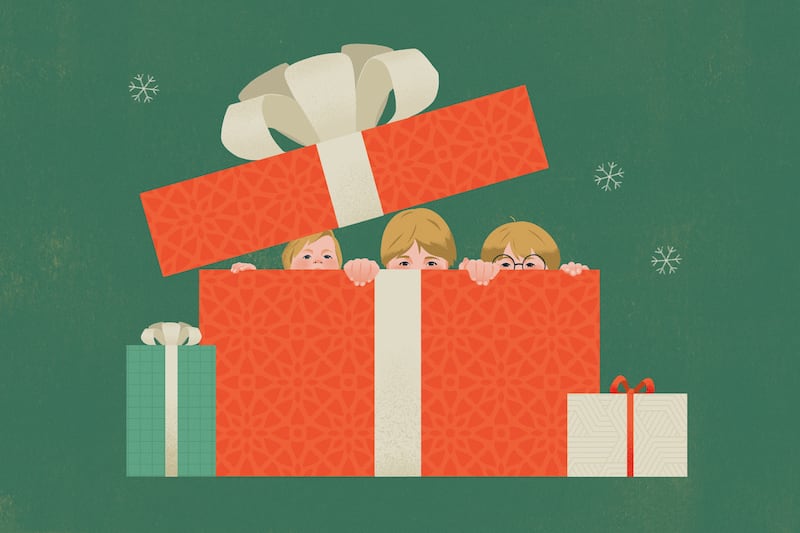
The days my parents struggled in the Great Depression were only whispers of yesteryear when I was born. By then, mink had replaced wool and the country club societal whirl had captured my parents’ fancy. For them, Christmas was an excuse to lavish each child with a fairyland of unrestrained wants. After opening one gift after another, I would tote my new acquisitions up and down the street so neighbors would know Santa loved me best.
From a background of material prosperity, it seemed natural for me to fantasize that when I had children of my own, extravagant giving at Christmas would continue. If that had been the case, I would not have had a memorable Christmas — just more of the same. Stuffed animals may have been bigger, clothes fancier and gadgets more sophisticated, but ho-hum can be found in the abundant life.
In 1977, my Christmas took a strange twist. I was no longer the little girl expecting a parental handout, I was an adult making my own way in life — completing a doctoral degree and raising three small sons alone. Like other graduate students, I was struggling to meet my financial obligations. Having more “month than money” was my norm. No matter how I worked the budget, five days before Christmas I knew there would be no gift buying this year. Cuddling my sons, I explained our financial plight. My emotions surfaced as the children said, “Don’t worry, Santa Claus will give us presents.”
“Santa is also having a bad year,” I said.
With certainty my son Brian declared, “On television his sleigh is filled with toys. He’ll have plenty for us.” His brother Todd added, “Besides, Santa won’t forget us. We’ve been good this year.” As my three sons nodded in agreement, I did too. Yet, in spite of their goodness they would be disappointed on Christmas Day.
That night, I pleaded with the Lord for a glimmer of hope that Christmas would be better than I imagined. My prayers awakened Brian. “Don’t worry about presents,” he said. “It doesn’t matter.” I knew it didn’t matter on December 20, but it would matter on December 25.
The next morning, self-pity marred my face. “What’s wrong?” I was asked at the university. My trite reply, “Nothing,” didn’t satisfy the inquisitive.
Stuffed animals may have been bigger, clothes fancier and gadgets more sophisticated, but ho-hum can be found in the abundant life.
Arriving home, I methodically pulled mail from the mailbox. A curious, typewritten envelope addressed “To a very, very, very, very, very Special Lady” caught my attention. I gazed at the envelope and wondered if it was meant for me. Hoping it was, I tore it open. To my surprise, there were several dollar bills inside but no note.
As I entered the home, my children gathered around me. Together we counted money, examined the envelope and expressed wonder at the anonymous gift. There was enough money to buy a gift for each son. It wouldn’t be a lavish Christmas, but it would be good enough.
“Where had the money come from?” I mused. “Could it be from a neighbor, a classmate or someone at church?” Neighbors assured me the money was not from them. Calling friends elicited clever responses. “If you find out who’s giving away money, tell them to send some my way.” Classmates made similar comments. I concluded the money must have come from our Latter-day Saint bishop. When he denied being our benefactor, curiosity got the best of me.
I read the typed envelope again: “To a very, very, very, very, very Special Lady.” This time I noticed the “e” and “i” were misshapen letters, evidence of an old typewriter ribbon. I also noticed that the dollar bills had been folded and refolded many times, as if each dollar was of infinite worth. My desire to discover the donor’s identity grew, as did a gnawing resolve to return the money. The misshapen letters and folded bills evidenced the generous donor also had financial difficulties.
I couldn’t sleep that night as I asked myself, “Who was it?” I can’t really describe how I finally knew, but about 2 o’clock in the morning I knew who my benefactor was — my three sons. I awoke the donors. Blurry-eyed, each asked, “What’s wrong?” I replied, “Nothing’s wrong. You gave me the money. You gave me all your money!” Opening their bedroom closet door, I pulled out three empty jars that had once contained their treasured fortune.
They were silent for a few moments until nine-year-old Brian punched his younger brother Todd. “You told!” he exclaimed. Hoping to fend off further blows, Todd said, “It wasn’t me. It must have been John.” John yelled, “It wasn’t me,” as his brothers pounced on him. In unison they asked me, “How did you know?”
“The Lord told me,” I said. “In the still of night, God told me it was you. I should have known for Jesus taught, ‘Suffer the little children to come unto me ... of such is the kingdom of heaven’” (Mark 10:14). I had searched outside my home for the answer — but the answer was within. For me, Christmas 1977 was a merry Christmas worth remembering.
Susan Easton Black is a retired professor of church history and doctrine at Brigham Young University.
This story appears in the December 2025 issue of Deseret Magazine. Learn more about how to subscribe.