

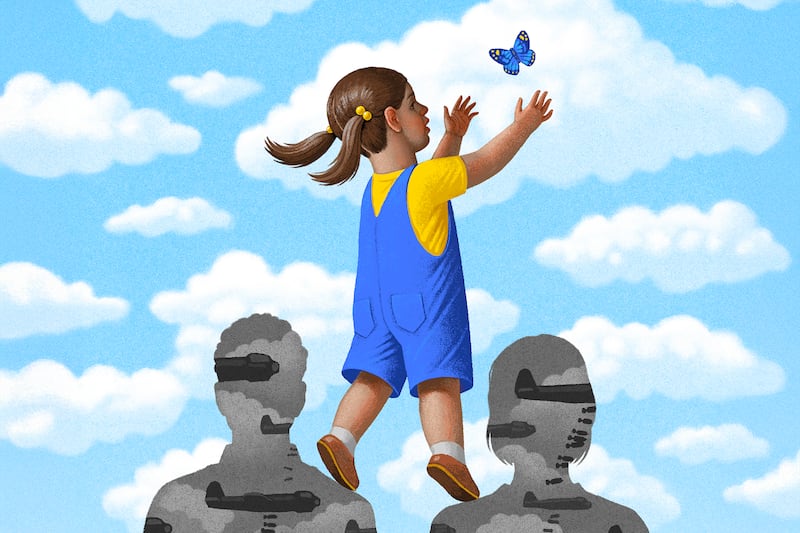

Through the grainy haze of old home videos, I see my younger self. In one clip, I toddle down the sidewalk outside our townhouse in a Bay Area suburb, my mom hovering over me, ready to catch every wobble. In another — dressed head to toe in pink with rounder cheeks — I’m celebrating my third birthday, devouring an ice cream bar while my dad warns me not to take such big bites. Fast-forward six years and I’m nine, bundled in two jackets, knee pads and a helmet on a weekend bike ride. We take a break and I’m feeding my toddler sister Cheerios on a park bench as Dad reminds me to hold her tight.
In every frame, I’m entering a new stage of life with my parents close beside me — protective, attentive, always a little anxious. Watching those videos now, living alone in Utah after leaving California for the first time, hit me harder than I expected. There’s something surreal about seeing your younger self grow up on tape — and realizing your parents were just people, too.
I can trace so much of who I am back to my family’s history — for better or worse — and I know some of that inheritance may have begun long before I was born.
Being first-generation American — the daughter of Jewish refugees from Belarus and Ukraine — shaped much of my childhood. My early years were filled with my grandmother’s beet soup and potato pancakes, mornings at a Russian-speaking preschool in my great-uncle’s house, folk dance lessons in bright sarafan dresses, and dreaded weekend math classes run by strict teachers who fit every Russian stereotype.
As a kid, I never thought much about my parents’ overprotectiveness. I figured all parents worried, especially immigrant ones from the former Soviet Union who wore puffer jackets in 60-degree weather and saw superstitions everywhere, from whistling indoors to celebrating birthdays early.
But by adolescence, I was embarrassed that my upbringing differed from that of my more “American friends,” whose parents seemed far more relaxed than mine. There were endless rules in my house — no going outside with wet hair, no joining Girl Scouts, always keeping my phone’s ringer on, visiting the doctor for every cold, no mall trips without an adult. Yet within my parents’ circle of Soviet émigrés, such vigilance was normal, rooted in an unspoken belief that safety could vanish at any moment.
I couldn’t wait for college and adulthood, expecting independence to bring freedom. Instead, time and distance brought something else — a newfound empathy for my parents. What I once dismissed as “helicopter parenting,” a 1990s buzzword for overinvolved parents, I now understand differently. My parents’ overprotectiveness wasn’t random — it was an inherited response to their past, a passing down of the survival instincts that once kept them safe.
That inheritance isn’t just anecdotal. Research shows that trauma and other environmental exposures can reverberate across generations — shaping family dynamics, learned behavior and even influencing how genes function outside the DNA sequence. My parents’ past shaped how they saw the world and how they raised me. Once I understood that, I began to see my childhood through a clearer lens; even the home videos seemed a little less grainy.
I never fully grasped my family’s history growing up. My parents loved to tell stories of starting over in America and falling in love, glossing over the hardships that came before. To them — and many immigrants of their generation — things hadn’t been that bad. They had food, shelter and schooling, even if it meant standing in ration lines or watching cartoons on a single state-controlled TV channel.
But the reality was more complicated. They came of age amid political upheaval, censorship and widespread antisemitism. After the Holocaust, under Soviet rule, synagogues were mostly closed or repurposed, passports listed Jews as a separate “nationality,” and access to universities and jobs was restricted. Jews were more vulnerable to arrest for alleged anti-Soviet activities and couldn’t freely emigrate until the late 1980s. Antisemitism in the region was nothing new — pogroms had swept through Eastern Europe since the 19th century and continued, in different forms, through the Holocaust. Each generation of my family had known this struggle intimately.
In the Holocaust, you couldn’t say goodbye. When you did, most likely it was the last time you’d ever see the person.
As the saying goes, we stand on the shoulders of those who came before us. Trauma research has built on that idea, expanding beyond isolated events — violence, life-threatening injuries — to include cultural, historical and collective experiences. A 2016 literature review in the Journal of Immigrant and Minority Health, analyzing 20 studies on intergenerational trauma in refugee families, found that experiences such as political persecution, displacement and starvation can leave lasting psychological effects — often manifesting as anxiety and depression in both parents and children.
Psychologist Yael Danieli has spent her career studying this phenomenon. As a Ph.D. student in New York City in the 1960s, she began interviewing Holocaust survivors for her dissertation. That work led her to found the Group Project for Holocaust Survivors and their Children in 1975, one of the first postwar counseling programs of its kind. In 1998, she edited the International Handbook of Multigenerational Legacies of Trauma, expanding the field’s scope to include other genocides and war crimes worldwide.
“As a psychohistorian, I always look to what history we are living,” Danieli says. “I’m addicted to it because I believe if we don’t know it, we don’t understand who we are.”
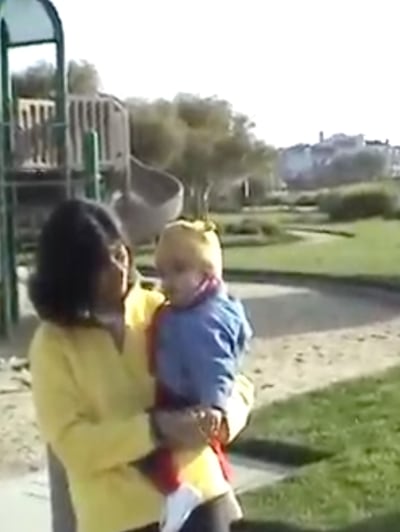
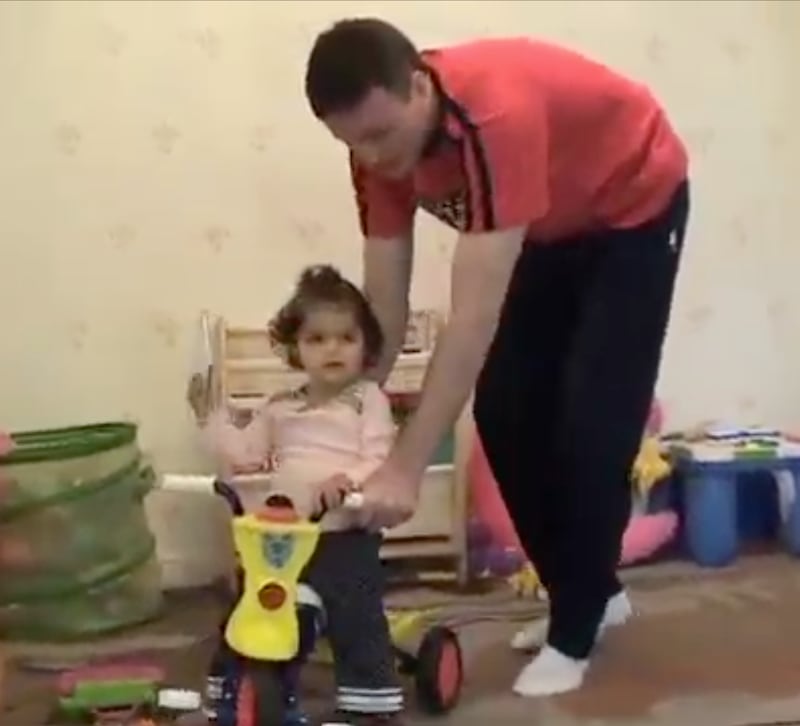
As a curious kid, I often pried into my parents’ pasts, piecing together fragments from half-told stories. My dad grew up in Kharkiv — Ukraine’s second-largest city — where Jews made up around 5% of the population in 1970 and were singled out at school, with teachers reading students’ “nationalities” aloud during roll call. He often came home with split knuckles after fighting classmates who taunted him with slurs.
In Minsk, Belarus, my mom’s family attended secret gatherings at Yama — “the hole,” a memorial built on the site of a mass grave for 5,000 Jews from the nearby Minsk Ghetto who were killed there on March 2, 1942 — where informal speeches stood in for prayers. My mom grew up in far poorer conditions than my dad, spending hours in ration lines for bread and milk and wearing the same patched coat winter after winter. Fruit was so rare that when bananas appeared once every few years at a state-run summer camp, she hid the leftover peels under her bed in the musky dorm she shared with 20 girls.
By the early 1990s, as the USSR collapsed, my parents — then young adults — faced limited futures. Within a year of each other, both families began the long process of applying for refugee status in Moscow. For my grandparents, leaving meant abandoning their language, home and everything familiar. But staying felt like a dead end, for their children and whatever future they hoped to build.
Before speaking with Danieli, I decided to take part in one of her most influential contributions to the field — the Danieli Inventory. Developed in 2015 after decades of interviewing Holocaust survivors and their children, the three-part behavioral questionnaire measures how survivors’ coping mechanisms — what Danieli calls “adaptational styles” — shape their children.
Though my parents were born decades after the Holocaust, many of the statements resonated, and I found myself scoring them high. My parents wanted to know where I was at all times. I was taught to mistrust authority. I find it difficult to say goodbye. I feel responsible for my parents’ happiness.
“Survival means adapting to the conditions that allowed you to survive,” Danieli says. “Those adaptational styles become lifestyles. They become who you are, how you live with other people, how you view the world, how you think about politics, how you think about the weather.”
During our conversation, Danieli often turned the focus back to me, like any seasoned psychologist. Talking to her felt less like an interview and more like confiding in an older relative who instinctively understood my family.
“A lot of people call all of this love,” she told me. “What you call overprotection — in a lot of cultures, that’s what love is.”
Political persecution, displacement and starvation can leave lasting psychological effects — often manifesting as anxiety and depression in both parents and children.
No one showed love more fiercely than my grandparents, who helped raise me while my parents worked. Their vigilance made my parents’ overprotectiveness seem mild. My paternal grandmother, a petite woman with a pixie cut, cooked enough food each week to feed an army. My grandfather arrived early for school pickup every day, refusing to wait in line. My mom’s parents were masters of frugality — my grandfather compared prices at every produce store before buying fruit, and they took multiple buses from San Francisco just to visit me each week.
Both sides of my family carried the aftershocks of World War II and the Holocaust, especially my maternal grandparents, who survived it firsthand. In 1941, they evacuated Belarus by train — my grandma to Kazakhstan, my grandfather to the Ural Mountains. That first winter, his younger brother starved to death in a dugout shelter. When he returned home after the war with his mom and older brother, their house had burned down, his father had died in combat and most of his relatives were gone. He lived in poverty for years afterward, only speaking about it when my mother recorded his biography, shortly before his death in 2018.
“It’s quite possible that your parents themselves inherited (overprotectiveness) from their own parents,” Danieli told me. “In the Holocaust, you couldn’t say goodbye. When you did, most likely it was the last time you’d ever see the person.”
In many post-Soviet families, closeness — sometimes to the point of suffocation — is the norm. Grandparents help raise grandchildren, adult children rarely move far. Even as a kid, I sensed my parents’ fear of distance and felt responsible for easing it. Part of me still feels guilty for leaving California, even though I talk to my mom at least three times a day. Danieli calls behaviors like this a “reparative adaptational impact,” a child’s instinct to protect their parents and undo the harm of the past.
“I believe that every child wants to heal their parents and themselves,” she says. “For children of survivors of trauma, there is no stronger mission in life.”
Understanding that my parents’ overprotectiveness was their way of showing love was one thing; accepting how deeply it shaped me was another. I recognize it in my empathy and attentiveness, but also in my need to prepare for everything and overthink what I can’t control. I’ve become a “mama bear” to my teenage sister, an overprepared traveler with every possible snack on a family trip, the self-appointed doctor diagnosing my parents when they’re sick. As an adult, I can trace so much of who I am back to my family’s history — for better or worse — and I know some of that inheritance may have begun long before I was born.
A lot of people call all of this love. What you call overprotection — in a lot of cultures, that’s what love is.
Transgenerational epigenetics, a field that gained recognition only in recent decades, challenges the idea that DNA alone determines who we become. In the early 2000s, biologist Michael Skinner at Washington State University discovered that environmental exposures could influence not just one generation of animals but several. Rats exposed to agricultural chemicals produced descendants three and four generations later with the same health defects — a discovery showing that heredity can be shaped not by changes to DNA itself, but by chemical tags that regulate how genes turn on and off.
“Stress and trauma are just as active as environmental toxins in terms of reprogramming the epigenome,” Skinner says. “The earlier in development you are, the more sensitive you are to change.”
In early embryonic development, a mother’s environment — her stress levels, diet or exposure to toxins — can most strongly influence her fetus’ epigenetic programming. These changes can persist into adolescence and later, and Skinner’s research in animal models suggests they can be transmitted through the germline to future generations.
In 2015, psychiatrist Rachel Yehuda, director of the Traumatic Stress Studies Division at Mount Sinai Hospital, found early evidence of this in humans. Her study, though limited in size, showed that 32 Holocaust survivors and their children shared epigenetic changes in a gene that helps regulate cortisol, the body’s primary stress hormone.
“The fact we got a hint was big news,” Yehuda told BBC in 2019. “Now the question is, how do you put meat on the bones? How do you really understand the mechanism of what is happening?”
Science can’t yet predict exactly how trauma and stress — what Skinner calls “inducers” — are passed down through generations. Rather than dwell on inevitability, Skinner hopes his research will pave the way for using epigenetic analysis to better trace family histories, assess disease risk and raise awareness. That same awareness is what I’m working toward, too.
There’s one video I return to often, whenever I miss my parents or after an argument. My dad’s voice fills the living room, narrating in Russian: “Today’s the sixth of December, about 10 minutes to 4. In an hour, we’re preparing to go to the hospital, to meet our Valerie. Here’s Mama.”
He pans to my mom, resting a book over her belly, wearing striped track pants and a vintage Betty Boop shirt. She begins reading Dr. Seuss’ “Oh, Baby, The Places You’ll Go!” in broken English — the same book she read to me throughout her pregnancy. Near the end, her voice wavers. She wipes her eyes, then laughs and tells my dad to turn off the camera before she starts crying.
Every time I watch it, I tear up, too. My mom wasn’t much older than I am now, just hours away from the unknown. Anyone would have been terrified, even without what she’d already lived through. Yet in that moment, her eyes are glazed with unmistakable joy.
There’s something cathartic about reliving my childhood on tape, and something even more special about witnessing my parents in the moments just before they became parents.
Each time I turn back the clock through a home video, I’m filled with more empathy. My parents, and theirs before them, did the best they could with what they had and the histories they carried. Now, I get to decide what to carry forward — and what to let go of.
This story appears in the January/February 2026 issue of Deseret Magazine. Learn more about how to subscribe.