

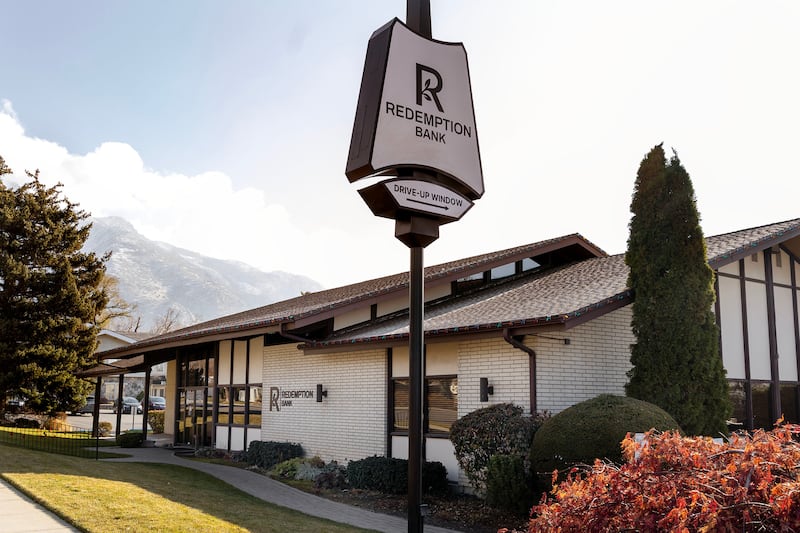

Inside the wood-paneled lobby of what used to be Holladay Bank and Trust stands an enormous mural. Stretching the length of the teller stations, it visually narrates the bank’s history using dozens of faces. Some are men in suits. Others ride in cars or play in the snow. Many more float along as heads alone, pressed onto circular, yellow backgrounds like saints in Byzantine art. The mural is colorful and intricate; you could spend hours exploring its layers, putting the story together. But whether you look deeply or barely skim the surface, the faces make one fact unmistakably clear: This bank was founded by white people.

It also almost exclusively served white people. It wasn’t that way out of malice, but circumstance: The people who lived in Holladay, a suburb of Salt Lake City, back then were almost exclusively white, and the bank existed to serve the local population. Those demographics haven’t changed much. The most recent census data shows Holladay remains 86% white — and just 1% Black. Yet in June of last year, a group of Black entrepreneurs acquired Holladay Bank and Trust. It was a purchase made possible not by shifting demographics but by new circumstances.
The impact on the community would be much bigger than the financial returns.
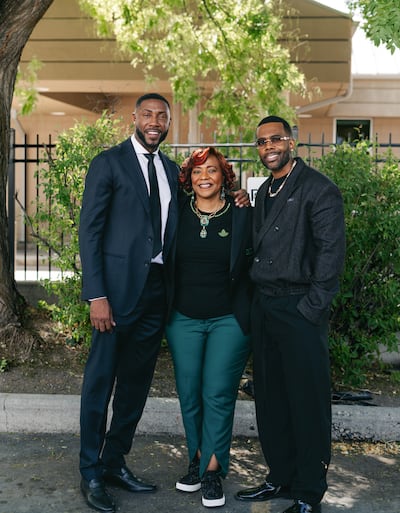
The group of entrepreneurs is led by Ashley Bell, who served in multiple White House roles during Donald Trump’s first term, and Bernice King, the youngest child of the Rev. Martin Luther King Jr. Their decision to purchase a bank in Utah last summer generated national headlines for the simple fact that it’s so surprising: A Black-owned bank in one of the country’s whitest states? Publications from The Wall Street Journal to Ebony magazine found that newsworthy. But, like looking at the mural and finding new storylines beneath the veneer, there’s more going on here than novelty alone.
The newly branded Redemption Bank offers a nexus for two contentious national issues: race and wealth. Just over five years ago, George Floyd’s murder unleashed a racial reckoning across the nation. Its momentum has slowed, but its aftershock remains in institutions like this one, which was founded explicitly to correct economic injustice. The bank’s founders believe capitalism is the key to that goal, because it gives everyone a chance at lasting success. But inequality is rising. Pew reports that in 1971, 61% of Americans lived in middle-class homes. By 2021, that had dropped to 50%, while the wealthy and lower-income groups both grew. The Congressional Budget Office similarly details how between 1989 and 2022, Americans in the top 10 percent of income distribution expanded their control of the nation’s wealth from 56 to 60%, while the bottom 50%’s share didn’t change at all. And inequality is particularly stark among racial groups; per the Federal Reserve, the “racial wealth gap” between median Black and white households in 2022 was more than $220,000.
Such inequities are long-standing and have discouraged efforts toward change. But Brandon Comer, a founding investor in the Utah venture, believes in capitalism’s potential to be a force for good, including for racial progress. And Utah has become the ideal laboratory to test his hypothesis. The nearest Black-owned banks are in Houston to the east and Los Angeles to the west, making what was once called Holladay Bank and Trust the only such institution in the entire Mountain West. It may seem a strange choice on the surface, but Utah’s unusual circumstances regarding race, business and their collective impact could be poised to deliver something revolutionary.
The founders call their project Redemption Bank, and in Holladay, new signs dress the space around the mural. For Bell, the name — like the institution itself — reflects the founders’ values. “If this opportunity is to be realized; if we are going to be able to do something that’s never been done before in our country,” he says, they needed a name that would be an anchor. A constant reminder of why they believe in the project’s potential. “And it’s for those people who need a second chance,” Bell adds. “For the communities that have been overlooked. For the marginalized. For the least, the last and the left-behind, to give them an opportunity to chase their dreams.”
Uniquely Utah
Redemption Bank chose Utah foremost for practical reasons. Going back to its earliest days, “Utah was founded as this new state by this new people, with a bank structure that was very different than what everyone else was doing,” says Mehrsa Baradaran, a professor of law at University of California, Irvine, and a leading expert in the history of Black banks. “It really was a very egalitarian, community-based bank.” Today, that legacy shows up in an unusual regulatory environment that’s streamlined and bank-friendly, encouraging innovation in frontier spaces like cryptocurrency and financial technology. Utah encourages banks, in other words, to get creative and think big, which in the past has attracted branches of Goldman Sachs, American Express, PayPal, Ally Bank and others.
Redemption’s founders also liked the idea of bringing a Black bank to a Black banking desert. And there happened to be a well-run community bank for sale. “I was aware of perceptions about the place,” Comer says. “But despite what things may have been or looked like, I think this was a great opportunity, and it shows that Utah is a welcoming place.” Indeed, Utah’s unique heritage has made a tremendous impact not only on the state’s business-friendly culture, but also on its civic conscience.
I don’t think what Redemption is doing is radical, but it is fighting against some pretty big headwinds, and so in that way, it’s pretty brave. And, I guess, radical in that way.
Under the late President Russell M. Nelson, who died in September, The Church of Jesus Christ of Latter-day Saints took significant steps to work with Black leaders nationwide during a time of a national awakening about the lingering effects of systemic racism. It formally partnered with the NAACP, offered financial support for Black scholarships and, during the faith’s worldwide general conference in October 2020, President Nelson bluntly condemned racism from the pulpit. He directly called on members to “lead out in abandoning attitudes and actions of prejudice.” He pleaded with them to “promote respect for all of God’s children.” Bell met with President Nelson in April 2023. “That’s when I knew,” he said, “that something was different. That this opportunity was being received very differently.”
The meeting wasn’t long, but Bell says he’ll remember it forever. President Nelson was spry for a man of 98, with incredible memory and unusual warmth. They discussed President Nelson’s recent acceptance of the inaugural Gandhi-King-Mandela Peace Prize from Morehouse College, a historically Black institution in Georgia. Bell asked him to pray for his venture’s success. President Nelson was supportive. “After that, there was a different confidence level from our team,” Bell says, “as far as, ‘This could be something extraordinary.’”
Given its unusual history, Utah tends to take issues of culture and diversity more seriously than other red states. “I know Utah to be a place that has a lot of people who are very interested in helping the underprivileged,” Baradaran says. “It’s sort of baked into the religious structure. It’s baked into how Utah sees itself, its history of being outsiders, of being discriminated against.” So when Redemption Bank set up shop, the state’s business infrastructure was eager to get involved. The Garffs, the Millers, the Huntsmans, the Eccles family and the Sorensens — major players in Utah’s business and philanthropic scene — invested in the project. “And guess what? They’re all white. They’re all Utahns,” says Byron Russell, a Black Utahn and Redemption Bank board member. “And that tells you that there is something very special about Utah. That it is unique in so many ways.”
Dinesh Patel, another local investor, saw it as a good opportunity. In his experience, Utah needs more community banking to finance small businesses and entrepreneurs within the state’s minority populations and beyond. He also believes in Redemption Bank’s potential to grow. But “am I investing in this to make 10 times my money? No,” he says. “I’m trying to help the community, and I’m hoping to get a good return. … The impact on the community is what would be much bigger than the financial returns.” Clint Stone, chief investment officer of the Miller Family Foundation, seconds Patel’s thinking. “Returns for us in this investment are secondary,” he says. “The primary motivation was seeing this opportunity that aligned with one of the missions of (our) foundation: economic empowerment. ... We felt like this was just right in the fairway of that.”
Returns for Redemption’s founders, however, are not secondary. They are very clear about the fact that they aren’t looking for charity. They want to grow and turn a profit for their backers.
Radical capitalism
When asked what he hoped Redemption Bank could accomplish in the days ahead, Bell said, “We hope that in five years, this bank will be publicly traded. We want to build a bank that is publicly traded, no different than Zions Bank, that gives us an opportunity for our investors to reap the benefit of a lot of hard work.” In other words, he hopes the bank will enrich its shareholders. That doesn’t sound new or revolutionary. Is the mission just a façade of racially conscious branding?
Absolutely not, argues Bell. Alongside Bernice King in Detroit, he said so in August. This is about profit, yes — but it’s also about values. “The movement for us is to give you an alternative to banking with a place that may not be aligned with your values,” he explained. “You don’t need to bank with us — but you need to bank somewhere that’s creating the world you want to see.” Too much of the corporate world today is purely selfish. “Greed has become an overarching factor that’s modified the system,” Comer says, “and a bit of a lack of empathy as well.” Rebelling against that paradigm, however, doesn’t require abandoning capitalism. “Economic justice just means that capitalism remains pure,” Bell says, “in the sense that everybody should have an opportunity” to succeed.
The bank’s investors can profit — but the people whose payments make that profit possible can also use the bank’s access to capital to enrich their own lives. To help them grow a business, buy homes, build wealth. Especially minority communities. “It’s really not about DEI. It’s about understanding the value of people … and wanting the best,” Bernice King said. “And when you’re honest about the disparities that exist in this world … we’ve got a lot of work to do to overcome the gaps.”
It’s for those people who need a second chance, for the communities that have been overlooked. For the marginalized. For the least, the last and the left-behind, to give them an opportunity to chase their dreams.
As he helps prepare Utah’s celebrations for the country’s upcoming 250th anniversary, Russell has been thinking a lot about how capitalism is a uniquely potent tool in that quest to overcome. “Financial independence is the best tool for racial equity,” he says. Throughout the nation’s history, our most powerful institutions have excluded Black Americans from much of their bounty; from the founding promises of equality and the pursuit of happiness. But progress to enable voting and ensure civil rights can be tenuous. “As you might read, those are being dissolved. They’re being erased. They’re being reversed,” Russell says. “But you can’t reverse a person’s financial independence, and you can’t reverse what you own. That’s what capitalism is supposed to be.”
In that sense, what Redemption is doing isn’t all that different. “There’s nothing that they’re doing that is trying to change the system,” Baradaran says. And that can be a problem, in her view, because stronger stuff is actually needed to fix certain systemic inadequacies. However, she likens Redemption to a “David and Goliath” type of story, with the bank swimming against the tide of not only structural racism, but threats to small businesses everywhere. If it succeeds, that alone could send a powerful message.

“To redeem faith in capitalism, you’d want to see small, nimble banks being able to compete with the large, heavy, institutional ones,” she says. “I don’t think what Redemption is doing is radical, but it is fighting against some pretty big headwinds, and so in that way, it’s pretty brave. And, I guess, radical in that way.”
Back in Holladay, little has changed. New signage aside, the bank’s preacquisition staff remains, alongside the aging decor and, of course, the mural. Redemption’s leaders don’t plan to alter the mural anytime soon, but it’s sure to look different in the future. Not literally, perhaps, but the context, the circumstances that surround it, will change. They already have.
“I’m excited for what the mural of Holladay Bank and Trust, now Redemption, looks like 20, 25 years from now,” Comer says. “Because it’s on that foundation that whatever we do going forward sits.” Some things, in other words, must remain the same. They cannot alter history. But even if the mural’s many faces don’t change, the faces looking up at it will. And, if Redemption’s mission succeeds, the promise and opportunity it renders in striking intricacy and detail could look entirely new.
This story appears in the January/February 2026 issue of Deseret Magazine. Learn more about how to subscribe.