

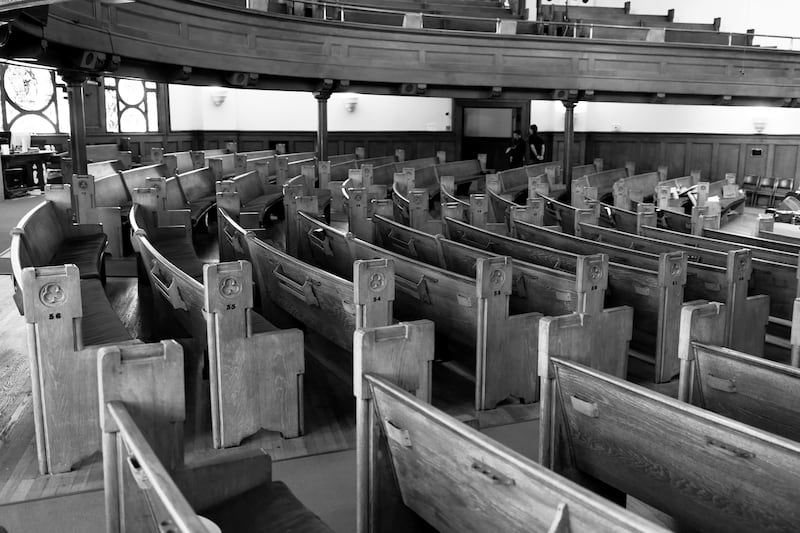

A pew can be a hard, unforgiving thing. I’ve been sitting here for a good hour and its wooden rigidity is taking a toll on my aching back. I rock side to side, angling to find some kind of cushion within my body, but the bench seems to resist my efforts. The service has ended, the candles are doused, and the priests walk past me toward the exit as a pipe organ plays Beethoven’s festive “Ode to Joy.” I know that standing up will bring me sweet relief, but I’m not quite ready for that. Instead, I lean harder into the polished oak.
I haven’t been to Mass in years, not with any frequency, though it was a common practice at the Catholic schools I attended as a boy. I’m here now at the Cathedral of St. Jude the Apostle in St. Petersburg, Florida, to remedy that, for the benefit of my young family but also for myself. We live near the striking Spanish-style building, with beige brick and red tile roofing. The space inside feels familiar, yet also evokes a distant time. Sunlight filters through stained glass in an arching rotunda, falling across a large crucifix set above a rather plain white altar. I’m sitting on the far left, within the array of semicircular pews that wrap around a raised dais built out of black stone.
The pews are shared. A middle-aged woman I’ve never met sits at the other end of my bench, too far for us to talk without shouting but close enough that we exchange waves following the Lord’s Prayer. She’s still here now, holding a hymnal and singing along with the organ. Looking around, I see dozens more like us, and it strikes me that we’re sharing not just benches but an experience. I dig a green hymnal from the wooden pocket on the pew in front of me and follow along on the page.
Pews come in different shapes and sizes, of course. Some are straight and long enough to hold three full-sized families without a break. Some are too small to share with a stranger. I’ve seen grids of padded benches that must feel like heaven by comparison. This pew is like none of those. I run my chewed-up fingernails across the surface and they crackle against the grain, the oak stained and finished to a glossy yellow. Pews haven’t changed much since they were first introduced in the 14th century, but that’s not because they’re so comfy. A pew doesn’t give so much as it asks something of you.
Before pews, people used to stand at church, or sit on stone slabs with no back support. Maybe that’s why a pew still seems designed to require a certain effort, which helps you to sit up straight and pay attention. It keeps you in the moment, in touch with your thoughts and feelings. This one reminds me of where I am and why I’m here — unlike my couch, where I can lose myself for hours without thinking much at all. Yes, the firm surface is mashing my poor coddled tailbone, born in this padded age, intolerant of even mild irritations. But I also find comfort in a seat that lifts me up without letting me sink into it.
With that realization, I stand up, stretch out my fatigue and return to a softer world.
This story appears in the January/February 2026 issue of Deseret Magazine. Learn more about how to subscribe.