

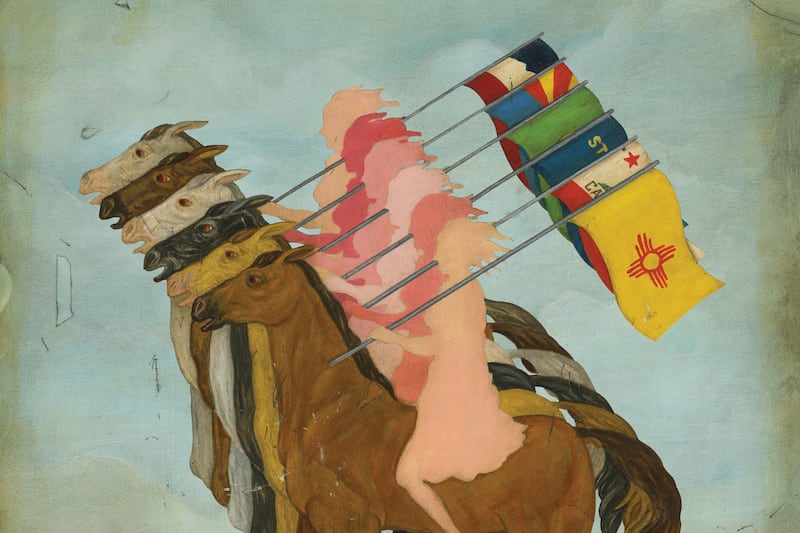

The Eisenhower Executive Office Building where Deb Haaland stood for her swearing-in relied heavily on the aesthetics of European imperial powers. Gilded mirrors, chandeliers and parquet floors filled the room — a design choice meant to mimic 18th century French architecture, made all the more imposing by the building’s history as a place of deliberating war. Haaland, huddled beside two of her sisters and her only daughter, stood out with a rainbow ribbon skirt, white moccasins, a turquoise necklace and dragonfly shaped earrings. That Thursday, March 18, 2021, the congresswoman from New Mexico was not concerned with blending in. She dressed to mark the occasion: her debut as the first Native American secretary of the Department of the Interior.
Haaland placed her left palm on a Bible her daughter held, then recited the oath of office. Her words were slightly muffled from behind a floral face mask — this was at the height of the COVD-19 pandemic — but the message still rang clear. She vowed to defend the Constitution, to bear faith and allegiance in her country as she prepared to head a department so all-encompassing it’s sometimes called the “Department of Everything Else.” And not only was she the first Native American to lead that department, but the first to lead any Cabinet-level agency. Only two other women served the same role before her in the agency’s nearly 200-year tenure.
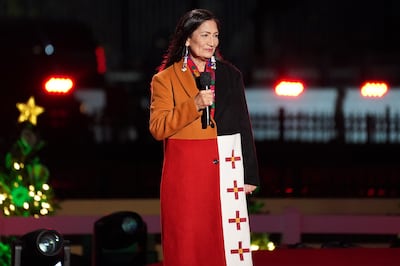
Before her rise to secretary, Haaland became one of the first two Native women elected to Congress in 2018. By then, women made up more than half of the national population yet only 20% of its largest legislative body. Though not for a lack of trying. The same year, a record number of women ran for Congress, more than any other time in American history up until that point. Despite centuries of men outnumbering and overrepresenting women in politics, the last decade has signaled something of a shift. More women are gaining positions of real power across the United States. Especially, like in Haaland’s case, women from Western states.
In 2019, Nevada became the first state where women held a majority of the seats in the Legislature. Colorado followed in 2022, then New Mexico in 2024. Today, women make up nearly a third of Congress — though Nevada, Colorado and New Mexico are still the only three states to have reached that majority milestone. California, Arizona, Oregon and Washington rank closely behind for state legislatures with the largest shares of women. “There is a pattern of women’s power (in the West) that we see replicated across different levels of office,” says Kelly Dittmar, director of research and scholar at Rutgers University’s Center for American Women and Politics. “We are a representative democracy. Those in office should be representative of those they serve. That includes fair and equal gender representation.”
Still, just 73 women have ever filled Cabinet-level positions. The highest echelons of influence in America, widely considered one of the more demographically diverse countries on the planet, have largely been reserved for men. That extends globally; according to the United Nations, women are underrepresented “at all levels of decision-making worldwide.”
When women do lead, it not only boosts democracy by engaging a group that represents more than half of all Americans, Dittmar says; it improves society through meaningful policy change. “Different issues and different perspectives are brought to democratic deliberation when women are at the table because they have different lived experiences and perspectives.” The Organisation for Economic Co-operation and Development points out that women politicians are more likely to prioritize social and economic policy changes that deal with issues like education, child care and health care.
As secretary, Haaland passed initiatives like female-focused hiring for law enforcement officers in the National Park Service as well as throughout the Interior’s bureaus and offices. “Women were meant to lead,” she told me in December. As a congresswoman, she was a vocal advocate for the Paycheck Fairness Act to close the gender wage gap. She knew, from personal experience, that economic independence has the power to take women and their children out of poverty, homelessness, and domestic violence situations. She speaks openly about having raised her own daughter as a single mother who cleaned floors and toilets at her child’s preschool so she could afford the tuition.
Throughout her career, Haaland took her lived experiences and turned them into substantive changes that prevent more women from struggling through the same pitfalls. When her tenure as secretary ended in 2025, she launched a bid to become the first Native woman governor in American history — a race she’s poised to win in New Mexico. And she’s making a point to follow the same playbook that brought her to the Eisenhower Executive Office Building five years ago, staring at a future once believed to be impossible. “If we can make things good for a single mom in New Mexico — if a single mom can pay their bills, have groceries in the cupboard at the end of the month, make sure that things are paid without falling short and without overdrawing their checking account,” she says, “then we’re doing OK.”
The West, of course, is far less populated than the Eastern Seaboard, the land far more rugged, a rural ethos far more prevalent. Yet when it comes to political gender parity, a benchmark of democracy that most other states have yet to crack, it’s the Western region that continues to lead the nation. Haaland is merely one such example of that legacy in action. For as many elected women came before her, she hopes there are even more to come in the generations ahead. Women who differ in party, ethnicity, faith and values; women who mirror the present face of the country they live in.
A history of empowering women
The tradition of Western states politically empowering women isn’t exactly new. The Utah Territory passed a law granting women the right to legally vote in elections in 1870, half a century before the Constitution granted that right to all women federally. Eventually, every state and territory in the West besides New Mexico granted women the right to vote prior to the 19th Amendment. That participation paved the way for Colorado to become the first state to elect women to a state legislature in 1894, Utah to elect the first woman state senator in 1896, Montana to elect the first woman to the U.S. House of Representatives in 1916 and Wyoming to elect the nation’s first woman governor in 1924.
According to historian Jennifer Helton, Western states were more inclusive early on due in part to necessity. Their governments proved more fluid because they had to be built from scratch. Populations were significantly smaller than out east, which meant settlers relied on women to vote and hold office in order for the territories to qualify for statehood. Because Latter-day Saints were often the first settlers in the Intermountain West, they played a particularly significant role, not just in politics, but in stabilizing fragile frontier communities and actively building civic and cultural institutions. Martha Hughes Cannon, for example, the first woman elected to a state senate (she defeated her husband), enrolled at the University of Deseret (now the University of Utah) at the age of 16 and received a medical degree at the University of Michigan. When she returned to Utah she joined Susan B. Anthony and other suffragists in a national campaign to push for the women’s right to vote. (In 2024, a statue of Cannon was placed in the U.S. Capitol).
“There’s been a culture of having women in leadership,” Dittmar says. “You can’t undersell what that then means for the expectation among citizens that you will and can and should see women in political leadership.”
In 2019, Nevada became the first state where women held a majority of the seats in its legislature. Colorado followed in 2022, then New Mexico in 2024 — the only three states to have reached that majority milestone.
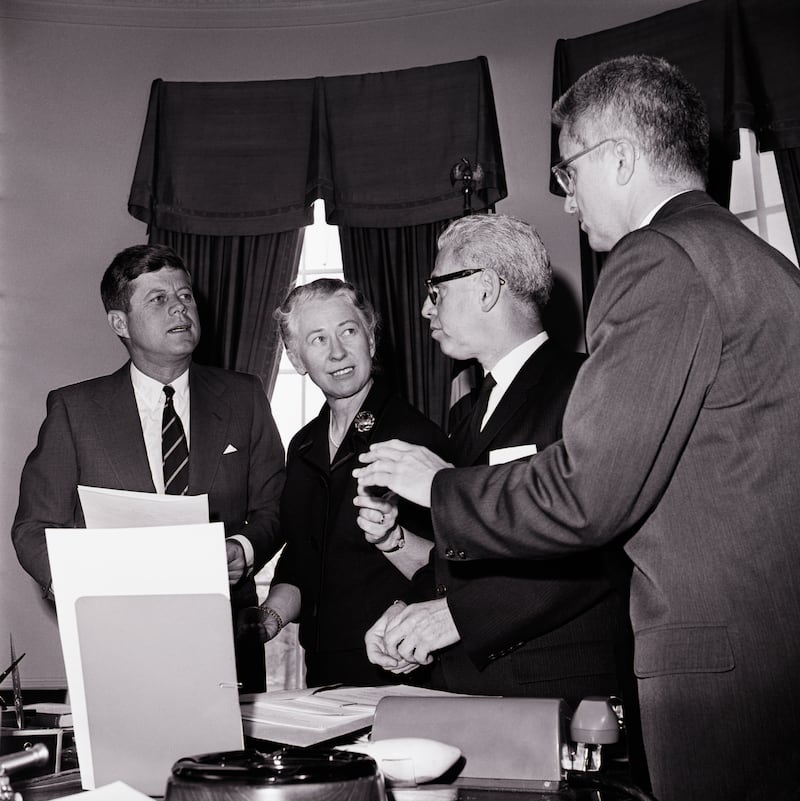
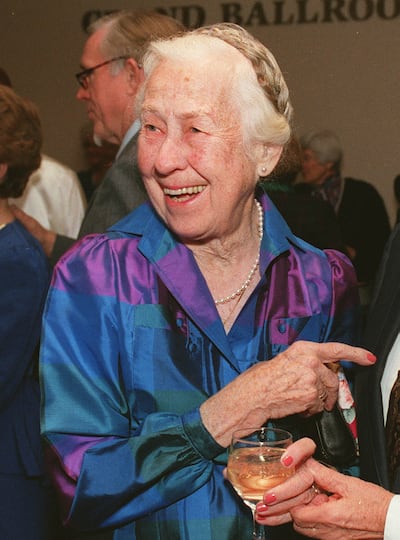
Through the decades, that expansion of political power in the region shaped issues not only relevant to Western states but the entire country. Esther Eggertsen Peterson served as head of the Women’s Bureau in the Department of Labor under President John F. Kennedy, making her the highest-ranking woman in his administration. The Provo, Utah-born director and Brigham Young University graduate was the principal driving force behind the Equal Pay Act of 1963, which outlaws wage discrimination based on sex and requires equal pay for men and women (While the 19th Amendment extended to all women, discriminatory state laws often excluded the participation of Native American, Black and Asian American women until the passage of the Voting Rights Act in 1965). Dolores Huerta, a New Mexico-born labor and civil rights activist, co-founded the United Farm Workers of America in 1962 — the largest farmworker organization in the country. Her work directly secured disability insurance for farmworkers, significantly reduced the use of harmful pesticides in agriculture, and resulted in the California Agricultural Labor Relations Act of 1975, which granted farmers the right to advocate for better wages and safer working conditions.
Yet despite strides both historical and modern, representation of women in higher office is still lacking in the United States. As of 2025, the country ranked 42nd on the global Gender Parity Index, which measures national gender disparities on political, economic and social criteria. There’s never been a female president, despite an estimated 32 women having been nominated to run for the office by their respective parties. In 2021, Kamala Harris, a U.S. senator from California, was the first woman to be sworn in as vice president. And women only really began making strides in the national House or Senate within the last few decades. Pew Research Center found that more than three-quarters of the women to have ever served in either body were elected or appointed within the past 34 years. Utah, for example, received a “D” grade on Represent Women’s Gender Parity Index, despite being home to the first vote cast by a woman in U.S. history. There are quieter, internal obstacles, too. Research from the Brookings Institution found that women are three times as likely as men to consider themselves “not at all qualified” to run for political office, despite data that points to how they often outperform their male counterparts in terms of efficiency and ability to reach across the aisle.
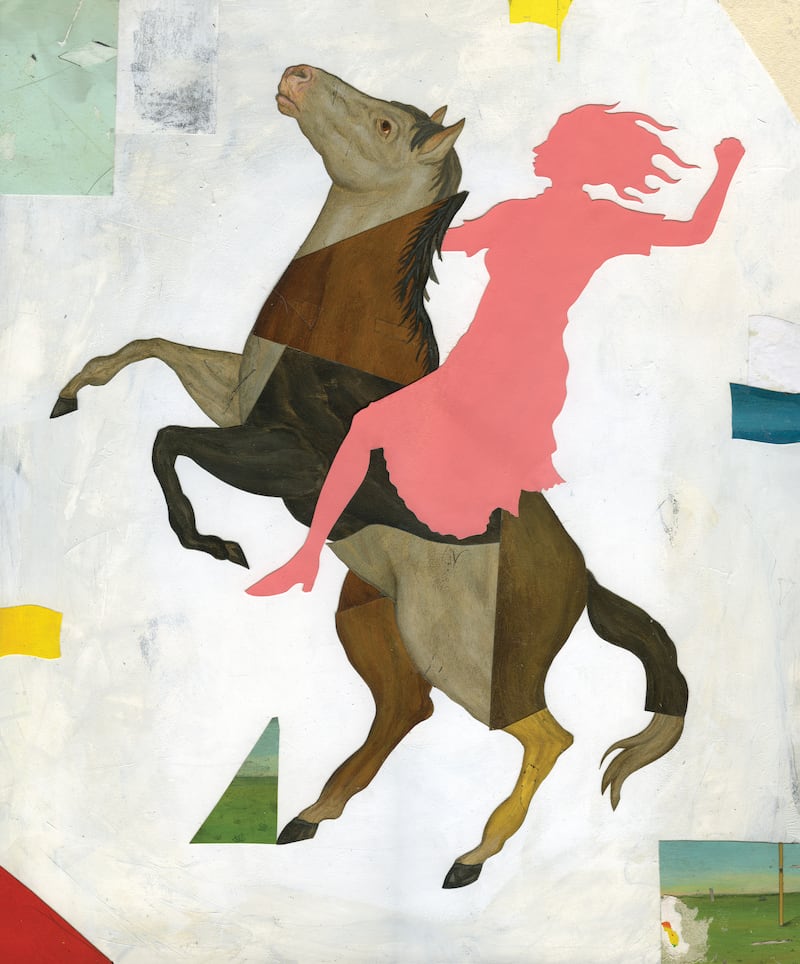
Dittmar admits that Democratic states are more likely to elect women and Democratic women are more likely to run for office. The West, after all, has a concentration of Democratic majority states like Nevada, California, Colorado, New Mexico, Washington and Oregon. But many of the region’s conservatives are following suit, too.
How women lead differently
Rosilicie Ochoa Bogh must have prayed every single day for a month straight. She prayed on her drives around California’s San Bernardino County. She prayed at work as a real estate agent in her city of Yucaipa. She prayed when she got home — with her family and on her own. She prayed because in 2019, the local county party chair had called Ochoa Bogh to ask her a life-changing question. Only, for a while, she had no clue how to answer it.
A Senate seat had become available in the state Legislature, and Ochoa Bogh needed to figure out whether she wanted to fill it. By then, she’d had experience in different forms of leadership: as a teacher, real estate agent, school board member, leader for the Yucaipa Valley Chamber of Commerce. Though she’d never envisioned herself in politics. “When the county chair called, I laughed and said I’m not qualified to run for state Senate,” she says. “(The chair’s) response was, ‘That is typical of a woman’s response. As women, we never think we’re qualified.’”
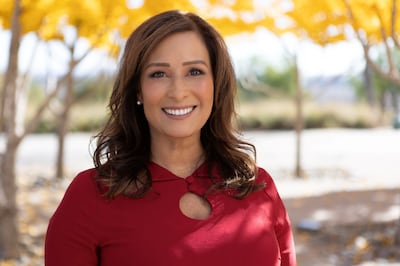
Ochoa Bogh is a daughter of Mexican immigrants. She grew up traveling back and forth between her parents’ country and her own, and had to learn English as a student since it wasn’t her family’s native language. She grew up feeling like an outsider, comparing herself to her classmates and doubting herself in the process. She converted to The Church of Jesus Christ of Latter-day Saints at 22 years old and has let her faith guide her through most of her adult life. So, when she got that fateful call in 2019 asking whether she’d be willing to represent about a million people, she found herself leaning on that guidance more than ever. One morning, she woke up without the heavy pit in her chest and stomach she’d been carrying around for a month. That’s when she knew her answer was yes.
In 2020, Ochoa Bogh became the first Republican Latina elected to the California state Legislature. She was reelected in 2024 to represent her newly drawn 19th Senate District, which has more Democratic than Republican constituents thanks to liberal cities like Palm Springs. Ochoa Bogh is a lifelong Republican but identifies as a bipartisan legislator. Last July, she urged President Donald Trump and her fellow Republicans to consider work permits for essential workers, like farmworkers, living in the country illegally. She’s introduced legislation to enforce penalties for fentanyl-related offenses, increase capital gains exclusions to help first-time buyers afford a home and reduce mobile home evictions so Californians experiencing poverty don’t end up homeless. During the 2023-24 session, she had more bills signed into law than any other Republican in the state Senate; of the 40 she introduced, 14 became law. “My goal … within my district has been to help understand why people think the way that they do,” she says. “How do we have conversations about ideas without vilifying people?”
Most of her legislative actions are in support of stronger schools, lower taxes and affordable housing. The Center for Effective Lawmaking recognized Ochoa Bogh in December as the top-performing Republican in the California state Senate and among the most effective lawmakers statewide for the quality and progress of her bills. Though that efficiency is not unique to Ochoa Bogh. Research from the Center for American Women and Politics has found women politicians tend to be more amenable to meeting halfway and working for solutions regardless of party or personal politics. “We have historically seen women push for more compromise, more cooperation, bringing different voices to the table,” Dittmar says. “They’ve been through too much to come here and get nothing done, so they’re more results-oriented than men.”
Western states were more inclusive early on due in part to necessity. Their governments proved more fluid because they had to be built from scratch.
In Nevada, Catherine Cortez Masto served eight years as Nevada’s attorney general before becoming the state’s senior senator. Most of the law enforcement officials she worked with were men and she was only the second woman to serve in the role. She became the nation’s first attorney general to prosecute violators of loan regulations during her tenure. She created programs to reduce domestic violence and Nevada’s first Senior Protection Unit in the attorney general’s office. Sworn in as a United States senator in 2017, she was the first woman elected to the Senate from Nevada and the first Latina senator in American history. But what placed the registered Democrat most prominently in the national spotlight was her choice to cross partisan lines by voting to end the longest federal government shutdown in history a total of 15 times in November, despite most of her fellow Democrats holding out for a guaranteed extension of the Affordable Care Act.
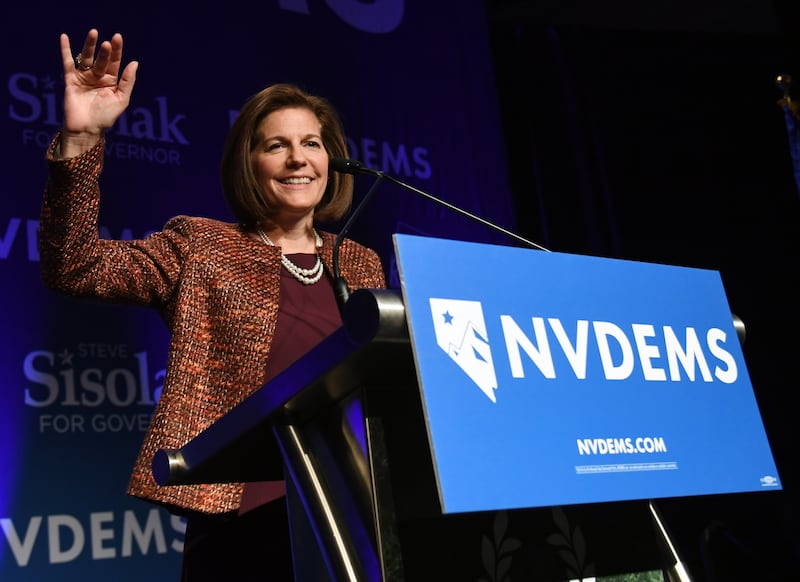
“Women have a tendency more to be problem solvers,” she says. “I voted to keep the government open because I knew it would be costly to shut the government down … and it would hurt hardworking Nevadans and small businesses there.” Though her choice was controversial and contested nationally, it helped save the state an estimated $606 million in lost gross state product and $224 million in lost wages for each month the shutdown lasted.
Research has found women politicians tend to be more amenable to meeting halfway and working for solutions regardless of party or personal politics.
Beyond a solution to polarization and gridlock, placing women in positions of political power increases trust in elections. An American University poll from October found that 83% of voters think institutions that encourage women to run for office are vital to democracy. The same poll found that two-thirds of men under 50 say women are better at solving the nation’s problems. They’re also more widely trusted than men to champion issues like child care and women’s equality.
“It did not take me long after assuming office as state senator to realize that my life experience was very valuable when it came to almost everything, including tax policy,” says Deidre Henderson, Utah’s lieutenant governor. “The way that I thought about things, the way I experienced things, was very different from the way the men in the room experienced things. I’m not saying it was better, it was just different. And having that perspective was critically important. We desperately need more of it.”
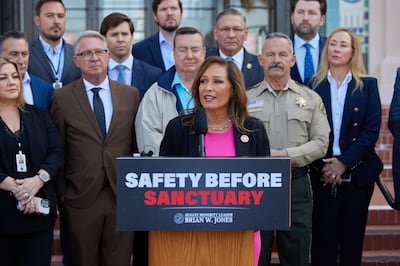
Another report by the Westminster Foundation for Democracy and the Global Institute for Women’s Leadership at King’s College London found that countries where women hold more political power are less likely to wage war or abuse human rights. “It does bring a different perspective to issues,” Ochoa Bogh says. “The ability to walk into other people’s shoes has been immensely helpful in understanding why legislation works and doesn’t work, the circumstances people are living in.”
Obstacles still left to overcome
There were about 100,000 new faces in the crowd, yet Haaland felt at home. That Saturday afternoon last October, she marched behind her handmade campaign float in another ribbon skirt and red moccasins as she made the three-mile trek down the Northern Navajo Fair parade route in Shiprock, New Mexico. She shook hands with young girls in braided pigtails and a 103-year-old grandma in a costume tiara, chatting whenever possible about tribal sovereignty or health care access. She had visited Shiprock as a child when her mom would travel there to work with Native students, which contributed to her familiarity and comfort level. Still, her support there was not guaranteed.
Haaland qualified for the New Mexico ballot within less than 24 hours, and despite the fact that the average donation to her campaign is $31, her campaign for governor has already raised millions in funding. Yet there are moments, like that afternoon in Shiprock, when it’s clear how much hangs in the balance. “It’s scary … to get out and say, ‘I’m running for something,’” Haaland told me. “I’ve done it and I am scared every single time.” Part of that fear is the natural result of committing to a task as vulnerable as campaigning, and part of it is the added land mines of running as a woman. She often thinks back to when she ran for chair of New Mexico’s Democratic Party in 2015 and her opponent kept asking her to drop out of the race and serve as his vice chair instead. He appeared, according to her retelling, under the impression that he’d won before the race was even called. Almost as if the thought of her holding that office were too outlandish to come true.
Dittmar points out that gender biases and stereotypes that have existed long before the women’s suffrage movement still affect women in office today. Namely: that women are weak, emotional, flawed or not assertive enough to lead. That men will be more naturally qualified to deal with matters of security and defense, while women are too sensitive. A majority of women surveyed by Pew in 2023 agreed that major reasons why women remain underrepresented in politics are because they have to prove themselves more than men, face gender discrimination and receive less support from party leadership as well as from voters themselves. For Ochoa Bogh, the state senator in California, it’s not unusual to be moved to tears during a town hall when she hears a constituent’s moving story or lived experience. “The number one criticism that I used to get was that, ‘She’s not up to the job, she cries,’” Ochoa Bogh says. “People are not used to seeing that type of leadership. Males in particular have a really hard time. But it’s interesting because even though it was one of my number one criticisms, there’s a different demographic that really has valued my ability to feel deeply.”
“There are some inherent biases based on gender, which are unnecessary,” says Cortez Masto, the centrist Democrat from Nevada. But when those mental blockades are felt, one need only look to the West, where politicians across local, state and federal offices have proven time and again that leadership can look different without risking efficacy or progress.
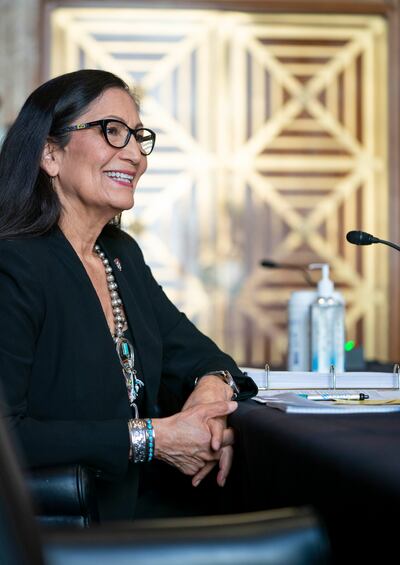
Haaland is no stranger to reflecting on the lives of her ancestors for wisdom on how to navigate life in the public eye. Her grandparents lived without running water and electricity at Laguna Pueblo into the 1970s. Haaland grew up visiting them often, plucking worms off cornstalks harvested from the pueblo fields and watching her grandma prepare food for feasts featuring hundreds of guests at a time. Her grandfather formed an all-Native American baseball team when his white neighbors in Winslow, Arizona, didn’t let him play in local games, only to outperform the players who ostracized him in the first place. She’d earn a nickel for each foul ball she picked up off the field. Those memories had already taught her how to make the most of whatever hand she was dealt. She, like anyone, feels much taller when standing on the shoulders of those who came before her.
At the parade in October, the afternoon sun shone over the fairgrounds, illuminating the nearby eponymous Shiprock, or Tsé Bitʼaʼí, a volcanic formation whose Navajo name translates to “rock with wings.” Haaland walked past families on the parade route, watching mothers with their smiling children, eating candy and cheering on floats. She couldn’t help but think of her own mom. She thought of her quarter century spent working for the Bureau of Indian Education, how she’d been taken to attend a federal Native American boarding school as a child against her own will, just like her own mother had before her. Haaland’s mom grew up in a different world with fewer options. As secretary, she already helped break that cycle. Maybe there was room to aim for more. The least she could do, she thought — for her family and the other families in the lonesome West — was try.
This story appears in the March 2026 issue of Deseret Magazine. Learn more about how to subscribe.