


I never intended to hide behind a tree.
It was Monday, and my family of four awoke late. My six-year-old daughter refused to brush her bird’s-nest hair, while my 10-year-old son frantically searched for his homework. When I finally corralled them into the car, construction turned our 20-minute commute into a 35-minute drive filled with arguing in the back seat. I dropped the kids off late and slumped over the steering wheel, exhausted.
I decided to decompress at a nearby park. Just minutes into my silent stroll, a familiar face caught my eye. Walking toward me was a woman I went to college with 20 years earlier. I liked her, and under different circumstances, I would have waved her down to catch up. But, at this moment, that was the last thing I wanted to do. I had no energy to talk, and a work meeting was quickly approaching. I clambered behind a large tree alongside the path and peered out from behind the pine needles. Watching with dread as the woman approached, I cringed. What exactly am I doing?
By the time I became a married mother of two, my solitude had shrunk to the size of the nine-minute drive between school drop-off and the commuter train to my office.
Well, I was being an introvert. With Latin roots meaning “to turn within,” the word introvert was first applied to psychology by Carl Jung in the 1920s. He coined the terms introvert and extrovert to describe two personality types: those who prefer to focus inward and gain energy from time alone, and those who prefer to focus externally and feel energized by social interaction. In the 1940s, Katharine Cook Briggs and Isabel Briggs Myers used Jung’s theory in their Myers-Briggs Type Indicator test, developed to help people land wartime jobs. Studies have since found key brain differences between introverts and extroverts, from the amount of gray matter in certain areas to the level of activity and blood flow in others. So the two personality types don’t just seem different — they are different.
The problem for us introverts, who comprise between 30 and 50 percent of the U.S. population depending on which survey you cite, is that while introverts and extroverts may be more or less equally represented numerically, our traits are not equally valued or respected.
“Modern educational and professional cultures tend to reward visibility, speed and verbal performance,” Soumia Bardhan, an associate professor of communication at the University of Colorado, Denver, who has written about introverts’ talents and needs, told me. She pointed out that we equate speaking frequently with competence and frame leadership around charisma and social dominance, rather than reflection and restraint. Even in the classroom, children are often graded partly on how often they participate in class discussions.
Despite what mom guilt might say, solitude is not social avoidance — it’s a necessary way to regulate one’s nervous system.
I found myself nodding at Bardhan’s words, much like I did when I read Susan Cain’s 2012 bestseller, “Quiet: The Power of Introversion in a World That Can’t Stop Talking.” In it, Cain describes the favoritism she calls the “extrovert ideal,” which, according to Bardhan, remains as pervasive now as when Cain’s book was published 14 years ago.
“Open offices, constant collaboration, rapid brainstorming, and group-heavy work cultures are designed around the assumption that more interaction is always better,” Bardhan said. “What gets lost is that some forms of intelligence, such as deep reasoning, ethical reflection and slow synthesis of ideas, are quieter and less immediately visible, but not less valuable.”
Yet just as introversion is undervalued, it’s also misunderstood. Introversion is often confused with shyness, which implies a lack of social confidence and fear of judgment. Contrary to popular belief, we introverts can be sociable; we just get drained by a certain amount of interaction and require alone time to recharge. Being reminded of this made me feel like less of an oddball for seeking out solitude behind a conifer.
Finding quiet early
As a child with extroverted parents, I saw a mom and a dad who both worked as physicians treating patients five days a week. On weekends, they played doubles tennis and brought me to brunch with their friends. The annual party my parents hosted on Christmas Eve drew dozens and lasted for hours. Afterward, we cleaned up — only to attend another annual party in a different part of town. I learned at lunches, dinners and parties how to hold a conversation with all sorts of people from an early age. But, looking back now, I realize that after those outings and interactions, I often retreated to my room for peace. I enjoyed that time to myself; spending hours reading, making jewelry and playing my drum set became a comfort to me.
The quiet time I was able to spend by myself, unknowingly recharging in the company of my drums and beaded bracelets, eroded as I came of age. Constant interaction and social assertiveness seemed like prerequisites to get a good job, find a solid friend group and date successfully. When I was single and working in open-floor-plan offices, I recovered from hours of collaboration by sequestering myself alone in my room. By the time I became a married mother of two, my solitude had shrunk to the size of the nine-minute drive between school drop-off and the commuter train to my office in downtown Denver. A lack of silence, solitude and low-stimulation environments sapped my energy.
“(Introverts’) nervous systems respond more strongly to sensory and social input like noise and crowds, and that’s linked to faster fatigue, overload and stress,” Bardhan says. Parenting involves intensive interaction. It’s important for introverts to get enough solitude, quiet and rest to avoid exhaustion and burnout. This became increasingly difficult for me as my children grew older. They became more independent, but also more involved in activities that required my participation: birthday parties, baseball tournaments and spelling bees, an endless parade of loud events filled with crowds and pleasantries and carpools.
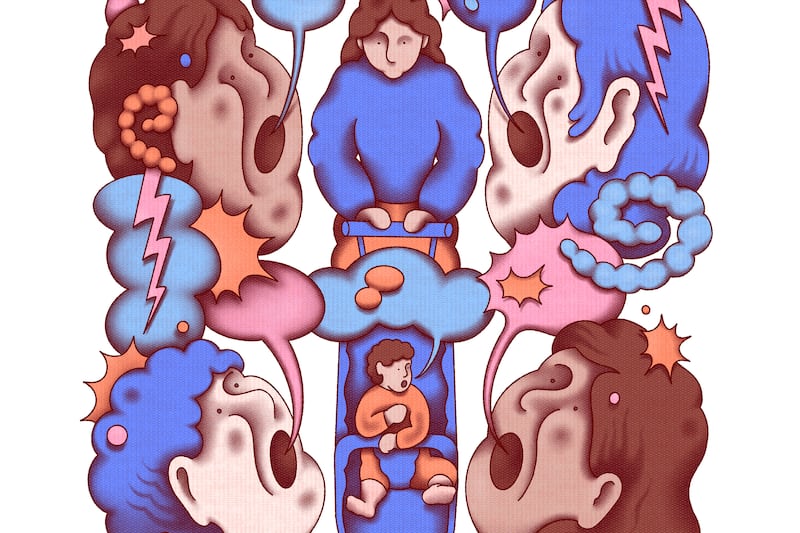
As my kids turned six and 10, two things became clear. First, raising a family with my husband and spending quality time with our children as they grew was more rewarding than anything I had ever done. And second, the level of interaction this entailed left me feeling fatigued, irritable and empty. I snapped at my kids more frequently and always felt guilty afterward. My head ached and my mind raced. I felt restless and tired at the same time.
Bardhan gently reminded me that, despite what mom guilt might say, solitude is not social avoidance — it’s a necessary way to regulate one’s nervous system. Too much stimulation creates stress for the introverted brain, prompting the release of “fight-or-flight” chemicals like cortisol and adrenaline. Having written a book on the health impacts of such stress chemicals, I know that over time they could lead to mental health symptoms like depression and anxiety.
I also know that having alone time makes me a better person when I’m with others. And if I don’t make sure I find that alone time, no one will.
When my daughter was recently invited to a birthday party at a crowded venue, I dropped her off and checked in with the host parents. Then I had brunch alone down the street and returned to socialize with the parents while our children slid down the slides. Because I’d taken time for myself first, I had the energy.
I also know that having alone time makes me a better person when I’m with others. And if I don’t make sure I find that alone time, no one will.
I’ve also become more courageous about defending my boundaries. A friend recently reminded me that I can’t expect the extroverts around me to understand my needs unless I explain them and ask for what I want.
Last fall, either because I eloquently asked for a reprieve or because my husband simply tired of my whining about our jam-packed calendar, he volunteered to drive the kids to their back-to-back soccer practices twice a week.
One Thursday while they were gone, I took myself out for a delicious bowl of borscht at an Eastern European diner and leisurely read a novel in silence. When the kids got home and my daughter wrapped herself around me like a baby orangutan, I was thrilled to cuddle. And when my son launched into a long line of questions, I had the energy to explore the answers with him (“When did the Pilgrims first come here?” “When did the first humans get here, like, on Earth, and where did they live?” “How was the Earth formed?”).
Instead of immediately responding to requests, I have started pausing to consider my bandwidth first. Recently, when my mother texted me to call her after bedtime, I replied: “I need some downtime after getting them to bed. If it’s not an emergency, I’ll call you in the a.m.?”
Bardhan says these kinds of strategies — protecting social boundaries, taking predictable rest periods and normalizing energy differences — are research-proven ways for introverted parents to protect their mental health and conserve energy for talents that are particularly useful in family life: listening, attuning to others’ emotional states and synthesizing complex information.
“The ability to reframe solitude as maintenance, not indulgence, helps prevent depletion,” she told me. Bardhan’s other recommendations include “sensory rest periods” (like 10-minute walks), reducing noise and light (like limiting background television and using earplugs and eye masks to sleep or meditate), and declining social invitations when necessary.
It’s all still a work in progress for me, as I was reminded when I hid behind that pine tree to avoid reconnecting with an old friend. While I tried to be still and fretted over what I would say if she saw me huddled behind the tree bark, she turned onto a different path. I was saved. But now that I think about it, maybe I’ll reach out and invite her to lunch — at a time and place that works for us both.
This story appears in the March 2026 issue of Deseret Magazine. Learn more about how to subscribe.