

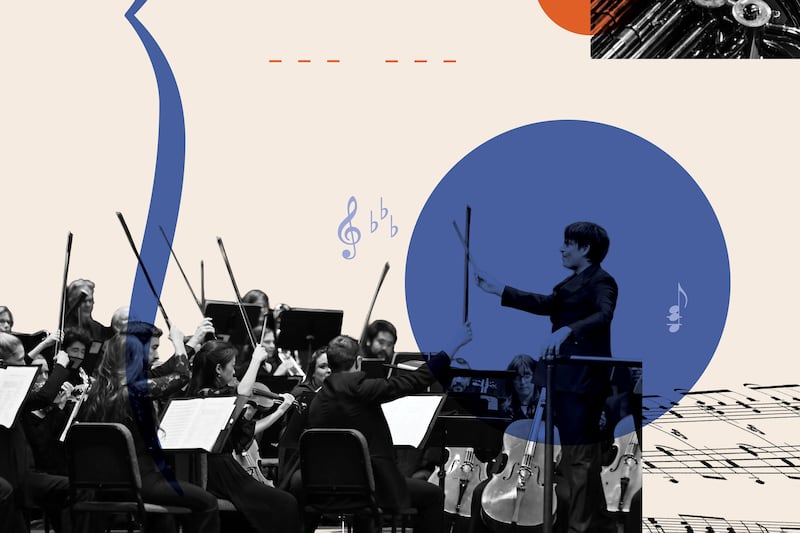

The strings pull the audience through time. Violins climb in a panicked chant, coiling like a rickety staircase that’s about to collapse. Cellos and basses deepen the suspense, layering uneven brushstrokes of gray-blue sound. Onstage, the conductor glows beneath white lights, his tailcoat swinging with each flick of the baton. To his left, the first violins lift their bows at sharp right angles. Somewhere in the sound, I hear the last droplets of a rare desert downpour tapping faintly against the concrete roof of Linda Ronstadt Hall, home of the Tucson Symphony Orchestra.
I sink into my plush crimson seat, one of many in curved rows climbing above the stage where a grand array of musicians clad in black play “Les Offrandes oubliées” (“The Forgotten Offerings”) by French composer Olivier Messiaen. In three movements, it traces Catholic beliefs from The Cross through Sin to the Eucharist, but no theology is required to feel its ache. When a barrage of trumpets bursts through the wall of sound, I jolt upright. Percussion and brass strike, strings whistling across an ominous glissando.
Beside me, Paul Meecham taps his foot just ahead of the beat. Checkered socks peek out from his scuffed dress shoes; his blue tie, patterned with green spirals, hangs loose at the collar. A genial Brit classically trained in piano and violin, Meecham is the Tucson Symphony’s president and CEO. He greets donors and longtime patrons before nearly every performance, but once the lights dim, he’s just another fan in a navy suit, save for the shiny name tag on his lapel. “Brava, brava!” he calls through the applause as the final chord fades out.
Somebody was passionate and crazy enough to come to a desert and create a symphony orchestra.

Meecham lives for the music, but it’s his job to ensure that the orchestra survives. Artistry alone is not enough. When he took the post in 2021, symphonies were struggling across the country, from small towns to major cities. Audiences had lost touch with the art form. Traditional funding models were falling short. The pandemic struck them like a knockout punch. He knew the symphony had to change, to make its work matter to people again. But tonight, as the orchestra sweeps through a suite of French works before a modest but enraptured crowd, the music feels very much alive. “Brava!”
The word symphony comes from the Greek symphonia, which means “sounding together.” Musicians played in groups for millennia before a small ensemble joined the French court around 1570 and evolved into a permanent orchestra called the Vingt-quatre Violons du Roi (The King’s 24 Violins) by 1626. In 1607, Italian composer Claudio Monteverdi first wrote distinct parts for each specific instrument in his opera “L’Orfeo” (1607). Orchestras evolved and grew with the advent of new instruments, more complex compositions and formalized organization into sections like woodwinds and percussion, largely playing for aristocrats and opera houses through the 18th century.
In some cases, the continued rise of merchants and bureaucrats influenced music. In 1743, 16 burghers and nobles in Leipzig, Germany, founded the first civic symphony orchestra: the Gewandhausorchester, or Garment House Orchestra, named for the building where it eventually moved. In 1748, the English city of Oxford built Europe’s first intentional music venue, designed for chamber music. Wolfgang Amadeus Mozart left the employ of a powerful archbishop to work as a freelance artist, sponsored by private individuals. During the Napoleonic wars (1803-1815), when composers like Ludwig van Beethoven channeled political unrest into their scores, amateur concerts flourished.
Beethoven’s work reached America in 1805, when a German conductor performed for a private audience in Charleston, South Carolina. But it was the New York Philharmonic, founded in 1842, that cemented a model for American symphonies, funded by philanthropy. The art form expanded as European immigrants — especially Germans — brought their instruments, teaching methods and repertoire with them. By the late 19th century, grand stateside concert halls were housing orchestras with 80-100 musicians, led by conductors who often became public figures. They even played the works of American composers like John Knowles Paine, Harvard’s first music professor. A night at the symphony was a special event.
The Great Recession further thinned support, shrinking endowments, shortening seasons and pushing orchestras to the brink.
The “Big Five” have set the national standard since the early 1900s: New York, Boston, Philadelphia, Cleveland and Chicago. Their presence helped to foster innovative composers like Charles Ives and Aaron Copland, who incorporated folk and jazz influences to create truly homegrown music. As industrialization followed railroads and resources across the country, orchestras sprouted up, too. There were just 17 before World War I and at least 270 by 1939, according to historian Joseph Horowitz, author of “Classical Music in America: A History of its Rise and Fall.”
Out West, symphonies arose in Seattle (1903), San Francisco (1911), Los Angeles (1919), Portland (1924), Albuquerque (1932) and Denver (1934). The Tucson Symphony began in 1928 as a volunteer ensemble in a high school auditorium under a Belgian conductor. Founded in 1940, the Utah Symphony was transformed when conductor Maurice Abravanel left New York’s Metropolitan Opera in 1947 to make the fledgling group one of the nation’s few full-time orchestras, touring internationally and paying musicians year-round.
That golden age persisted through the Jazz Age, the Big Band Era and the birth of rock ’n’ roll, even as radio and recorded music transformed popular culture. The economy was booming and philanthropies like the Rockefeller Foundation and the Ford Foundation funneled money into grander halls, longer seasons and celebrity soloists. Conductors became stars, shuttling across continents in what became known as the “jet-set maestro” era.
So it was jarring when Leonard Bernstein issued a stark warning in 1980. Speaking before the American Symphony Orchestra League, the former director of the New York Philharmonic — famous for his televised “Young People’s Concerts” and for blending jazz and Broadway styles — cautioned that orchestras could not survive as museums. They had to provide “fertile soil” where new music could grow. “If (the musician) is fenced off, he will stagnate,” Bernstein said. “So will the orchestra. So will the public. So will art.”
A monumental gray box met Meecham in stony silence. The building known then as the Tucson Music Hall is almost foreboding in its modernist severity, with straight lines and thick walls, tucked between a parking garage and a beige office building on the city’s convention center campus. In May 2021, the sun pummeled the spare plaza dotted with palm trees and palo verde. Live music had gone quiet in response to the pandemic, at least indoors, leaving the symphony dependent on federal relief funds. Some employees were furloughed. Others left. That was just one more challenge for the new president, the fourth in five years, but Meecham knew what he was getting into.
He had been managing orchestras for decades, from London to Baltimore, Seattle and Salt Lake City. When he joined the business in the 1990s, crowds were already shrinking, the audience was aging and the culture felt lost, relying on safe, repetitive programming and a revolving door of guest conductors. The rise of the internet only made things worse, offering audiences infinite alternatives and raising up the next generations on streaming and instant entertainment. Many private donors were aging out or redirecting their giving.
The Great Recession further thinned support for classical music, shrinking endowments, shortening seasons and pushing orchestras like Pittsburgh to the brink. Others, like Honolulu and Syracuse, filed for bankruptcy or simply shuttered. Even once-reliable subscription models — concert packages purchased months in advance — faltered. Ticket revenue, which made up more than half of U.S. orchestra income in 1990, fell to roughly a quarter by 2023.
Like Meecham, Carlos Izcaray lived the unraveling. From 2016-24, he was music director of the American Youth Symphony in Los Angeles, founded in 1964 to develop emerging musicians. Long before Covid, the AYS struggled with dwindling donations and disagreements over its identity. Izcaray believes the organization had become siloed, its leadership disconnected from each other and their purpose. He watched in dismay with a rebranding plan in hand as the 60-year-old organization disbanded in 2024. “It’s not just battling about more budget, less budget,” he says. “What’s the mission? How do you implement it?”
Meecham recognized the same questions in Tucson, but he knew he couldn’t answer them alone. So one day he stood on the balcony inside the hall with music director José Luis Gómez, gazing over empty seats. Concrete pillars jutted from stone-lined walls, their wooden borders catching bits of light. The dark, rather minimalist space — built in 1971 — felt hollow. As they prepared for the first in-person season in nearly two years, the pair agreed that the symphony needed to shed its image as distant or elite, and give the people of Tucson reasons to come back. “Without the community finding us, we wouldn’t exist,” Meecham said later. “So I think it’s incumbent upon orchestras to reflect the needs of the communities.”
Or, as Gómez puts it: “The Tucson Symphony has to breathe like Tucson, it has to look like Tucson, it has to sound like Tucson.”
An hour before the concert, the hall hums softly. Early arrivals settle into seats near the front: gray-haired regulars, college students clutching notebooks, a giddy couple on a date. Gómez, a Venezuelan-born Spaniard, paces onstage as he speaks, his dark hair swaying along a clear side part with each gesture. Several rows back, Meecham is hard at work on his phone, but looks up to check in. “I will encourage you to find the poetry in the music,” Gómez tells the audience. “The words are said in notes. The colors are painted in notes.”
Tucson is a colorful city at the eastern edge of the Sonora Desert, surrounded by five arid mountain ranges dotted with saguaro cacti, home to Gila monsters and seven kinds of snakes. A Spanish outpost-turned-Mexican presidio and American border town, the city is conscious of its historical identity, proudly celebrating Día de los Muertos and hosting an international mariachi festival. Murals and casitas pepper the older, narrow streets. Spanish is commonly spoken in certain barrios; 42 percent of the population is Hispanic or Latino.
On the other hand, Tucson is a modern Sun Belt destination city, a sprawling and glimmering grid of strip malls, golf courses and gimmicky restaurants. Its economy is anchored by a major research university, an Air Force base, a nearby Army intelligence center and an array of defense contractors. An annual influx of “snowbird” retirees descends on the city each winter along with overwhelming crowds for the country’s biggest gem expo. So how can anything belong to everybody?
Fittingly, the hall was renamed in 2022 for Linda Ronstadt, a Hispanic icon and beloved daughter of Tucson who won 24 Grammys in her singing career. Each September, the orchestra partners with the Mexican consulate to give a free concert with mariachi music for that country’s Día de la Independencia. And this year, for America’s upcoming 250th anniversary, the symphony presented a national portrait through Tucson’s lens — playing Bernstein’s “West Side Story” alongside works by Duke Ellington, contemporary Hispanic composers and patriotic classics. “We tried to change people’s perceptions of a traditional symphony orchestra,” Meecham says, “by making it more relevant to all of the community, not just some of the community.”
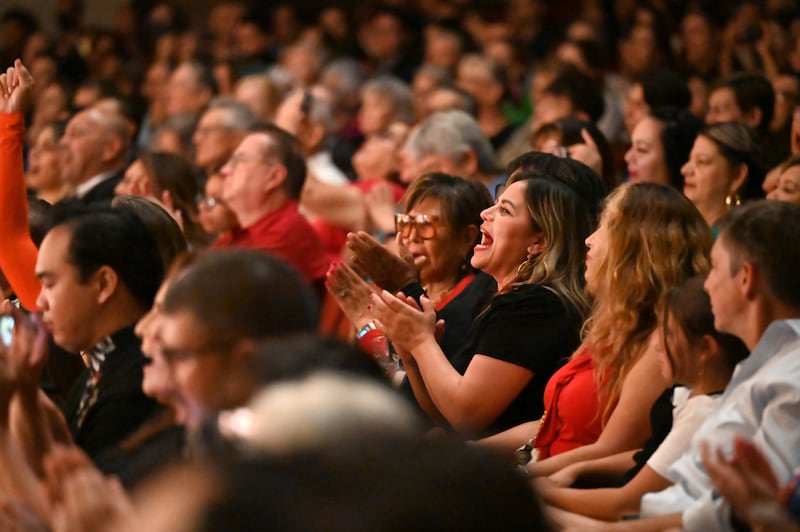
But it’s also imperative to make the symphony welcoming and fun, enlivening a form that people often hear in fragments — film scores, café playlists, elevator rides. So the symphony screens films like “Star Wars” and Chaplin’s “The Gold Rush,” and plays the soundtracks live — with popcorn at intermission. Meecham and Gómez have also launched “Underscore,” a series that explores individual works in depth; hired the first principal pops conductor; and expanded youth outreach, bringing ensembles and composition lessons into classrooms. And the pair have continued holding an informal talk before each concert, less a lecture than an invitation.
If the musician is fenced off, he will stagnate. So will the orchestra. So will the public. So will art.
“We are trying to make the audience experience a little looser,” Meecham says, hoping the broader programming “helps over time to break down our perceptions that we’re kind of a very formal experience where you can’t applaud between movements and you just have to sit and be very quiet.”
Tonight’s program will culminate with Claude Debussy’s “La Mer” (“The Sea”). As a young composer studying in 19th-century Rome, Debussy became fascinated with Japanese art, scouring antique shops for woodblock prints. Years later, he translated one iconic image — Hokusai’s “Great Wave off Kanagawa” — into three symphonic “sketches,” music rooted in tradition yet radical in its rejection of rigid symphonic structure. “We sometimes think that our music … is boring or very academic,” Gómez says. “But they were all experimenting. It’s all about experimenting and discovering things.”
Tucson’s not the only symphony embracing its local identity or trying something new. In Sioux Falls, the South Dakota Symphony’s Lakota Music Project bridges Indigenous and Western traditions. In Florida, where some orchestras have gone dark, the Naples Community Orchestra has hit record attendance with community events and savvy social media outreach. The Arkansas Symphony’s membership model — unlimited concerts for a monthly fee — has outperformed traditional subscriptions. A regional orchestra’s smaller scale can be liberating, with fewer legacy constraints, seats to fill or donors to please, and a lower threshold to keep the lights on.
Between numbers, Meecham leans over and whispers, his British accent thick with delight:
“Now the sea, in land-locked Arizona.” Debussy’s piece unfurls like dawn breaking over water. Violins and violas shimmer, timpani rolling behind them like an approaching tide. In the second sketch, two flutes and a piccolo trade playful phrases, like children splashing at the shore. By the final movement, the full ensemble erupts into a stormy exchange between wind and sea. Brass roars, cymbals crash — surf breaking over rock. I can’t name every instrument, but I can feel the ocean.
Gómez says that orchestras show how society can work together in hard times. Tonight, that feels undeniable. For two hours, an ensemble moves in synchrony; no single instrument can be removed without changing the whole. Hundreds of strangers breathe in tandem, listening as one, each unmistakably moved in their own way. No wonder he’s an optimist. “Somebody was passionate and crazy enough to come to a desert and create a symphony orchestra,” Gómez says. “Am I worried? No, I am excited about what is going to happen in the next hundred years.”
Outside, I feel the vertigo that great art leaves behind — unsure where I’ve been, certain I couldn’t have been anywhere else. The air is crisp, freshly washed by rain. Musicians chatter as they load their instruments into trunks. Slightly disoriented, I circle the convention center and emerge on the far side of downtown, across from an older neighborhood of beige adobe houses with chipped paint. Above me, a wide sky, studded with plenty of stars.
This story appears in the April 2026 issue of Deseret Magazine. Learn more about how to subscribe.