

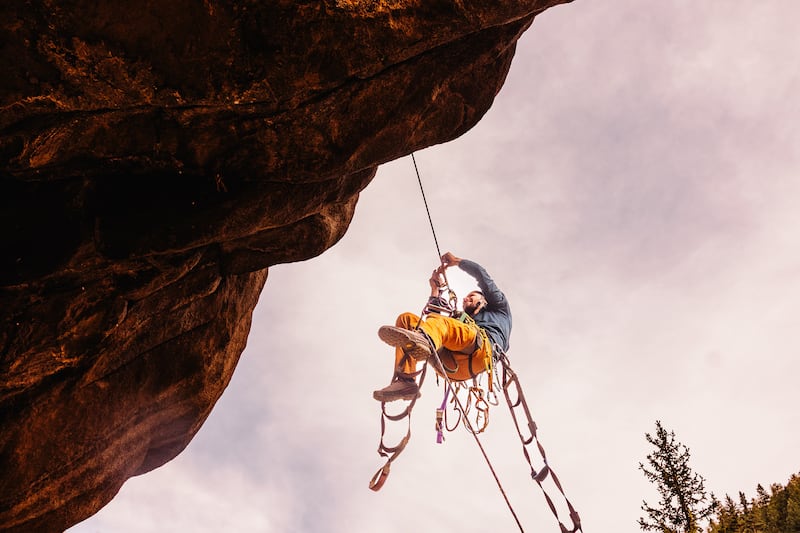

Only when the rope went slack did Donald Bearie know something was wrong. He was less than halfway down a climbing route in South Platte, Colorado, paused mid-rappel to clean a piece of gear. The rock blurred into bits of blue sky. For an instant, it felt like he was hovering. But he was falling.
“Take!” he yelled — a request in most climbing situations, now a futile plea to get some, any, tension on the rope.
He hit a ledge first. Both heels shattered. He ricocheted off the rock, instinctively jerking his shoulder up to shield his head. When his back struck the ground, something deep in his spine cracked. Dust rose around him.
“Everything’s broken,” he whispered.
Aaron Sprengeler, on the other end of the rope, stood frozen, tears streaking his face. Bearie tried to stand. His legs buckled.
The route ahead
That September morning in 2021 had started like dozens before. Bearie, 29, packed up his favorite climbing shoes — still dusty from the weekend before — and headed from his house in Denver to the climbing area about an hour away. An audio engineer working long hours at a recording studio in the city, he looked forward to Saturdays spent outside.
A self-described “Gumby,” he’d been climbing barely a year. Instead of starting in gyms or on bolted sport routes, he’d jumped straight into traditional, or “trad,” climbing, which requires climbers to place their own anchors to protect from falls instead of relying on permanent bolts.
His usual partners were busy on the day of the accident, so he texted Lauren Bourguignon, his ex-girlfriend, who was now dating Sprengeler, a longtime gym instructor. He also invited his new girlfriend, who’d never climbed outdoors.
Outdoor recreation’s culture has long rested on the doctrine of assumed risk: You accept the inherent danger of what you’re doing.
The group had met at a dusty Interstate 70 pullout before heading into the Front Range. Dense pine forests thinned, revealing granite walls as Highway 285 wound deeper into the mountains.
By the time they hit Pine Valley Road, cell service had disappeared. Sprengeler picked the route. Classic Dihedral, a 5.7 he’d done over half a dozen times. The route glowed in the afternoon sun, 160 feet of granite split by a crack running up the right like a crease in an open book.
The wall looked intimidating.
“Hey man, what do I need?” Bearie asked, tightening his helmet.
“Just the anchor and some cams,” Sprengeler replied. Then, almost to himself, he added that he wished they’d brought an 80-meter rope.
Bearie laughed. He didn’t ask why. He grabbed the 70-meter rope from Sprengeler and tied a figure eight through his harness. No one tied a stopper knot in the rope’s tail, a simple safeguard that prevents the rope from feeding entirely through the belay device. An hour later, that’s exactly what happened.
At the base of the route, Bearie lay crumpled but alive. Sprengeler sprinted toward the road until he found cell service, returning with rescue crews and a sheriff. When a helicopter circled overhead, Bearie refused an airlift — he’d recently canceled his insurance. The EMTs got him onto a stretcher and into an ambulance instead.
“What’s wrong?” Bearie asked a pale medic in the front seat. “Please, just tell me what’s going on.”
The man hesitated. He was a climber too and had done that route himself. Most people didn’t survive falls like this, he told Bearie. And the “golden hour,” the critical window to treat internal bleeding, was ticking down.
Bearie would survive, but as he spent days in the hospital — recovering from surgery with casts on all four limbs and in a back brace, unable even to use the bathroom — he replayed the day on a loop.
Each tiny oversight, pieced into the worst day of his life. How had he forgotten the knot? How had Sprengeler, who knew the route, not realized the rope was too short?
A growing frontier
Over the past two decades, America’s backcountry has become a playground for all. According to the Outdoor Industry Association’s 2025 trends report, more than 181 million people, nearly 60 percent of the population, participate in some form of outdoor recreation. Climbing, skiing, hiking and camping have seen record growth for nine straight years. The benefits are real: better health, lower stress. But safety is never guaranteed.
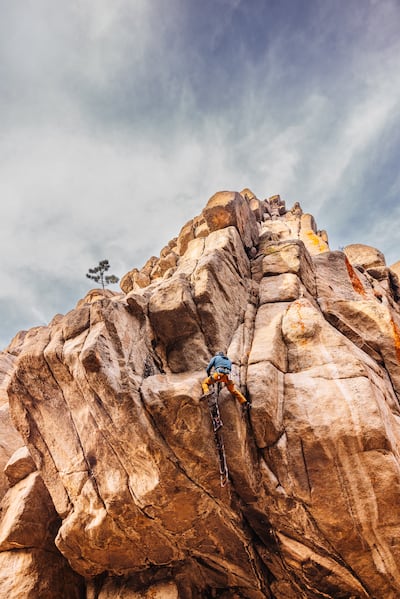
Outdoor recreation’s culture has long rested on the doctrine of assumed risk: You accept the inherent danger of what you’re doing. Yet, with more entry points into the backcountry and myriad ways to be educated about how to stay safe out there, it’s increasingly unclear who fully understands those risks. Some learn from certified guides. Others from YouTube, friends or trial and error.
“At a young age, we think that nothing can go wrong,” says Ron Watters, a lifelong recreator and former director of outdoor education at Idaho State University. “With time and experience, you learn that there are dragons out there, and you need to watch out for them.”
When a group ventures into remote terrain — into a canyon or steep slopes, down a whitewater river, up a mountain — each person brings their own experience and comfort with risk. In the backcountry, those differences can collide in unpredictable ways. A single misjudgment or lapse in communication can determine whether everyone gets home safely. Sometimes, accidents are unavoidable. But usually, they are the chain reactions of simple choices.
On February 15, a group of 11 skiers and four guides set out on a three-day backcountry trip to the Frog Lake huts near Lake Tahoe’s Castle Peak, despite forecasts of a major storm and an avalanche watch issued that morning by the Sierra Avalanche Center. Blackbird Mountain Guides assured participants that it would “manage the risks” and terrain navigation, as reported by The Associated Press. Two days later, as the group rushed back ahead of worsening conditions, an avalanche above 8,000 feet struck, killing nine people — the deadliest avalanche since 1981 in the United States.
Ever since the accident, the backcountry community, the families of those lost and even investigators have been trying to figure out what went wrong.
This kind of counterfactual thinking — trying to figure out how an outcome could have been different if different choices were made — can reveal a lot about an accident. In the weeks after Bearie’s fall, he was still trying to figure out where it went wrong. Certain details surfaced in his mind — Sprengeler distracted at the belay while arguing with another climber in their group, the rope brushing the ground during the climb. But it can also lay the groundwork for blame.
People need to understand that their lives are in their hands.
Online, Sprengeler posted that Bearie had fallen about 25 feet, blaming an untied knot and rushed safety checks. But climbers who returned to the route to retrieve Sprengeler’s gear estimated the fall much higher, at least 75 feet. According to guidebooks, Classic Dihedral requires two 50-meter ropes for descent. A knot would’ve stopped the fall, but a 70-meter rope was always too short.
He never saw Sprengeler, who didn’t respond to requests for comment, again. A month later, they had a brief phone call where he apologized, the closest thing to closure Bearie would get. Back home, his mom and brother moved from Michigan to help him navigate daily life, taking shifts with his roommate to carry his wheelchair upstairs and help him shower. He didn’t work for three months.
But Bearie never considered suing. He knew mistakes were made. But he had agreed to that climb. He hadn’t tied the knot. He hadn’t questioned the rope. He may have been the Gumby, but he understood the risks.
Fault lines
Despite America’s litigious reputation, there are few cases of backcountry partners suing one another after an accident. But the line between what’s an accident and what’s negligence is being drawn. In 2025, a British climber sued his partner for $1.3 million, after a fall left him with a broken neck and the possibility of double-leg amputation, claiming the belayer let go of the rope. This past February, an Austrian court convicted a mountaineer of gross negligent manslaughter after he abandoned his girlfriend on Austria’s highest peak — she died alone less than 200 feet from the summit — sentencing him to five months in jail and fining him around $11,000.
In the United States, lawsuits typically target organizations — ski resorts, outfitters, climbing gyms — not individuals. After the Lake Tahoe avalanche in February, the Nevada County Sheriff’s Office and California’s workplace safety agency opened investigations into whether criminal negligence was involved and why Blackbird Mountain Guides proceeded with the trip despite recognizing the hazards. Although participants likely signed liability waivers, those agreements protect a company only from ordinary negligence, not gross negligence — a distinction that hinges on whether or not the company consciously and recklessly disregarded the likely harms of their actions.
Others have been held at fault for accidents that have led to deaths in the outdoors. In Austria, for instance, prosecutors identified nine separate mistakes made by the amateur climber that led to his girlfriend’s death — the most serious being his decision to take her on an alpine route the court determined was beyond her ability. But determining ability is somewhat of an abstract concept in the outdoors, when often you only learn that you are capable of something if you make it out safely.
Despite the squishy nature of liability in the outdoors, as participation grows, some Western states have determined it best to create new regulations and pass laws that shield against certain negligence claims before litigation takes precedence.
In Oregon, new laws have restored the legal power of liability waivers for ski areas, gyms and outfitters, allowing them to protect against lawsuits for “ordinary negligence,” and defined which activities qualify for protection on public and private land. Idaho’s SB1051, passed in March 2025, limits how or if people can sue licensed guides or outfitters, even if they’re harmed by negligent, reckless or intentional conduct. Bill sponsor and Idaho Republican state Sen. Todd Lakey has said that “we do these things in places or in ways that are inherently dangerous. But frankly, that’s part of the fun.”
Utah’s laws recognize the “inherent risks” of certain activities, and have recently expanded the rights for outfitters and guides to be protected by liability waivers, although, generally, the state operates under a modified comparative negligence rule — meaning that if a plaintiff is determined to be 50 percent or more responsible for their own injury by the courts, they cannot recover damages.
Most of the new legislation in the West minimizes the opportunity for personal injury or wrongful death lawsuits, because, can you regulate risk in an activity built on it? Many, including Bearie, doubt it.
“The only person that can keep yourself safe is yourself,” he says. “That’s the accountability you’re taking every time you go out.”
Beyond blame
Pete Takeda has spent much of his life studying what goes wrong in the mountains. In 2009, he traveled to China to search for his friend Jonny Copp after an avalanche swept him away on Mount Edgar, a 21,713-foot peak summited only three times. By then, Takeda had nearly three decades of climbing experience from the Andes to the Himalayas. He and Copp had survived close calls before together, as partners. But this time, Copp didn’t come home alive. Takeda and five other American climbers recovered his body from the debris and brought him back to Colorado.
More than a decade later, in 2021, Takeda became editor of the American Alpine Club’s annual “Accidents in North American Climbing” report, documenting serious incidents since 1948 to identify patterns that lead to accidents. Now overseeing the annual publication, he collects reports and firsthand accounts, traveling to big walls and mountain ranges to understand what can go wrong, and how to avoid making similar mistakes. Today, he says, the leading cause of accidents isn’t equipment failure. It’s inattention.
He’s watched as outdoor sports have grown in popularity since the 1980s and ’90s, when he first started. Now, he says, participating in outdoor sports can resemble “an amusement park” — social, accessible and commercial. People can join at any level without fully grasping the stakes. When things go wrong, blame is easier than sitting with your own faults. Takeda says finger-pointing does little to prevent the next accident. Careful reporting and pattern recognition matter far more.
Others have been held at fault for accidents that have led to deaths in the outdoors. But can you regulate risk in an activity built on it?
The goal isn’t to eliminate risk. It’s to confront what Takeda calls the outdoors’ central paradox: pushing our limits while recognizing how thin the margin for error truly is, before an accident forces that lesson.
“People need to understand that their lives are in their hands,” he says.
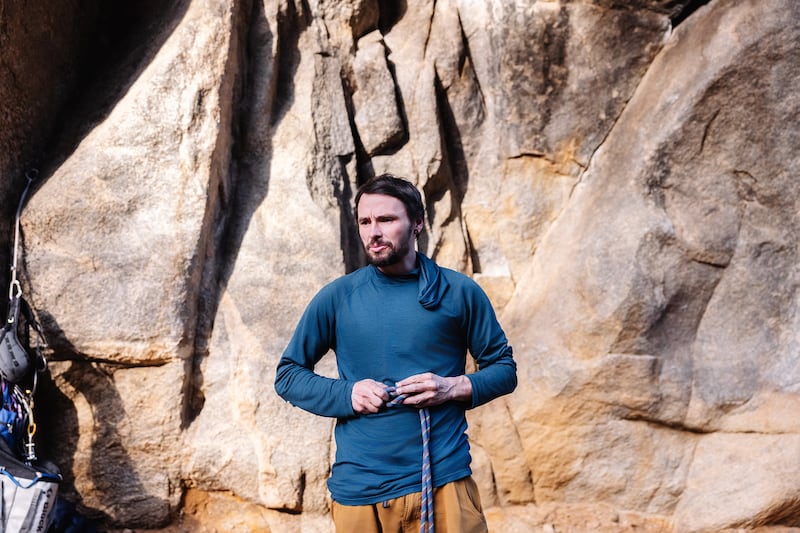
Some lessons crystallize only in the shadow of death. Bearie remained conscious through his rescue. His mind flickered through broken reels of memory. Growing up in Grand Rapids. Road trips with friends. Days spent with his brother. Every route he had ever tied into.
“That 45 minutes is the reason why I climb now,” he says. “Although it could’ve been the end of everything, it also showed me that life’s precious. You need to live it while you have the chance.”
Six months after the accident, he returned to climbing. But his mindset has fundamentally changed.
He reads accident reports. He triple-checks knots. He’s overprepared, sometimes overly communicative, and never hesitates to ask for clarification when uncertain about a route. Above all, he chooses partners carefully, going out with people he trusts on and off the rope.
In December 2024, more than three years after the fall, he returned to Classic Dihedral with his roommate to finish the route. The sky was the same deep blue. The slab smelled of pine sap and sun-warmed dust. But it no longer loomed so large. This time, they brought two ropes.
This story appears in the May 2026 issue of Deseret Magazine. Learn more about how to subscribe.