

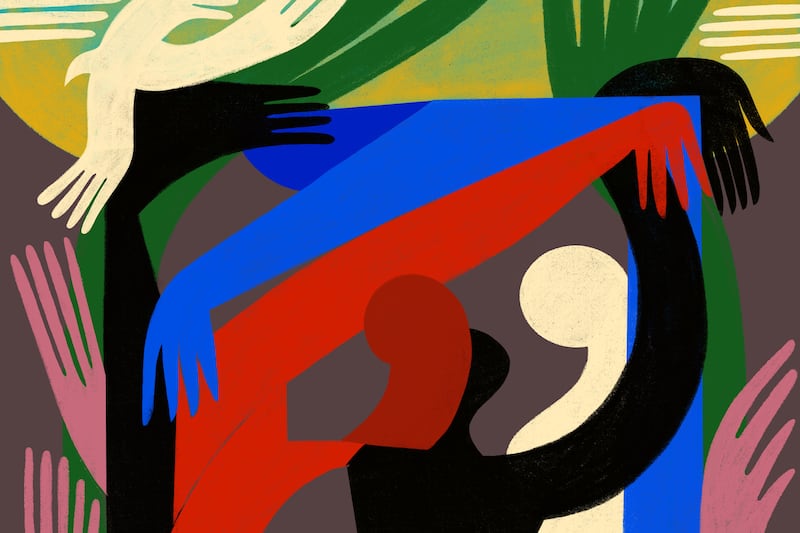
Wendell Berry’s 1980 essay “Family Work” is a short meditation on the meaning of home, its disintegration under the pressures of modernity, and how it might, to some degree at least, be restored. Like so much of Berry’s work, it locates the center point of human society in the home, and explains many of the failures of contemporary Western — specifically American — society as a neglect of that truth. The home, to Berry, is the place where the real stuff of life happens, or should: the coming-together of man and woman in partnership; the passing-down of skills and stories from elders; the raising and educating of children; the growing, cooking, storing and eating of food; the learning of practical skills, from construction to repair, tool-making to sewing; the conjuration of story and song around the fire.
Universally, across the world and across cultures, the family and the home, however they were quite constituted, have always been the heart and root of culture. It follows, therefore, that what I call the Machine — the technological capitalism that is hollowing out humanity — must uproot both in order that culture may be destroyed and replaced with a marketplace in which we can buy and sell products, identities and ideologies while our ground source heat pumps maintain a constant and inoffensive temperature around us. Self-sufficient people, skilled people, independent people, thinking people: These are anathema. The home must go, so that the Machine might live.
In my lifetime, in my part of the world in the U.K., the notion and meaning of “home” has steadily crumbled under this external pressure until it is little more than a word. In a Machine anticulture, the home is a dormitory, probably owned by a landlord or a bank, in which two or more people of varying ages and degrees of biological relationship sleep when they’re not out being employed by a corporation, or educated by the state in preparation for being employed by a corporation. The home’s needs are met through pushing buttons, swiping screens or buying‑in everything from food to furniture; for who has time for anything else, or has been taught the skills to do otherwise? Phones long ago replaced hearth fires.
Handily, a phone, unlike a fire, can be kept under the pillow in case something urgent happens elsewhere while we sleep. We wouldn’t want to miss anything. Even back in 1980, Berry recognized that the home had become an “ideal” rather than a practical reality — and it had become an ideal precisely because the reality had been placed out of reach for many. “I do think that the ideal is more difficult now than it was,” he writes. “We are trying to uphold it now mainly by will, without much help from necessity, and with no help at all from custom and public value. For most people now do seem to think that family life and family work are unnecessary, and this thought has been institutionalized in our economy and in our public values. Never before has private life been so preyed upon by public life.”
What killed the home? Three things, said Berry back then: cars, mass media and public education. The first — “automobiles and several decades of supposedly cheap fuel” — meant that both work and leisure could, for the first time in history, happen a long way from home. The second — “TV and other media” — have, since the mid-20th century, “learned to suggest with increasing subtlety and callousness — especially, and most wickedly, to children — that it is better to consume than to produce, to buy than to grow or to make, to ‘go out’ than to stay home. If you have a TV, your children will be subjected almost from the cradle to an overwhelming insinuation that all worth experiencing is somewhere else and that all worth having must be bought.” It’s sweet how old-fashioned those sentences seem now. Bittersweet, rather.
Self-sufficient people, skilled people, independent people, thinking people: these are anathema.
Finally, says Berry, the school system — a machine of its own — is designed “to keep children away from the home as much as possible. Parents want their children kept out of their hair; education is merely a by‑product, not overly prized.” Much public education, says Berry, is more like “a form of incarceration.” Schools exist to train children to fit into the Machine world being built for them, to inculcate and normalize its ethics and goals, and to prepare children for a life serving the Machine’s needs.
What could we add to this list now? The triumph of supermarkets, for one, and the whole panoply of long-distance shopping and global supply chains that go along with them. Back in 1980 it wasn’t common to buy avocados in winter in the Northern Hemisphere, let alone endless streams of screen-based gadgets put together by slave labor in China. It wasn’t common either to ship the resulting waste to Turkey or West Africa, where the poor would sift through it for pennies. It’s not only the homes of Western consumers that are devastated by the global supply chain of the Machine.
We could add “careers,” too, and perhaps this is the main culprit. What the Luddites called the “factory system” (we should maybe call it the “office system” now that all the factories have been shipped off to China) was the main reason that the home was broken into in the first place. The premodern home was, as few homes are today, a workplace.
When work left home
The Luddites were handloom weavers running literal cottage industries, and their rebellion against the rise of industrial capitalism was a rebellion in defense of the home as a place of both work and domesticity. That work was shared by men and women, who would each have their domestic spheres of influence whatever the particular business of the home was.
In this sense, there is a case to be made that the premodern woman, working in her home with her husband and family, had more agency and power — in that sphere at least — than her contemporary counterpart whose life is directed from outside the home by distant commercial interests.
Certainly the feminist movement, by accident or design, has either been hijacked by or has morphed into Machine capitalism. The “liberation” of women has often translated into the separation of women from their self-sufficiency, as men were separated before them, and their embedding instead into the world of commerce, whether they want it or not. Today’s “liberated” woman is liberated from her home and children, who will be looked after by a paid stranger while she is out adding numbers to the gross national product like the men were before. “Freedom,” the highest prize, is always to be sought and won away from home, family and place.
My point is not that women should get back into the kitchen: it is that we all should, and into the other rooms of the home too. Machine modernity prized the men away from the home first, as the Industrial Revolution broke their cottage industries and swept them into the factories and mines, where their brute strength could be useful to the Machine.
Later, the women, who had been mostly left to tend the home single-handedly, were subject to the same “liberation,” which was sold to them as a blow struck against inequality. Perhaps it was, but it was also a blow struck against the home, for both sexes. In this context, the accelerating attack on traditional family structures, “gender roles” and more recently gender and biology themselves — while presented as yet more liberation from the tyranny of both tradition and biology — can also be seen as propaganda in the interests of the Machine. Making a home requires both men and women to set their own desires below the needs of the wider family — but this kind of sacrifice does not feed the monster. Only by unmooring the human being from his or her roots in community and place can the emancipated individual consumer and self-creator be born. Only by promoting the fulfilment of individual desire as the meaning of a human life can the selflessness that we once prized as a cultural ideal be transmuted into the selfishness that the Machine needs to thrive.
I thought about this most recently when I came across a BBC story about “the limitations of motherhood.” Here we met the screenwriter of a new TV show, “The Baby,” who explained how “excited” she was “about the possibility of exploding cultural ideals around motherhood” in her work. A true child of the culture of inversion, she explained how the traditional way of thinking about motherhood “reinforces the idea that ‘the mother’ is cis, female, straight, middle-class, white, caring and nurturing.”
The job of writers like her was to “explode” such outdated notions. Caring, nurturing mothers? Female mothers? Perish the thought. Could it be, after all, that motherhood itself is problematic?
It is, of course. To the Machine, biology and family and home and place and anything at all with borders and limits always will be. Reading that article took me back to the days when I had a TV and found myself watching an episode of the British current affairs blatherfest “Newsnight,” also courtesy of the BBC. Some talking head or other was arguing that the government should give all women the “right” — which sounded more like a veiled obligation — to put their newborn children into paid child care at just six weeks old and get “back to work” to help “grow the economy.” What the children might grow up to feel about this was never considered. Nor was the notion that any mother might be horrified at the thought. Liberation and profit, again, were proving a seamless fit.
Maybe this is all misplaced nostalgia; or at least, the shutting of the stable door long after the horse has been turned into dogmeat. Perhaps people leave homes, or don’t make them, because they just don’t want them much anymore. Maybe we are all loving our liberation.
When I was a teenager, I certainly wanted to escape my family and its values — as we mostly do — and I did in the end. But I suppose I always assumed there would be something to come back to. That the act of rebellion, of leaving, would not somehow diminish or demolish the thing being rebelled against. That I, in my turn, would grow up to be the thing that was pushed out of the way so that the world could be opened up before the young.
But I wonder if we can make that assumption now. I wonder especially if young people can. How does it feel to grow up in a society whose young can barely afford anywhere to live, let alone dream of owning a family home? In a world in which mothers should not be assumed to be female, and “chestfeeding” is something that daddy can do too? Among the manic promotion of radical individualism, with greed and lust and pride not warned against but sponsored? With a generational fear of the future which leads increasing numbers to not want families at all? With everything pointing, always, toward movement away, toward not looking back, toward progress?
We can begin to regain our footing in the place we all came from. The home can be a friction against the machine. If this is a war, it is long past time to begin fighting back.
The loss of the security of a home is, in some way, the loss of the heart of things, and the most local and personal manifestation of triumph of the Machine. But it is also potentially the most reversible. The war against home manifests on the human scale, which means we can reverse it — at least to some degree — under our own steam. In these times, any blow struck for the survival or the revival of the home and the family is an act of resistance and of rebuilding.
Back in 1980, Wendell Berry ended his essay by suggesting some actions that could be taken in this direction. He suggested that we should “try to make our homes centres of attention and interest,” to make them as productive and nurturing as we can. Once you rid yourself of the propaganda of the corporate media-entertainment complex (“a vacuum line, pumping life and meaning out of the household”), you will see new possibilities begin to open up. You will see, in Berry’s words, that “no life and no place is destitute; all have possibilities of productivity and pleasure, rest and work, solitude and conviviality that belong particularly to themselves,” whether in the country, the city or the suburb. “All that is necessary,” he suggests, is “the time and the inner quietness to look for them.”
The “all” in that sentence is doing quite a lot of work — more than ever, perhaps, 40 years on. Where is time and inner quietness to be found now? It is hard; but perhaps it always was. Even so, it is worth searching out. Home work is, perhaps, the most important work of all, and it will certainly teach you things. Since we moved to our home eight years ago, I’ve learned a whole suite of new skills, from construction to tree planting, chicken-keeping to breadmaking, hedging to unblocking drains.
Rethinking freedom
Home-making, it turns out, is not something to flee from in pursuit of freedom, as I wanted to do when I was younger. It is a skill, or a whole set of them: a set I have come to value maybe above anything else I do. I am still not very good at it; but even so I feel, on my best days, that I could walk with some of my ancestors and be recognized by them as a fully qualified human being. Maybe this will turn out to be my greatest achievement, in the end.
Back in the day, John Michell concluded that the loss of the fireplace from the heart of the home had driven society mad without it quite knowing. “We knocked the center out of it,” he wrote, “and ever since we have been fumbling around looking for it, mistaking our own or other people’s obsessions for the real thing.” The Machine’s war against home knocks the center out of our lives in the same way. It throws us all off balance — but we can begin to regain our footing in the place we all came from. The home can be a friction against the Machine. If this is a war, it is long past time to begin fighting back. I recommend starting with the TV, and working out from there. You might be surprised what emerges.
Excerpted from “Against the Machine: On the Unmaking of Humanity” by Paul Kingsnorth. Copyright © 2025 Paul Kingsnorth. Printed with permission of publisher, Thesis, an imprint of Penguin Random House. All rights reserved.
This story appears in the May 2026 issue of Deseret Magazine. Learn more about how to subscribe.