

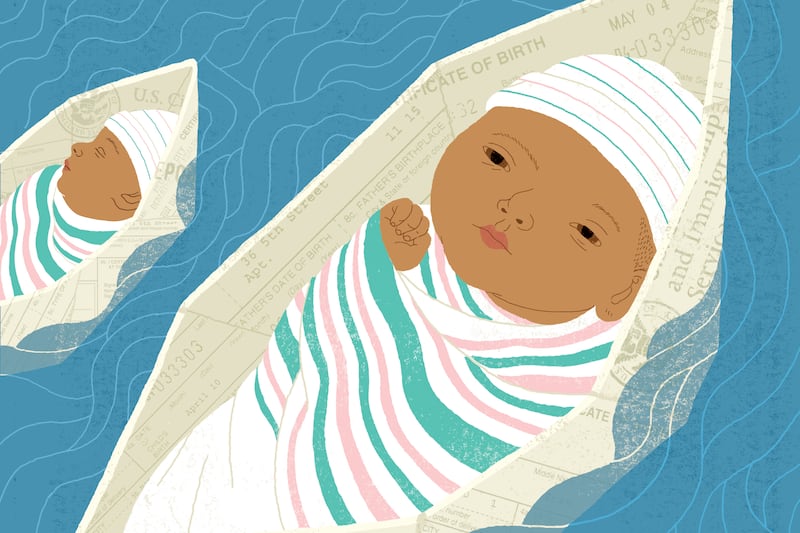

Within hours after being sworn into office on January 20, 2025, President Donald Trump sat behind the Resolute Desk in the White House to sign 26 executive orders — more than any other president on their first day. The directives ranged from tackling inflation to pausing the federal ban on TikTok. One in particular, an order to end birthright citizenship as we know it in the United States, prompted immediate backlash from around the world. Largely because it sought to change a right enshrined in the Constitution and upheld by courts for more than a century.
“Birthright,” Trump said as he readied to sign the document. “That’s a big one.”
“What about that one in the courts?” a reporter in the room asked. “That one is likely to be challenged.”
“Could be,” the president replied, still scribbling his signature with a black Sharpie. “I think we have good grounds, but you could be right. I mean, you’ll find out.”
There’s been some chatter at various times about whether birthright citizenship makes sense. But no president has sought to restrict it.

Not even two hours after the ink dried, immigrant rights activists in New Hampshire challenged the order through a lawsuit. The next day, attorneys general from 22 states sued to block it. Opponents decry the president’s move as inhumane and in direct violation of the 14th Amendment, which has legally granted citizenship to all persons born or naturalized in the U.S. since 1868. Proponents say ending so-called birthright citizenship would decrease illegal immigration rates, limit “birth tourism” and protect the value of American citizenship.
Courts have interpreted birthright citizenship in the Constitution to mean that those born in the United States are citizens, regardless of whether their parents are citizens. Trump’s executive order would effectively change that to mean a baby born stateside would not have American citizenship if the father is not a citizen or legal permanent resident (also known as a green card holder) and the mother is undocumented or has legal temporary status.
While it’s not the first time the principle of birthright citizenship has faced scrutiny, the current legal battle marks the most ambitious attempt yet to redefine it. “There’s been some chatter at various times about whether birthright citizenship makes sense. But no president has sought to restrict it,” says Kevin R. Johnson, a professor of law and director of the Aoki Center for Critical Race and Nation Studies at the University of California, Davis. “It’s quite extraordinary.”
It’s a new world. It’s the same Constitution.
At least six federal courts thus far have sided with opponents to Trump’s order. On April 1, as Trump sat on the first row of the public seating area of the Supreme Court — the first time a sitting president has attended a high court hearing — the justices heard oral arguments for Trump v. Barbara, a nationwide class action lawsuit backed by the American Civil Liberties Union that has blocked the order from taking effect anywhere in the country. A ruling is expected late June or early July — a decision that could have seismic ramifications. It could leave countless children stateless, unable to access federal programs or perform civic duties. It could complicate obtaining proof of citizenship and giving birth for immigrants and native-born citizens alike. “If somehow the court comes up with a way of avoiding the clear constitutional rule, then all bets are off in terms of any kind of immigration action by the president or Congress,” Johnson says. “If immigrant rights advocates lose this, they’re gonna have a hard time winning anything.”
For both sides, the stakes go beyond the ongoing immigration debate and contest to build up or break down obstacles to citizenship. The laws that define what it is to be American could be amended. And in a nation built by immigration, that leaves any sense of identity in flux.
Framing the stakes
Amanda Frost didn’t waste much time arguing legalities. The University of Virginia law professor summarized the precedent for birthright citizenship before the Senate Judiciary Subcommittee on the Constitution in March, which gathered senators and legal experts to discuss the 14th Amendment ahead of the Supreme Court hearing arguments in Trump v. Barbara. She raised the defining legal precedent from United States v. Wong Kim Ark, a Supreme Court ruling in 1898 that granted citizenship to a son of Chinese-born parents. The landmark decision solidified that birthright citizenship extends to every person born on American soil, regardless of race or parental citizenship status. Frost also reminded the panel that half a dozen federal judges had already deemed Trump’s order unconstitutional, including Reagan-appointed District Judge John C. Coughenour in Washington state. Yet for the bulk of her time, she focused not on matters of history or ideology or on technicalities, but on consequences.
Should the order take effect and revoke birthright citizenship, it would affect anyone born on or after February 20, 2025. A key factor that differentiates this moment from past challenges is that it isn’t just targeting immigrants living in the country illegally. The executive order would also deny citizenship to some children of “temporary legal residents.” That includes parents with student, work, family, tourist and humanitarian visas. People who have opted for legal pathways like the three plaintiffs identified by pseudonyms in Trump v. Barbara. They include Barbara, a Honduran asylum-seeker who had a child in October; Susan, a Taiwanese citizen in the U.S. with a student visa whose daughter was born last April; and Mark, a Brazilian citizen who has applied for permanent legal residence and had a son last March who initially received an American passport. They allege the executive order unlawfully revokes their children’s citizenship as guaranteed in the 14th Amendment, and they’re suing in part to maintain their kids’ access to services like Social Security, SNAP and Medicaid.
On average, more than 250,000 children born in the U.S. each year over the next 50 years would begin their lives as noncitizens. Research from the Migration Policy Institute and Penn State’s Population Research Institute found that would actually increase the nationwide population of immigrants lacking permanent legal status by 2.7 million people in the next two decades, and by 5.4 million people in the next half-century. Many of these children, Frost pointed out in her testimony, might face deportation on the first day of their lives. “It doesn’t just affect the children of immigrants,” Frost says. “It would unwind the citizenship of enormous numbers of people in the country.”
State-issued birth certificates would no longer count as final proof of citizenship. Instead, citizenship could only be proven by verifying the parents’ immigration status at the time of the child’s birth. With about 10,000 children born nationwide every day — or more than 3.6 million every year — the shift would require hospital and state workers to take on screening new parents about their citizenship status, requiring proof of immigration status or their own birth certificates and naturalization documents. A study from the National Foundation for American Policy estimated the added hurdles would cost immigrant parents $600 per child in government fees and anywhere from $600 to $1,000 in associated legal fees. The federal government would also likely have to create a new layer of bureaucracy dedicated to proving citizenship status. “I don’t think anybody is safe,” Johnson says. “Since changing birthright citizenship could affect the rights of people we think are citizens now, I think the ramifications are much more far-reaching than one could imagine.”
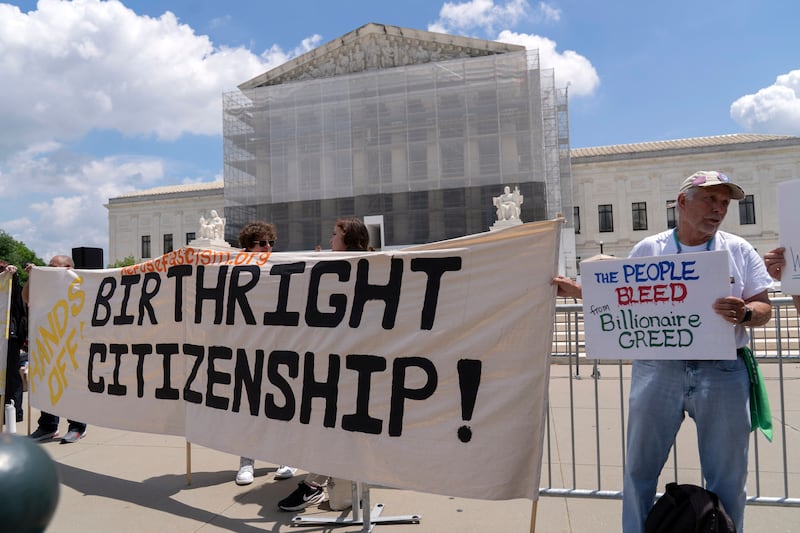
Origins of citizenship
When voters ratified the 14th Amendment on July 9, 1868, it granted birthright citizenship to “(a)ll persons born … in the United States, and subject to the jurisdiction thereof.” The jurisdiction clause is central to Trump v. Barbara.
Supporters of the executive order contend that children of immigrants living in the country illegally cannot express allegiance or take an oath to renounce foreign ties, and that heritage tied to other countries implies they owe allegiance abroad. In other words, they would not be subject to the complete jurisdiction of the United States. “Because ‘subject to the jurisdiction thereof’ excludes individuals born owing allegiance to a foreign country, the phrase excludes children born to illegal immigrants,” writes New York University law professor Richard Epstein in a Supreme Court brief supporting the administration’s position and echoed in oral arguments. “Even the most precocious newborn babies cannot renounce foreign ties. Only their parents can. And illegal aliens, by definition, have not done so.”
Epstein’s filing is one of 73 briefs submitted to the court: 46 against the executive order, 26 in support of it and one taking neither side. Authors range widely from professors, labor organizations, religious organizations to senators, nonprofit groups, law firms and former attorneys general.
There’s a regulation that can be enforced, and if there’s a problem, let’s enforce the regulation. Don’t get rid of everyone’s citizenship.
Regardless of what the experts and advocates say, Americans are clearly divided on matters of birthright citizenship. Pew Research Center reported in June that half of adults support citizenship for people born in the U.S. to parents who immigrated illegally receiving citizenship, while another 49 percent say they should not. Meanwhile, 94 percent of adults say the children of parents who immigrated legally should be considered citizens in the eyes of the law.
At the time the 14th Amendment was ratified, American borders were largely open. The new right was written as a response to the end of slavery, extending citizenship to formerly enslaved African Americans who had not yet been considered equal citizens despite their newfound freedom. Nearly 30 years after the amendment’s ratification, the Supreme Court heard oral arguments for the Wong Kim Ark case, which concerned a California-born son of Chinese parents who was denied reentry to the U.S. after visiting China. The justices ruled that Wong Kim Ark was a rightful American citizen, and could not be denied citizenship based on his parents’ nationality.
The modern concept of “illegal” immigrants didn’t exist at the time. And Congress didn’t begin introducing bills to end birthright citizenship until 1991, nearly a century after the Wong Kim Ark ruling. That year, a representative from California introduced a bill proposing only children born to mothers who are legal residents ought to be considered citizens. It died in committee but garnered significant support and started a pattern in anti-immigration policy. Republicans in every single Congress since then have introduced similar legislation attempting to end birthright citizenship.
Another reason why birthright citizenship remains such a divisive and at times emotional issue is that it deals directly with what it means to be an American. For many immigrants who have paid thousands of dollars and waited years to become naturalized legal citizens, the idea of automatic citizenship granted to children of immigrants who did not opt for legal pathways can feel like cheating or jumping the line to gain access to government entitlements and other benefits of citizenship. Especially disconcerting to proponents of Trump’s order is “birth tourism,” where noncitizens travel to the U.S. with the sole intention of giving birth and securing citizenship status for their children.
Though many legal experts argue birth tourism is far from a threat, numbers indicate that fears are not entirely unfounded. The Center for Immigration Studies, a nonpartisan and nonprofit research organization, estimates that as many as 26,000 women with tourist visas give birth to children on American soil each year. That’s less than 1 percent of babies born annually, yet enough to sound the alarm for proponents of Trump’s executive order, relevantly titled “Protecting the Meaning and Value of American Citizenship.” Outside of the courtrooms, Republicans in Congress have moved to cover their legislative flank on the issue, proposing laws like the “One Nation, One Visa Policy Act,” introduced in February by Florida Sen. Rick Scott and Wisconsin Rep. Tom Tiffany, which they say will “close a massive loophole that is allowing Chinese nationals, many with ties to the Chinese Communist Party, to exploit birthright citizenship.” Republican Sen. Ted Cruz from Texas cited a report in his Supreme Court brief for the Trump v. Barbara case that claimed anywhere from 750,000 to 1.5 million Chinese nationals have been born in the U.S. as citizens within the past 15 years.
But it’s unclear whether doing away with birthright citizenship would decrease any problems related to the number of immigrants living in the U.S. without legal permission. It could disincentivize birth tourism and long-term residency, but those aren’t the main reasons why people flock to America. Most immigrants do pursue official pathways to citizenship, not exploit loopholes. The American Immigration Council reported in 2024 that more than three out of every four immigrants eligible for naturalization in the U.S. have become naturalized citizens. “The Trump administration is not attempting to restructure naturalization. So, anyone who was born outside of the United States, then moved to the United States and successfully navigated the citizenship application process, is absolutely unaffected by the executive order and by any decision from the Supreme Court, even if the Supreme Court sides entirely with President Trump,” says César Cuauhtémoc García Hernández, a professor of law at Ohio State University. “The people who do stand to be affected are people who receive citizenship at the moment of birth by virtue of being born in the United States, and that’s the vast majority of people who are alive today and are U.S. citizens.”
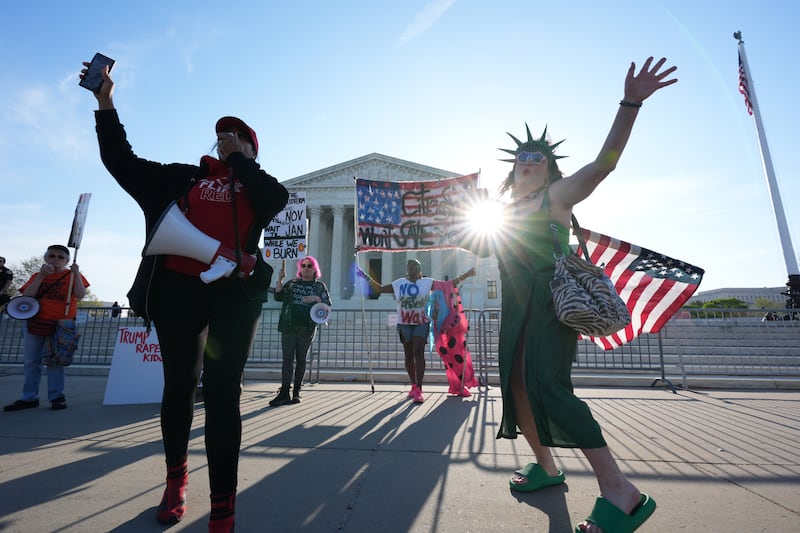
Inside the courtroom
On the morning of April 1, the government’s Solicitor General D. John Sauer drilled down on the term “domicile,” mentioned about 20 times in the high court’s Wong Kim Ark ruling more than a century earlier. The justices then agreed 6-2 that Wong should be granted citizenship due in part to the fact that his parents had already domiciled stateside, or established a home in connection with the United States, before their son was born in 1873. Immediately after Sauer’s opening remarks, both conservative and liberal justices alike picked apart his reasoning.
“We have an unusual situation here because our immigration laws have been ineffectively and in some instances unenthusiastically enforced by federal officials,” Justice Samuel Alito said. “So, there are people who are subject to removal at any time … but they have, in their minds, made a permanent home here and have established roots and that raises a humanitarian problem.” Justice Neil Gorsuch pointed out that foreigners were able to take up residence easily in the 1860s, when the amendment was written. Modern immigration laws didn’t exist then and “that was perfectly fine,” he said.
Trump watched the case alongside spectators for more than an hour as Sauer compared immigrants in the country illegally to “temporary sojourners” and that we live “in a new world” calling for a new interpretation of the 14th Amendment. “It’s a new world,” Chief Justice John Roberts agreed. Then he reminded Sauer, “It’s the same Constitution.” Roberts earlier described supporting points of the administration’s argument as “very quirky,” and fellow conservative Justices Amy Coney Barrett and Brett Kavanaugh also expressed skepticism about the administration’s case. They asked whether the executive order, even though it was written to only apply to children born on or after a certain date, could open up an opportunity for officials to later retroactively question the citizenship of those already born in the U.S. and considered citizens — creating a massive underclass of stateless people.
Shortly after Trump left the hearing during ACLU attorney Cecillia Wang’s opening argument, he’d already taken to Truth Social, where he posted that “We are the only Country in the World STUPID enough to allow ‘Birthright’ Citizenship!” Actually, more than 30 countries offer birthright citizenship, but the president’s reaction signaled that even if the court doesn’t side with him, this fight may be far from over. In addition to current legislation targeting Chinese nationals, lawmakers could amend the 1952 Immigration Nationality Act, which codified birthright citizenship. There are also sanctions the government could impose on parents from other countries who are in violation of immigration laws. In 2020, during Trump’s first term, he sought to limit temporary visitor B-1 and B-2 visas to anyone entering the U.S. for the primary purpose of birth tourism.
Even the 14th Amendment isn’t impenetrable. To change it, the proposal would have to pass either two-thirds of both houses of Congress or a constitutional convention called for by two-thirds of state legislatures. Then, voters in 38 states would need to ratify the change. More than 11,000 amendments have been proposed in the course of American history, yet only 27 have ever been ratified. And those that have cleared those hurdles — the 14th included — have altered and defined American life for generations.
Amending the Constitution wisely requires a strict procedure to avoid succumbing to polarized and fleeting political agendas. And some American values are far too sweeping to tinker with. “There’s a regulation that can be enforced, and if there’s a problem, let’s enforce the regulation, which says you’re not allowed to get a tourist visa to come to give birth and gives the Customs and Border Protection the power to bar someone coming into the United States who’s visibly pregnant,” Frost says. “Don’t get rid of everyone’s citizenship. Enforce the regulation.”
This story appears in the May 2026 issue of Deseret Magazine. Learn more about how to subscribe.