

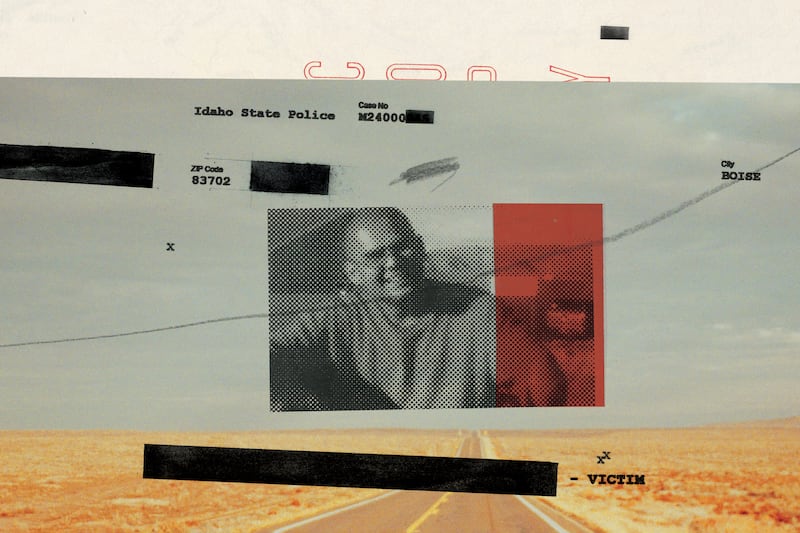
Peter Jackson Jr. sat at a window in his sprawling ranch house, binoculars pressed to his brow. He didn’t want to lose the two men, appearing and disappearing behind the sagebrush. The wind was blowing hard, the snow falling down like a curtain outside the glass. His pistol, heavy with loaded rounds, was nearby, just in case.
Jackson, who’s in his mid-60s, had looked out onto this horse pasture thousands of times. After his parents moved from California to Owyhee County, Idaho, they formed a business partnership with the Riddle family, the original owners of this ranch — the Riddle Ranch. In 1958, his parents bought the Riddles out, and he’s “been here ever since.”
Like quail, the figures flushed from the ditch.
One of the men, a police officer, clambered over the bank, losing ground. Jackson didn’t know the officer’s name. Just that of the one being chased. Cody Whiterock.
Not many people knew Cody Whiterock, but he was raised on this land, which has been a home to generations of his Shoshone relations, living and dead, for nearly 1,000 years. Splitting across the state lines of southwestern Idaho and northern Nevada, this was one of the last places within the Lower 48 to be mapped. But many knew the corridors of its canyons and the contours of its hills long before it was called Owyhee County or Duck Valley Indian Reservation.
It’s one of the most isolated regions in the continental U.S. — more than 90 miles in any direction just to reach an interstate that can get you to a population of more than 20,000 people. The town at the center of the reservation, also called Owyhee, is home to around 800. Surrounded by a checkerboard of sprawling private ranches and unincorporated communities alongside federal public lands, the only indication a person has that they’re driving into or out of the reservation is a faded welcome sign full of bullet holes and a rusted cattle grate interrupting the sun-bleached asphalt.
That morning, March 2, 2024, had already been tumultuous at Riddle Ranch. Cody Whiterock was visiting his girlfriend, Megan Garity, who lived and worked there as one of Jackson’s ranch hands. Things had gotten out of control. Whiterock, a meth user, was intoxicated and shouting and banging on the bunkhouse doors, upset about something.
Jackson needed his ranch hands to get to work. So he called the Bureau of Indian Affairs, or BIA, police station on the reservation at about a quarter before 9 a.m., telling the dispatcher that Whiterock, the man with a recent warrant out for his arrest for evading police, was on his property, maybe even with a gun on him; he’d been seen with one before. Jackson wanted him gone.
“I know we’re off the reservation,” Jackson told the BIA dispatcher. “But he’s also somebody that is of interest to you, I think.”
“Yes,” the dispatcher responded. “My officer is going to be heading that way. And I do believe he has shared info with Owyhee County, as well.”

Jackson explained that he hadn’t called the county sheriff’s department — he didn’t think they’d be able to get to the ranch in time before things escalated. The deputies on patrol are almost always at least an hour away.
Together, Owyhee County and the Duck Valley Indian Reservation cover nearly 8,000 square miles — an area roughly the same size as the entire state of New Jersey. On any given day, somewhere between four and eight officers from the sheriff’s office, the Bureau of Indian Affairs and the Idaho State Police are responsible for all of it. Each agency largely keeps to its own jurisdiction — Indian Country, the county or the state. But there are never enough officers to cover the ground.
The radio waves carried their messages into the storm. BIA officer Joshua Garoutte was already in his patrol unit and on his way. The drive from his station to the ranch was only about 20 minutes. Owyhee County dispatched its nearest deputy, but as Jackson suspected, that deputy was in Mountain Home, a town far enough away that, with the snow slowing him down, it would be two or three hours before he could get there.
In the past handful of years, county, state and BIA officers in the region have shot at least eight men during use-of-force incidents.
Garoutte switched his lights on when he turned into the property and saw Whiterock’s BMW 325iS. Whiterock was at the wheel, backing up to leave.
Garoutte drew his gun.
“Stop!” he yelled into the wind.
Instead, Whiterock peeled out of the bunkhouse driveway, tires spinning up snow. He only made it a little over a third of a mile before Jackson watched the car slide off the icy dirt road. Garoutte caught up and drew his pistol again. “Cody, get out of the car! Show me your hands!” he yelled. Whiterock got out of the car and ran.
Garoutte called for backup. The chances of getting it were slim. He was the only officer on duty at the reservation that morning.
But Officer Mitchell Bacon had his radio on. He was off duty. When he heard Garoutte’s call for backup, he decided to go to Riddle Ranch anyway.
When Whiterock had taken off into the fields, running, it was Bacon who took off after him. That’s who Jackson could see through the lenses of his binoculars, trained on the gaps between the brush. Seeing Bacon tear off his ballistic vest and toss it into the snow, Jackson picked up his pistol, got into his truck and drove down to the fenceline of the horse pasture. He knew exactly where the vest was. The radio transceiver was still attached. He dusted it off and tried to get a message out to Garoutte and Bacon — whoever could hear.
No one responded.
In sprawling, rural areas, law enforcement agencies often lack the training, staffing and resources required for maintaining oversight.
He got back into the cab and kept driving along the fenceline, then up to the highway, watching for any movement. He remembers seeing the figures of two men appear. They were BIA officers Garoutte and Bacon, walking back to Garoutte’s truck. He hadn’t seen White-
rock being cuffed in the brush. And they weren’t walking him in. As he handed the vest over, he glanced into the back of the patroller, but Whiterock wasn’t there, either.
“Are we all done?” he asked.
At 10:49 a.m., the Owyhee County coroner got the call. There was a man down on the Riddle Ranch. When he arrived nearly eight hours later, at 6:38 p.m., he found Whiterock face down in the sage with eight bullet wounds to his face and body, a blanket of snow covering him.
“I don’t know what happened out there,” Jackson said recently, looking back on that day. “I don’t know if it’s ever been said exactly what had happened out there.”
The life he knew
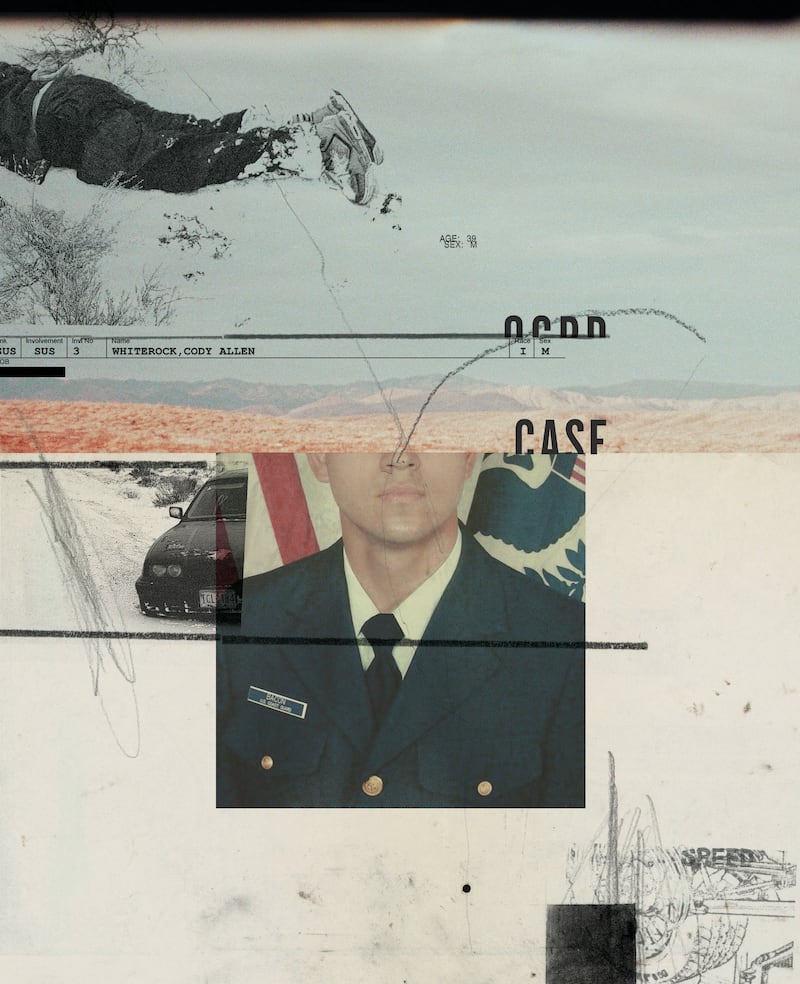
Cody Whiterock grew up riding motorbikes from the reservation far into the Owyhee mountains and casting lines into fishing holes hardly anyone in the world knows about. When he was 17, he left. He moved to Ely, Nevada, met a girl, and started a life with her. They had a son. Then two sons. They moved to Oregon, where he found work as a tire technician. In September 2023, when he was 39, he moved back to the reservation.
He spent that Christmas with his sons. The first time in a long time. When they were little, he’d wrestled with them between the Christmas tree and piles of presents in their grandparents’ living room, and, of course, he let them win. Those were happy memories. Now the boys were 18 and 16, but being back together on the reservation for a week, it seemed like making happy memories was still possible.
It hadn’t been easy. The 19 years he’d spent with their mother, Haylie Hume, had been punctuated with violence. She often blamed it on the liquor he drank. But after years of distance, Whiterock was working on making amends with his sons. With Hume, too. They were getting along. However fragile and new it felt, it felt good, too.
Whiterock was a member of the Ely Shoshone Tribe, but Owyhee was home. It’s where he learned to ride horses through the bunchgrasses with his sisters, and to play five-card at tables shared with his mom and dad. He joked that in another 10 to 15 years, he’d be here, old like them.
The weeks since Christmas had tumbled by, and his sons were back in Oregon.
On the evening of March 2, Haylie Hume was at home in Cottage Grove, Oregon — in her little house with the big front porch — when her oldest son, Eliyah, called her. “Mom, my dad is dead,” he said on the other end of the line. “They killed him.” He couldn’t say much more than that. Both of her and Whiterock’s sons were at her house 20 minutes later. They packed up and were gone by the time the sun rose, headed toward Owyhee. As they drove, Hume felt the shock settle in. There were so many questions. She told herself they would be answered once they got there.

Instead, she found herself at the funeral parlor, answering questions about Whiterock to identify his body. Eliyah couldn’t sleep. Neither could she. When the Idaho State Police, or ISP, called the Whiterock family and told them about Cody’s death, they said the shooting happened during a pursuit from the Duck Valley Reservation to the Riddle Ranch. “But there was never a police chase from Nevada to Idaho, because Cody was at Megan’s house that morning,” Hume said.
What the ISP told Hume and her sons wasn’t adding up, and she didn’t believe everything they said about what had happened. Neither did Eliyah. On one restless night before Whiterock’s funeral, he told his mom, “Something’s not right with the situation.”
Two days after Whiterock’s death, the Idaho State Police published a news release about the shooting. It was only 150 words long, restating the same series of events that officials had told the family; that “BIA law enforcement pursued a vehicle from the Duck Valley Reservation in Nevada into Idaho,” and that “once in Owyhee County, the male driver ran from his vehicle and shots were fired.” It closed with the assurance that the incident was under investigation, and “updates will be provided when available.”
The updates that the police statement promised never came. Whiterock’s family began searching for answers — they even hired a private investigator and a lawyer. “Families, they don’t know what to do,” said Hume. “They’re so defeated. … No one has heard anything from the feds; from the BIA, nothing.”
In these lonely corners of Idaho and Nevada, there are plenty of reasons why people are wary of law enforcement officers. One member of the Shoshone-Paiute Tribes of Duck Valley said in passing that it’s easy to feel that law enforcement is “out here just killing Indians,” because “that’s what it seems to be.” In the past handful of years, county, state and BIA officers in the region have shot at least eight men during use-of-force incidents. Whiterock’s cousin, Kirby Paradise, was one of them.
Native people like Whiterock are killed in police encounters more than any other racial or ethnic group in the United States, dying during law enforcement interventions at a rate that’s nearly five times the rate for white Americans and double the rate for Black Americans. Almost all the victims are male, mostly in their 30s, killed by gunshot wounds that are most likely to happen in a home or alongside a road.
On March 11, one week after the ISP’s news release was published, ISP detectives Kirill Fomin and James Millar asked Peter Jackson Jr. about what he had seen on his ranch that day. At the end of the interview, Jackson had a question for them. Why were the details of the official public statement from the ISP so wrong?
Fomin brushed it off, responding as if it hadn’t been written by his own agency. “We saw that as well, and I don’t know where they got that statement from,” he said. “Or maybe it’s the news, and they made it up.”
In sprawling, rural areas, law enforcement agencies often lack the training, staffing and resources needed to do the job. The result is “completely lawless, and people are getting hurt and there’s no faith,” said John Heenan, a lawyer in Billings, Montana, who represented a Native client in a recent case that awarded her $1.6 million in damages from the BIA after an officer pleaded guilty to coercing the woman into sexual intercourse under the threat of arrest. “When the community loses faith in the police, it creates all kinds of ripple effects.”
With few details available, speculation about what happened at Riddle Ranch that first Saturday in March spread through Owyhee County. A former Owyhee County dispatcher, who still works in law enforcement and requested anonymity out of fear of retribution, told me that “this whole case is very, uh, sketchy, I guess I could put it. Just the way it all occurred.”
Mitchell Bacon is the only person alive who knows exactly what happened.
Bacon’s account
The door to the BIA Office of Justice Services in Owyhee, Nevada, was open. Inside, Mitchell Bacon sat at a desk underneath a thin blue line flag, his laptop open, and a camouflage hat sitting next to him, embroidered with the fictional Dutton Ranch brand from the TV show “Yellowstone.” His thick, dark hair was cut short, his tactical Coyote Tan boots neatly laced.
He leaned back in his worn office chair and Googled “Owyhee County BIA officer shoots man,” then deleted “man,” and typed in “suspect.” When the page loaded, all the links were purple; he’d clicked them before. He has read everything that’s been published about the incident, although he’s never been named before in media reports as the officer who shot Cody Whiterock. He’s not even sure that the community knows that it was him. He wasn’t officially on duty that day.
Bacon’s return to Duck Valley was similar to Whiterock’s in some ways. The land has a way of reclaiming its own, as if there’s a tether. Bacon’s father, Alfred, was born on the reservation, but he had raised Bacon, who is a member of the Shoshone-
Paiute Tribes of the Duck Valley Indian Reservation, in California. After high school, Bacon joined the U.S. Coast Guard, which took him from Virginia to Bahrain. Alfred, meanwhile, moved back to the reservation. In the summer of 2023, Bacon did too. He hadn’t been here much since he was a boy, running alongside the unhurried shallows of the Owyhee River with his two brothers on short visits to see where their father — and their father’s family before him — had come from.
Some things had changed since he was here last, but most hadn’t. The land could still make a person think the whole world is covered in scrub and sage, only dotted with the occasional double-wide as you get closer to town.
I don’t know if it’s ever been said exactly what had happened out there.
Remote, rural margins of America like Owyhee County and Indian reservations like Duck Valley share struggles that exist cheek to jowl with isolation: poverty, crime, unemployment, drug and alcohol addiction, stagnated economies, a lack of oversight from authorities, and a sense that the rest of the world has forgotten about this place.
The use of drugs and alcohol on reservations like Duck Valley is higher than national averages, especially among youth, which is more than twice that of the general population. On the reservation, the poverty rate is nearly 40 percent.
Violent crime is a problem, too. Research from the Department of Justice shows that crime rates on Indian reservations are more than double the national average. The BIA estimates there are over 4,200 missing and murdered Native women cases that are unsolved due to the complex legal jurisdictions of Indian Country and under-resourced law enforcement, including the case of Agnes Marlene Thomas, a retired nurse and tribal elder who was found shot dead in her truck on the reservation in March 2021.
When Bacon moved to the reservation, he was 27 years old. He knew he wouldn’t be there for long — he was only there to help his dad, and he had a girlfriend he missed in Texas — but he wanted to do something good for the community in the time he had. He wanted to be a leader. It was something he didn’t see much of on the reservation or in the region. So, he took a job as the school resource officer at Owyhee Combined School, but was frequently pulled to patrol duties.
There just weren’t enough officers, and the BIA needed him to work double-duty. The roles of the job weren’t defined, the hours were long, and the responsibilities became overwhelming. He recalls working 12-hour mandatory shifts that were often extended due to new calls coming in. There were always new calls coming in.
So Bacon decided to apply for the permanent lieutenant position. He thought it would offer him a more manageable schedule and the opportunity to help change patrol operations.
But he was only an interim lieutenant until he completed additional training at the United States Indian Police Academy Advanced Training Center at Camp Grafton in North Dakota. That’s where he was headed on the morning of Saturday, March 2, 2024.
It was just after 9 a.m., and he had loaded his bags into his patrol unit when he heard Officer Joshua Garoutte on the radio. Garoutte sounded scared.
Bacon called into dispatch to ask what was happening. Buried under the frizzling static, he picked up that Garoutte was at Riddle Ranch, answering a call to remove Cody Whiterock from the property.
Bacon’s body seemed to be reliving that day as he told the story of the shooting, temples sweating and breath tough to catch.
He knew how it felt to be the only officer on shift and decided that Camp Grafton would have to wait. He drove north, his tires bumping over the cattle grate at the border of the reservation, until he saw Garoutte’s patrol truck, its lights flashing off the snow, parked on the left shoulder of the road.
When he pulled up and asked Garoutte what was going on, he got hurried and disjointed details — Owyhee County asked BIA patrol to help with the call, Whiterock was out of hand, and was armed and dangerous with warrants out for his arrest. Bacon said Garoutte told him Whiterock had tried to hit him with his car, twice, and then veered off the road and got stuck before fleeing on foot.
Bacon put on his ballistic chest plates, grabbed his AR-15 duty rifle, and told Garoutte that they should go find Whiterock. When Garoutte suggested they split up, one officer on the road and one in the field, Bacon didn’t think much of it and took off into the brush. It made sense to try to close in on Whiterock from different directions.
It was hard to see in the storm, but Bacon kept moving, following the footprints in the snow. When he got within eyesight of Garoutte, he yelled out to Garoutte to hurry up and get into the field. He had found Whiterock. He was only about a hundred yards away.
Whiterock ran, and Bacon took off after him. After running about a half-mile, crossing ditches through deep snow, he was exhausted. He took off his chest plates to drop weight, but before he left them behind, he remembered to grab his Taser, which had a camera on it, out of the vest pocket. He didn’t have his belt on with his baton or pepper spray, so if he needed a less-lethal weapon with him, this would have to be it.
He said he caught up with Whiterock, yelling for him to stop. That he was police. Bacon pushed him down, and they both collapsed into the snow. Whiterock got up and kept running.
When Bacon caught up with Whiterock again, he discharged two Taser rounds.
Bacon said he hit Whiterock with the Taser, but Whiterock didn’t fall. He just kept running. The Taser was a mass of tangled wires now, so Bacon threw it, and the camera on it, into the snow, leaving it behind.
He kept shouting at Whiterock to stop. In between yelling and ragged breaths, he called for backup on the radio. Garoutte didn’t answer.
Three times, he said, he caught up to Whiterock and knocked him over, telling him to stay down. But Whiterock always stood up and kept running. Except this time.
Instead of running away, Bacon said Whiterock turned toward him and charged. When he closed the gap, he closed it quickly.
Bacon had a choice to make.
He had another duty firearm on his hip — a pistol. He was spent, and didn’t want to be fighting with two loaded guns, or three, if Garoutte was right about Whiterock being armed. He pulled the rifle up above his shoulder, muzzle next to his ear to keep it out of Whiterock’s reach. Then he fired two rounds.
It happened so fast, he wasn’t sure if he had shot Whiterock. When Bacon told this part of the story, he switched from calling Whiterock a “guy” to saying things like “target” and “threat.”
“The threat stopped in its immediacy as I fell back. He fell down to his hands and knees, but immediately got back up and started coming back after me. I noticed, it’s pretty graphic, but his whole face was split open. … I reengaged — I always count my shots. This time it was four, four rounds, before he stopped and fell back down to his hands and knees. And then that was it.”
He yelled as loud as he could for Garoutte as Whiterock died.
Bacon didn’t radio medical. Instead, he called dispatch on his satellite phone. “I need you to notify the FBI that there has been a shooting,” he told them. “There is one male suspect down. I don’t have any known injuries. I don’t know where the heck the other officer is. I just need response out here immediately.”
No one came.
There were no lights, no sirens. Every other responder was still far away. The ringing in Bacon’s ears faded, and the fallen snow dampened the sound of anything else. There was just wind now.
He started counting telephone poles to figure out the distance from his patrol vehicle to Whiterock’s body. But before he walked back, he checked Whiterock’s pockets and waistband to see if the weapon he had been warned about was there. All he found was a syringe.
As he made his way back to the road, Bacon saw Peter Jackson in his truck.
“Hey, are you OK?” Bacon remembers Jackson asking when he handed over the vest. “I heard what happened.”
When Bacon went back to the car where Garoutte was waiting, he asked if he had heard his radio calls, his shouts for help, the gunshots. Garoutte said he hadn’t, and has declined to talk about his experience of that day since.
Bacon’s body seemed to be reliving that day as he told me the story of the shooting, temples sweating and breath tough to catch.
“I know that I did everything that I could.”
He knows there are bad cops doing bad things. It happens everywhere, he said, but “I’m not one of those guys. Even if somebody thinks I’m a piece of crap and whatever they want to think, I’m still going to do the right thing, the best that I can.”
But it bothers him when he sees the news stories and the chatter online, or when he hears about the officers who “executed” Whiterock.
“They have no idea what I did. They have no idea what I was going through.”
He paused.
“It wasn’t the outcome that I wanted. But it’s one that I have to deal with.”
He had been waiting for everyone to hear that the officer involved in the shooting had been cleared, that the investigation was over — something that might confirm, publicly, what he had been telling himself privately: that he hadn’t done anything wrong.
“The only reason that I like law enforcement is because it should be black and white, but it’s really not. Like the incident, it’s not very black and white.”
He didn’t reach for anything to wipe the tears from his face. He just let them roll.
Where death began
There’s a Shoshone story that explains the origin of death. It begins with Coyote’s resentment of his brother, Wolf. The people greatly respected Wolf and his power to bring the dead back to life. Thinking that he could change the people’s opinion of his brother, Coyote manipulates Wolf into agreeing that the dead should remain dead. After his trick, Coyote’s son dies, leaving him to plead with Wolf to bring the son back to life. Wolf refuses, reminding Coyote of his own belief that the dead should not be resurrected, holding Coyote to his word and to his loss. That, the Shoshone say, is the day death came to the land. Ever since, the people have also come to know the deep sadness of mourning.

Cody Whiterock’s body lay in the mortuary for 31 days after his death, awaiting a second autopsy his family requested. It never happened.
The first autopsy records eight total bullets, not six, like Bacon accounted for. This report had not previously been released, despite the Whiterock family’s request for the BIA to disclose its findings. The bullet count contradicts the property log taken by ISP detectives Fomin and Millar for the investigation’s evidence report after the shooting. Fomin and Millar took possession of Bacon’s AR-15, a magazine loaded with 24 rounds, and three unused magazines loaded with 30 rounds each, the total number of bullets each magazine can hold. Only six bullets were missing from Bacon’s rifle. Later, the autopsy would show the discrepancy between how many bullets were used from Bacon’s rifle and how many bullets were recorded in the examination. But the detectives did not take possession of his duty pistol or Garoutte’s weapon at the scene. It was three days later, on March 5, when they arrived at the BIA police station in Owyhee to collect dash camera, Taser video, and dispatch audio for evidence. No dash camera footage was released or submitted. That’s because, Bacon says, footage that shows anything doesn’t exist now.
But each of the pathways recorded in the examination is plausibly consistent with Bacon’s account of the shooting. There were, however, no indications of Taser wounds documented in the autopsy report.
Questions also remain about who was responsible for investigating what happened at Riddle Ranch that day. The FBI is tasked with investigating all shootings on reservations; they, along with the Department of the Interior’s Office of Justice Services, would both be expected to look into shootings involving a BIA officer. But the FBI notified the county that it would not be investigating because the shooting happened outside of Indian Country. The Idaho State Police took over the investigation instead.
Mitchell Bacon isn’t sure that the FBI would have shown up, even if the shooting had occurred on the reservation. He estimates that in his time with the BIA police, there have been more than 20 deaths that require investigation that his office can’t investigate on its own, and the FBI has been requested to lead. They’ve never shown up. “We can’t get them out here if we wanted to,” he said.
During the ISP investigation, Bacon hired a lawyer. He voluntarily participated in interviews with investigators. He kept showing up to work on the reservation and was placed on administrative leave. Officers placed on leave during open shooting investigations typically continue to receive their full salary and benefits. But Bacon said the BIA took his badge, reduced his pay and reported him AWOL when he requested to take medical leave. He was living check-to-check. It got to the point where his lawyer sent a letter to the agency, threatening legal action for how his superiors were handling Bacon’s employment during the investigation. “We don’t really have any level of management in this entire agency,” Bacon said.
Derris Waukazoo, the acting chief for the BIA’s Eastern Nevada Agency at the time of the shooting, had been removed from the Northern Cheyenne Reservation before his transfer to the Duck Valley Reservation. At that time, the Northern Cheyenne tribe wrote a letter to the BIA regarding its resolution to ban Waukazoo from its territory, citing disrespectful and unprofessional behavior.
In March 2025, a year after the shooting, the Owyhee County prosecuting attorney sent a letter to the BIA’s Western Region Office stating that after a thorough review of ISP’s investigative report, he had determined that “there is insufficient evidence to support a criminal charge against the officer and the shooting of Whiterock was justified.”
In December, with his name cleared, Bacon resigned.
Just two months later, Cody Whiterock’s family filed a federal civil rights lawsuit against three previously unnamed Bureau of Indian Affairs police officers — Joshua Garoutte, Mitchell Bacon, and their supervisor, who, at the time, was Chief Derris Waukazoo. The lawsuit claims that Bacon, Garoutte and Waukazoo “falsified or withheld evidence to escape accountability.”
“No one ever really brought any light to anything,” Haylie Hume, Whiterock’s ex, said. “But what I care about more so than anything is that we keep trying to spread the awareness of the extent of what’s happening on tribal land. If Cody didn’t have a family to back him, they would’ve killed him that day and that’s where it would’ve landed. It would’ve been just another body, no big deal.”
The lawsuit’s core argument is that Garoutte and Bacon, as BIA officers, had no jurisdiction on Riddle Ranch — and that without it, the force used against Whiterock was illegal. Owyhee County Sheriff Larry Kendrick had deputized Bacon just 38 days before the shooting, extending his jurisdiction outside the reservation, but now there are questions of whether that deputization was legal in the state of Idaho. It’s never been clarified whose badge Bacon was acting under that day. As far as public statements from the ISP go, it’s also never been clarified what their investigation concluded.
“There’s just no trust,” said Heenan, the lawyer in Bozeman. “Not only in the officers, but the entire system. So, how do we regain trust? More oversight, more funding, more accountability, and consequences in both the civil and criminal justice systems when people break the rules. These are all things that I think are fairly easily solvable. I just don’t think anybody really cares.”
In Owyhee, the BIA police force is down to two patrol officers in a condemned building with no dispatch. After a separate investigation, dispatch was disbanded, and now, all communications to Duck Valley come through Fort Duchesne, about 400 miles away on the Uintah and Ouray Reservation in Utah.
“Any normal person would not want to do this job,” Bacon said. “It’s extremely dangerous. There’s no radio communications, there’s no backup. It’s just horrible.”
As patrol forces within the BIA and other agencies dwindle, the officers who do remain are left to work longer shifts with less training, and to work alone. The result is infrequent, but volatile, interactions between some of the most underserved communities in the country and those tasked with protecting them, and a lack of resources to investigate crimes or prevent them from happening in the first place. In response to these increasingly high rates of violent crime in and around Indian Country, the FBI has initiated multiple six-month investigative efforts through what it calls Operation Not Forgotten, which places FBI agents on temporary duty to investigate unsolved and open BIA cases. So far, the operation has supported efforts on more than 700 of over 4,100 open death and violent crime cases, resulting in 1,260 individuals charged and 1,123 arrests made in 2025 alone. But this support only comes after loved ones are lost. In these corners of the country, it feels like those who aren’t here choose to look away, and those who can’t stand to look anymore leave.
One morning last December, Mitchell Bacon packed up his old white Dodge diesel truck. It was time to go. He remembered his dad telling him, “Son, I think this area is cursed because we can never get things going right.” The best they could do was to know they tried.
When they hugged goodbye, Bacon felt the old man hold on a little longer than usual.
The truck was aimed toward southern Texas. He wanted to spend his 5-month-old daughter’s first Christmas with her. He already had a job lined up as an investigator with the U.S. Customs and Border Patrol, and he had a few weeks before training started.
Ten miles down the road, he passed the faded sign riddled with bullet holes as his tires bumped over the rusted cattle grate. He wasn’t in Indian Country anymore.
This story appears in the May 2026 issue of Deseret Magazine. Learn more about how to subscribe.