

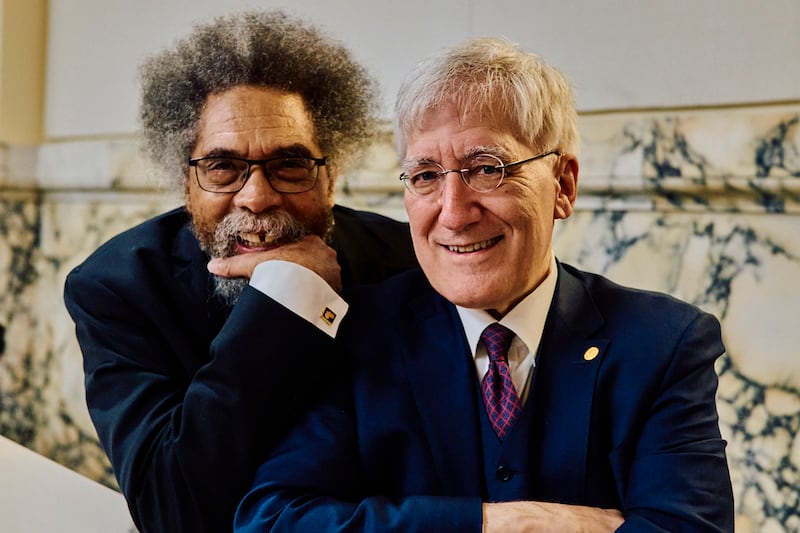
Professors Robert P. George, at Princeton University, and Cornel West, from Union Theological Seminary, are unlikely friends.
George is a leading conservative voice. West is a lifelong progressive activist. George is white. West is Black. George is Catholic. West, an unaffiliated Christian. Yet, the admiration they each have for one another is so genuine it projects a rare collegiality and respect in today’s climate of political and cultural confrontation. As they stand firm in their personal convictions, they co-teach college courses and co-author books, and their joint appearances showcasing civil dialogue between people with starkly different points of view draw large audiences in person and online.
The pair recently sat down with Deseret News Editor Sarah Jane Weaver in a wide-ranging conversation about their history together, what can happen when you “put truth above your infatuation with your own opinions” and the transforming effect of centering life around vocation rather than career. The interview has been edited for length and clarity.
Sarah Jane Weaver: The best place to start is your friendship. How did you meet?
Robert P. George: We first met at Princeton University. I was a very young assistant professor. Cornel West was already Cornel West when he came and joined our faculty from Yale. We’re both interested in the same subject areas in moral and political philosophy, religion, ethics and so forth and initially got to know each other participating in some faculty seminars on those topics. But it wasn’t until 2005, more than 20 years ago, that we really got to know each other when one of our common students asked me to do an interview with Cornel as a faculty interviewer of another faculty member for a new student magazine. And so, of course, I was delighted to have the opportunity to do that. We had the interview, and boy, did we have a raucous four hours. It was supposed to be one hour, and it actually went beyond four hours.
As a result of that, when we got an invitation from the dean of our faculty to teach freshman seminars, I conceived the idea that Cornel and I should just carry on that dialogue with 16 or 18 of these brilliant Princeton freshmen. So we proposed the course and the university was very enthusiastic about it. And we began teaching together. And from that very first moment in the classroom, I knew we had something special. You’ve heard about people having chemistry. We had magic, and we had a great semester. And so we just kept going, kept doing it, teaching our freshman seminar, Adventures of Ideas, we called it, until Cornel abandoned me and went to Harvard. And then once we were no longer able to teach together because we weren’t in the same place, we took our show on the road.
And over the years, we’ve gotten to not only be dear brothers, but get to know each other’s families and love each other’s families. And his daughter is really like a niece to me. She calls me Uncle Robbie. And my kids have a similar relationship to Cornel. So it’s been a beautiful thing. And one of the great blessings of my academic career.
Cornel West: Absolutely. Part of it is just being able to revel in my dear brother’s humanity at the deepest level. He’s someone of integrity, honesty and decency. So even given our political and ideological disagreements, I know that he is his mama’s child and his daddy’s kid. And it’s that kind of common, human bond and trust that makes all the difference in the world. Intellectually, he flows out of Aristotle and Thomas Aquinas and Edmund Burke. And I flow out of, well, in the way I flow. And personally, we are just blessed to be brothers.
Weaver: There’s a growing cynicism over higher education, even among young people. How do you help them understand that education matters?
West: It’s important that we recognize there’s never been a golden age where cynicism didn’t exist, where elites were not corrupt. It has always been a challenge to muster the courage to think critically. And how have those in the past responded? You have to make examples and be examples so that young people can feel as if there are alternatives to the superficial models, paradigms, frameworks that are pervasive in any moment. Right now, the superficial models are celebrities, markets, money, status, manipulation, transaction. Those things we know are old, but they take a particular form these days.
Put truth above your infatuation with your own opinions.
George: Those things are not necessarily bad, but they’re not good in themselves. What distinguishes things that matter are those that are worthwhile for their own sakes. David Brooks has a nice way of putting it. He says there are some things, like wealth and power and status and money, that we might call the CV virtues, the things you put on your CV. But what we really need to prioritize and care about, even when we’re 18, 19, 20, 21, 22 years old, are what Brooks calls the “tombstone virtues.” What do you want it to say on your tombstone? Summa cum laude, Harvard Law School, Goldman Sachs? No. You want it to say: faithful husband, loving father, loyal friend.
Those are the things that really matter. And I think this is why the great Greek thinkers always say consider things from the perspective of your death, because it’s from that perspective that you can get your values in the proper order.
Weaver: We have disagreements that are tearing apart families — the very core unit of society. What do we do to help people prioritize relationships above opinions?
West: We both believe that each person’s made in an image and likeness of a loving and almighty God, and therefore they have a certain sanctity, dignity to be affirmed in all circumstances, no matter what color, no matter what gender, no matter what sexual orientation, no matter what national identity they have. And how do you hold on to that, given all of the messiness thrown at us by young people every day? You see, that’s a matter of practical wisdom. It depends on the kind of lives we live and hope that others actually can find attractive.
If you have a conception of yourself tied to something that’s broader, it means your sense of calling is deeper than just your sense of career.
George: You know, the great Saint Francis of Assisi is credited with saying: “Preach the gospel always. If necessary, use words.” Now, I’ve always loved that because I think there’s so much truth, and it’s such a deep truth in that. But I’d amend it just a little bit. I think when it comes to teaching the value of loving people across your differences, despite your disagreements, we do need to do a little preaching. But it’s even more important to model the behavior that we want students to appreciate and therefore adopt.
And much of the witness Cornel and I try to bear is in that mode. Now, we do a lot of talking because we’re a couple of talkers, but I think we probably have a greater impact on our own students just by virtue of what we model: that you can disagree deeply about very important things and still love each other, learn from each other.
Put truth above your infatuation with your own opinions.
Weaver: What can we do to make character, integrity, truth — some of these virtues that you were just talking about — matter more?
George: I believe those things have a certain luminosity about them, such that when we see them in practice, we can’t help but admire them and can’t help but be inspired to at least want to emulate them. The problem is, there are things that obscure those virtues so that we don’t see them.
Some of them are just normal human vices, the deadly sins of greed, lust, envy and so forth. They can also be blocked by ideology. And so if we’re deeply in the grip of an ideology so that we are so deeply in love with our opinions that we prefer them to truth, that ideology will block our vision of the truth.
It’s like something being put up in front of the sun, like an eclipse, like when the moon blocks them, blocks the sun. The sun is very luminous, you know, it’s a grand thing if you see it, but if something’s blocking it, you don’t see it. So I think part of our effort needs to be to remove those blockages.
And again, I think example is even more important than precept. That modeling is even more important than teaching. You do that by showing that you’re a person who is open to critique, to challenge, to criticism. You engage in a truth-seeking spirit. Then you’re setting a wonderful example that will remove what’s obscuring the luminosity of the virtues.
West: I’m thinking of the great John Bunyan, who wrote “The Pilgrim’s Progress” while imprisoned for 12 years. The conception of life in which you are a pilgrim or sojourner, moving through time tied to something bigger than you, even beyond time, means you’re going to be less likely to succumb to the forms of idolatry. If you have a conception of yourself tied to something that’s broader than just time and space, it means your sense of calling is deeper than just your sense of career. Me and Robbie encounter this all the time when young people come and say, “We love your brand.” We say, “No, we don’t have a brand.” We have a cause. We have a calling. And it’s beyond just history and time and space. And historically, it’s been those figures who had a sense of what (jazz musician) John Coltrane called the bigger picture that connects us to the smaller picture that allows us to persevere with levels of integrity and love and honesty that make no sense in the eyes of the world.
George: You know, Cornel, I wonder if we talk too much in general in the education sphere about careers and career choices?
West: Oh, no doubt about it.
George: Maybe we should just stop with our young people speaking the language of career choice and start asking, “Have you discerned your vocation?” A vocation is fundamentally a way of serving. And if I ask, what is your vocation, I’m asking, what is the way you have been called to serve others? Now it might be as a lawyer, as a doctor, as an accountant. But the focus then is not on how much money I can make or on how much social status I’ll have. That’s not bad, but those things are made secondary, and what’s primary is how am I going to serve? How am I going to use the talents, abilities, opportunities that God has given me to serve other people?
West: Absolutely. That sense of calling means there’s got to be some voice, some standard, some being that’s bigger than you. Socrates had his Daimonion calling him. Christians have some grand set of standards and criteria calling them. Even the great artists, you know. (John) Coltrane said I want to put a smile on Johnny Hodges’ face. Miles Davis said I want to put a smile on Charlie Parker’s face. Aretha Franklin said I want to put a smile on Marion Williams’ face. These are people who set higher standards, and it’s not a matter of being for sale. Integrity is not for sale. You’re not for sale. Your divine mission is not for sale.
George: You know, maybe, Cornel, that’s where the concept of the transcendent comes in, it’s so important in our practical living, because it’s a burden if you don’t have that in your life, if you don’t have an openness to something great. When we ask the question: What am I going to do with my life? I think the temptation will be to try to calculate or reason out what would make me happy or what would make me happiest. But we know from all of human experience, the worst way to find happiness is to pursue it. To be obsessed with it. I think when you’re open to the transcendent, you shift from what’s going to make me happy in that psychological sense of how can I accomplish my mission.
Weaver: Can each of you share one quality that you’ve observed in the other, that you think could help bless or strengthen this nation?
George: Well, and in brother Cornel’s case, I think it’s the way he combines being a person of conviction, who’s willing to act on his convictions, with being open to challenge, open to critique. If he weren’t open to challenge, open to critique, he would have thrown me out the window a long time ago. But intellectual humility, his willingness to recognize that he could be wrong does not paralyze him and make it impossible for him to act. But he acts, having in view that there’s always the possibility that, “I’m off track here, so I need to remain open.” That’s a deeply admirable quality that Cornel possesses that I try to emulate.
West: I would say, Robbie has both integrity and sincerity. He says what he means. He means what he says. He doesn’t pose and posture. He doesn’t act as if he’s X when he’s Y. He is who he is. And there’s a certain kind of integrity and sincerity that you can always trust that what he’s saying and what he’s doing is something he’s putting his whole self into. And that is too rare these days.
This story appears in the May 2026 issue of Deseret Magazine. Learn more about how to subscribe.