

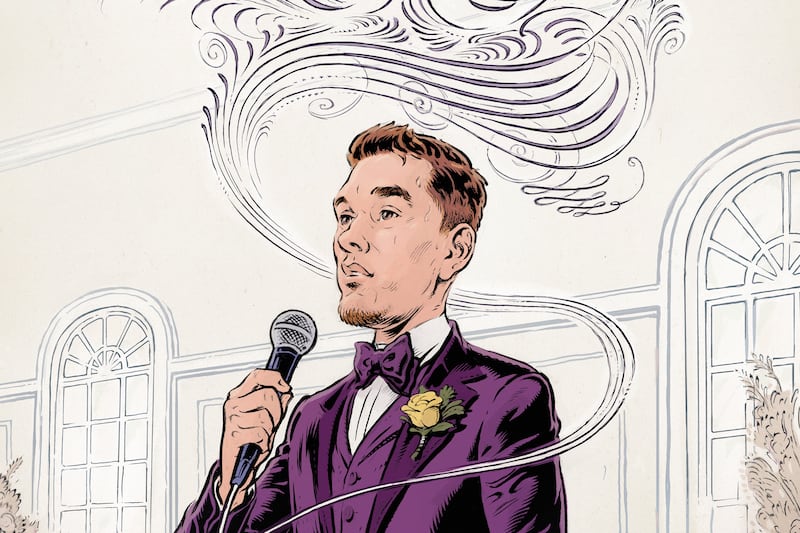

“It has to be funny,” I was told. What did I know?
I’d never seen or heard a wedding speech. I’d never been to a wedding, any wedding, period.
Nowadays, I might consult some chatbot for general advice, just to help me get started. Maybe I’d search for a “best wedding speeches” compilation on YouTube. Ask the internet for advice. But, even back then, 10 years ago and with my first go at being a best man, that felt like cheating. I turned to an old college professor instead.
“It just has to be funny,” he said again. Funny. OK, I told myself. I can do funny. Right?
I had so much time to prepare. My college roommate asked me to do the honors many months before, along with a succinct explanation of my duties: I had to plan the bachelor party and deliver a wedding speech. The bachelor party had long since come and gone. But I’d waited until a few days before the ceremony to collect my thoughts and put them to paper, hence my last-minute trip to the halls of my alma mater.
Part of the trouble was that I didn’t really understand what a good wedding speech was supposed to do. And so, seated outside my professor’s office, I started there.
The intimidating moments when we’re called to speak about our admiration for our loved ones are “problems” worth grappling with personally.
What should I say in a best man’s speech? It was a good question then, in 2019, and an even better one now, when AI services promise stress-free speeches in just “three steps.” Need to sum up your father’s life or a 20-year friendship quickly and without thinking too much? Get started by clicking here.
Reddit is overrun with posts from people asking whether it would be “unethical” or “disrespectful” if they had a chatbot compose wedding speeches or eulogies. The stakes are framed as a tradeoff between crisp, concise and clean over something potentially awkward and messy, but also human. What are life and marriage if not the latter?
“Make it funny,” I told myself as I began typing away outside my professor’s office. All the while worrying no one would laugh.
Stage Fright Sets In
It was a warm day in January. The day had come, and I was sweating. Under my much-too-small rented white dress shirt and my matching purple vest and bow tie, stashing props under the DJ’s tablecloth, oh yes, I was sweating.
The scaffolding that held the speech together was “SpongeBob SquarePants,” the Nickelodeon hit we’d both grown up watching. The very first line of the thing was a callback to the original “SpongeBob SquarePants” movie, and concluded with me calling my friend a “GREAT BIG JERK.”
The idea was to use a show-stopping line he would recognize, but that almost no one else would, to call everyone’s attention to the speech. Perk up, it was meant to say, because you’re about to hear something different.
The audience had just listened to the maid of honor’s lovely, if somewhat predictable, dedication to the bride, in which she talked about how the couple was “perfect for each other” and “blessed by God” and the like. My speech, in contrast, for better or for worse, was going to be a stand-up comedy routine.
The stakes are framed as a tradeoff between crisp, concise and clean over something potentially awkward and messy. But what are life and marriage if not the latter?
Thankfully, the jokes got better. They started landing. And by the time I reached under that table for my main prop, the room was ready to explode.
My friend, I told the crowd, was a big fan of creative gifts over the four years we lived together. When we were seniors, and my birthday fell just a few weeks before we were set to move out and start our adult lives, he outdid himself.
I retrieved it from under the table, so they could see it and believe it before I explained it: a life-sized cardboard cutout of himself. “So that I could, and I quote,” I told the crowd, “‘be with him wherever I went.’”
It was ridiculous. It was sincere. And it was funny.
I was pretty pleased with myself. But a few years later, when I was asked to give another wedding speech, I couldn’t shake the nagging feeling that I’d forgotten something.
The Missing Piece
The bride! I hadn’t mentioned the bride!
I didn’t know, in fairness, that I was supposed to, at least as a courtesy — one that makes a lot of sense, given that a wedding is a celebration of a new union rather than a rehashing of past lives. I also, upon listening back to my original speech and several other wedding speeches over the next few years, thought my initial attempt lacked much depth.
It was funny, yes, but I hadn’t realized that the funny parts should be more like dressing. The best speech I’ve ever heard was at my own wedding, in 2021, from my wife’s maid of honor. It was funny at times, sure, but it was more heartfelt than anything, drawing on memories of a friendship that began in prekindergarten to tell a complete, complex story about why that day was so special — for her, for my wife, and even for me. It was masterful. And I was jealous.
My opportunity to try something similar came nearly five years after my first wedding toast. My own best man, who I’d known since third grade, asked me to do the honors. This time, my goal looked something like: “Share some stories about your friend that show who he really is — and what makes him a good match for his wife.”
I started in familiar territory: humor. I told of the time we detonated a ketchup-
and-baking soda bomb in my parents’ kitchen, and when he helped me cheat on a physics assignment in 11th grade that ended up winning my school’s science fair. As an overdue thank-you, I presented him with the trophy.
But later on, I shifted toward something new and much more uncomfortable: sincerity.
I offered some very serious wisdom (I was 28) about “what makes people compatible.” And, nested in a joke about how my friend once manufactured and sold counterfeit lunch tickets, I praised his new wife, who “speaks up against injustice, and always centers genuine concern for others” as a valuable counterweight to some of his scammer tendencies.
Then I finished with a dedication “to friendship, to companionship, and to never being without the people who make us who we are.”
This second rendition felt like I’d learned the right lesson the first time, but also overcompensated and swung too hard the other way.
I still wanted to get it right.
A Different Approach
There was no best man this time. This third friend, rather, assigned all his groomsmen character classes from Dungeons and Dragons. The groomsman deputized to pick the location of the bachelor party, for example, was the “Scout.” I was the “Bard” — an “inspiring performer,” per the official “Player’s Handbook.” That was certainly one goal of mine.
Like before, I gathered stories about my friend. I made sure to balance those stories with some sincerity — but not too much this time — and more of a spotlight on his bride. I thought I had it down to a science. But at the last minute, my friend threw in an extra wrinkle: Since he’s also good friends with my wife, he asked that we share the speech.
This presented some technical challenges — I had to write the final version like a script, which I enjoyed — but what better way to impart wisdom about marriage and commitment than to share such a duty with my own bride?
What should I say in a best man’s speech? I didn’t really understand what a good wedding speech was supposed to do.
I got to tell funny stories of my own. Like the time my friend, just two months older than me, got a haircut and the barber gestured in my direction before asking my friend whether his “son” was also getting a haircut. But to bridge our parts together, we framed the speech around something this friend did in high school, when he was a student TV reporter.
At a statewide competition, he needed to find a story. He was struggling, but he was as clever then as now: What if the search for a story, he thought, was itself the solution to the problem? And so, his story became his search for one. Our speech was accordingly titled, “The solution to the problem of marriage.”
Ironically, he’s now a cutting-edge AI leader, and would probably evangelize ChatGPT’s ability to help with a wedding speech. Or maybe not. In past conversations about AI more generally, he’s always framed the future as a question of priorities.
Not only in terms of easy cost-cutting, but in a more deliberate, comprehensive way. Rather than what can be outsourced to technology, he asks what should be. And I hope he’d agree that the intimidating moments when we’re called to speak about our most amusing memories and the admiration of our loved ones are “problems” worth grappling with personally.
Foremost, because of the sheer delight of thinking through the memories. But also because, in general, it’s good to grapple with hard things. To take on challenges that scare you. Like being funny. Or embracing sincerity and vulnerability in a landscape invaded by irony. Or, ideally, doing both at the same time, even if it’s a bit messy.
That was the goal for my wife and me as we attempted to answer the question, “How do we solve the problem of what we should tell you about our wonderful friends tonight?”
To borrow from our script: “I think we just did.”
This story appears in the May 2026 issue of Deseret Magazine. Learn more about how to subscribe.