
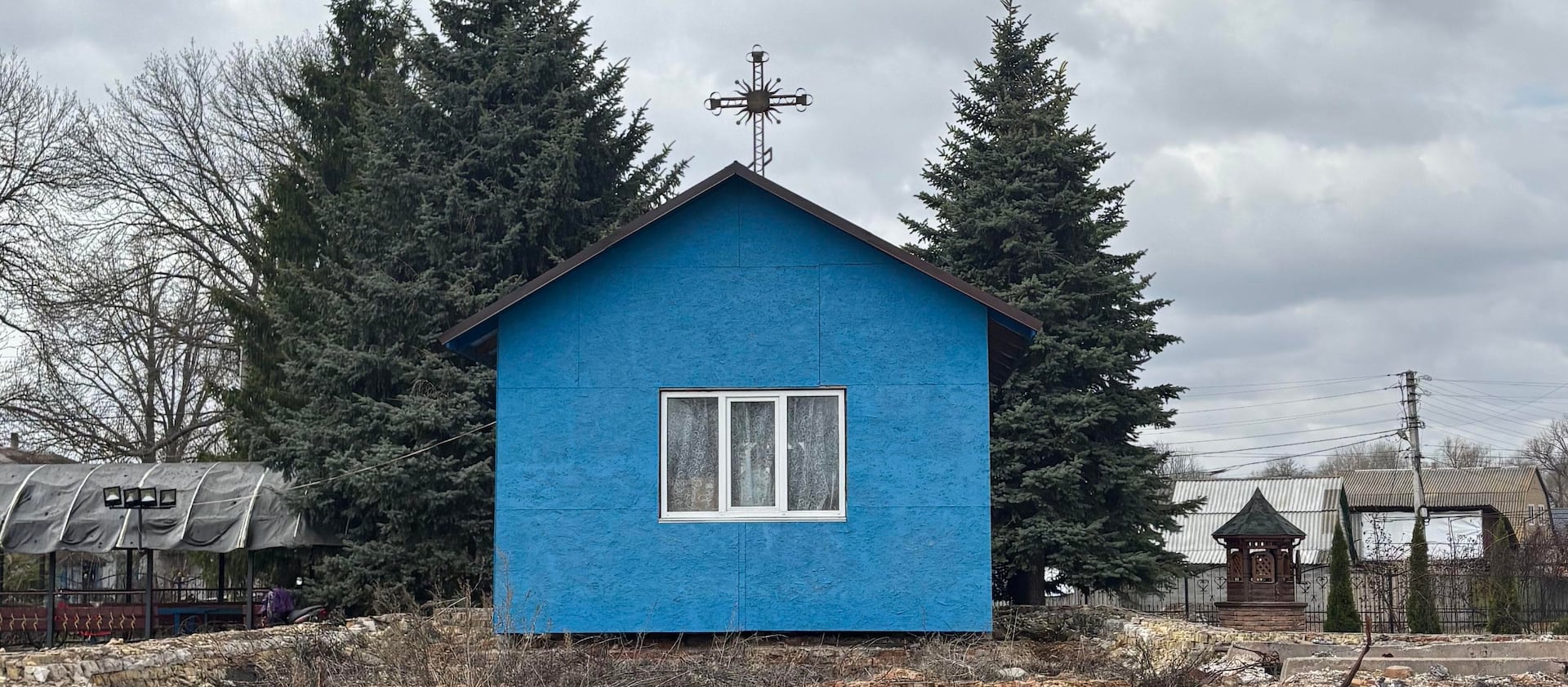


The ground where the church stood is strewn with crumbled brick, charred wires and gnarled metal that looks like it’s been twisted by some malevolent giant. Amid the wreckage, shoots of weeds push up through the debris. A splotch of turquoise paint on a shard of cement is a glimpse of what was once the vibrant blue walls of the St. George Orthodox Church in Ukraine.
The arrival four years earlier of Russian soldiers in Zavorychi, a quiet village about 40 miles northeast of Kyiv, seemed unlikely to the locals. In early March, all bridges leading into the village had been blown up except one. After crossing it, the column of Russian tanks and artillery pushed through swampy, peat-filled land and occupied the village.
During an artillery strike on March 7, a shell hit the green dome of the St. George Church, as it was then called, immediately setting it ablaze. The residents believe the blow was deliberate, aimed directly at the church. Within seconds, the wooden church was in flames, blue smoke billowing over the village like a storm cloud.
Built in 1873, the church had survived the Russian Civil War and Josef Stalin’s famine of the 1930s. It remained unscathed through the Nazi occupation and withstood decades of Soviet atheism.
By architectural standards, it was a typical village church, but the locals made it their own. In its walls, they christened their children, buried their dead and lit candles for loved ones in need. On Easter, worshippers from neighboring villages came to Zavorychi for services.
Oksana Teslia, a Zavorychi native, saw the blue smoke when she emerged from the cellar of her home, where she was hiding from the occupants with her family. “It’s as if part of my heart was torn away,” she recalled, as we stood by the burnt church site in early April. Teslia had baptized her two children in the Zavorychi church. When her cousin died in 2011, they held a funeral service there. “We cried as if it were our home.”
Two or three hours after the first shell struck, the church burned completely to the ground.
Wartime’s spiritual wounds
Four years into Russia’s full-scale invasion, Ukraine’s houses of worship and other sites of religious heritage are some of the war’s most overlooked casualties. By February 2025, 643 religious structures and houses of prayer have sustained damage, according to a report from Religion on Fire, a Ukrainian volunteer organization that documents the destruction of religious sites. Other reports place that number over 700.
Orthodox churches, about 400 of them, have been most affected, but there are also over 170 Protestant churches, 17 Jewish religious structures, including synagogues, and eight buildings from the Islamic tradition that have been impacted. Nearly 53 churches were fully destroyed, according to the report.
Experts describe damaged landmarks as being “wounded,” like a soldier on the battlefield. These “wounds” vary in severity — shattered glass, plaster peeling off, frescoes flaking and detaching inside from the pressure of a blast wave. But sometimes, the damage is less visible.
The attack on a church in wartime represents a psychological assault that suggests that even the place where peace should readily be found is no longer safe.
In January, at the Kyiv-Pechersk Lavra, an 11th century UNESCO World Heritage Site that includes an active monastery and a sprawling underground cave complex, a high-pressure blast wave caused thousands of microcracks in the foundation and the walls leading into the lower stretch of the caves. Over the years, these microcracks can deepen, Lavra’s historians told me, letting in moisture and impacting the load-bearing capacity of the churches. During a recent visit, a window at the cave entrance, blown out in the attack, was yet to be repaired, awaiting a string of government approvals.
The attack on a church in wartime represents a psychological assault that suggests that even the place where peace should readily be found is no longer safe. It’s also an attack on shared cultural memory and the very essence of what it means to be Ukrainian. Sites like Kyiv-Pechersk Lavra and St. Sophia Cathedral, where a blast damaged a cornice on the central apse of the church, link modern Ukraine to a medieval civilization of Kyivan Rus, a bustling center of culture and trade that was baptized into Christianity in the 10th century.
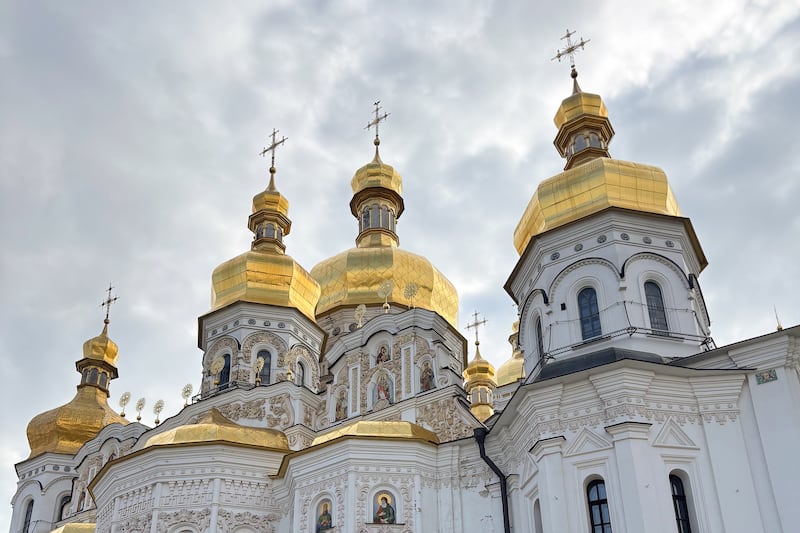
Nelia Kukovalska, the director of St. Sophia of Kyiv National Reserve, called the church a “symbol of Ukrainian statehood.” “It is the place where Ukraine’s spirituality, science and culture were born, where the most important events in Ukraine took place,” she told me. “To ruin it is to ruin a nation.”
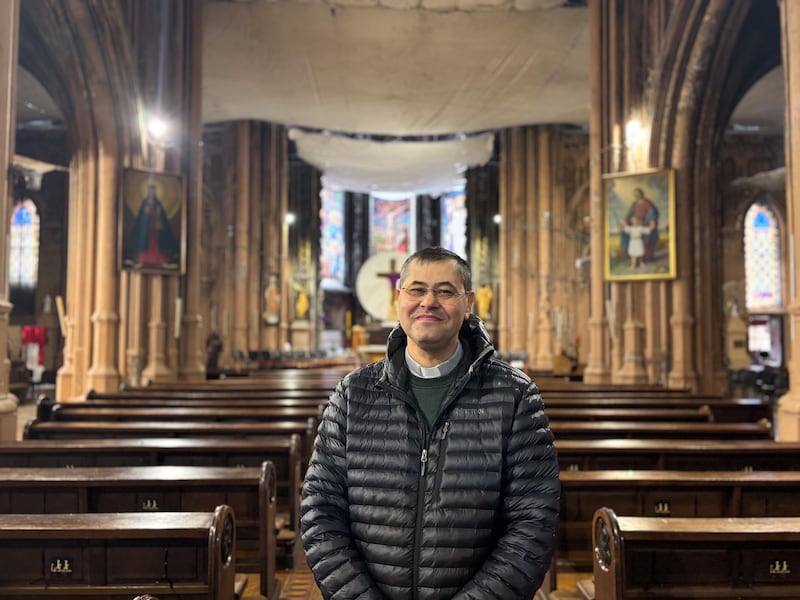
But even amid the threats to their places of worship, Ukrainians refuse to stay away. The parishioners of the St. Nicholas Roman Catholic Cathedral in Kyiv were preparing for Christmas when, on Dec. 20, 2024, a blast wave shattered close to 100 windows in the church, including the intricate rose window on the facade. Still, the attack didn’t stop them. “We had five Masses with an open window,” said Father Pavlo Vyshkovskyi, the priest of the church.
“It is the place where Ukraine’s spirituality, science and culture were born, where the most important events in Ukraine took place. To ruin it is to ruin a nation.”
When I visited the church during Holy Week, the rose window had been patched up with polycarbonate. In the upper gallery of the church, the shards of colored glass were scattered on the ground like a puzzle waiting to be put back together. Without waiting for funding, the parish pitched in to cover elongated lancet windows with blue and yellow banners made with coarse fabric to protect the interior from snow, rain and pigeons. “There’s no real point in restoring stained glass right now while the war continues,” Father Vyshkovskyi told me. “And what guarantee is there that this won’t happen again today or tomorrow? These are enormous costs — truly huge sums of money.” The cathedral’s full restoration, from both aging and war damage, could cost $20 million or more.
To document countrywide destruction, grassroots organizations like the Ukrainian Heritage Monitoring Lab, based in Lviv, dispatch expedition teams of architects, art historians, museum professionals and forensic photographers to carefully record the damage on-site. In the territories under Russian control, experts rely on reports from residents or soldiers on the ground. Systematizing this knowledge feeds into a larger goal: building a meticulous record of evidence to keep Russia accountable for the war crimes against Ukraine’s cultural heritage.
The need to rebuild
“We knew that we would never have a church like that again,” Teslia recalled thinking. But Easter was around the corner and Zavorychi residents needed a place to hold the services. So parishioners got busy. Teslia, who spearheaded a fundraiser, wrote on Facebook in April 2022: “Let’s get to work! We will have our sanctuary and we will have our Ukraine!”
Someone donated cement leftover from nearby construction. The state forestry provided wood for the frame. The local men insulated the walls and installed the roof. The ceiling was painted blue, walls yellow, the colors of Ukraine. On Orthodox Palm Sunday, a tiny chapel right in the spot of the old church’s entrance held its first service.
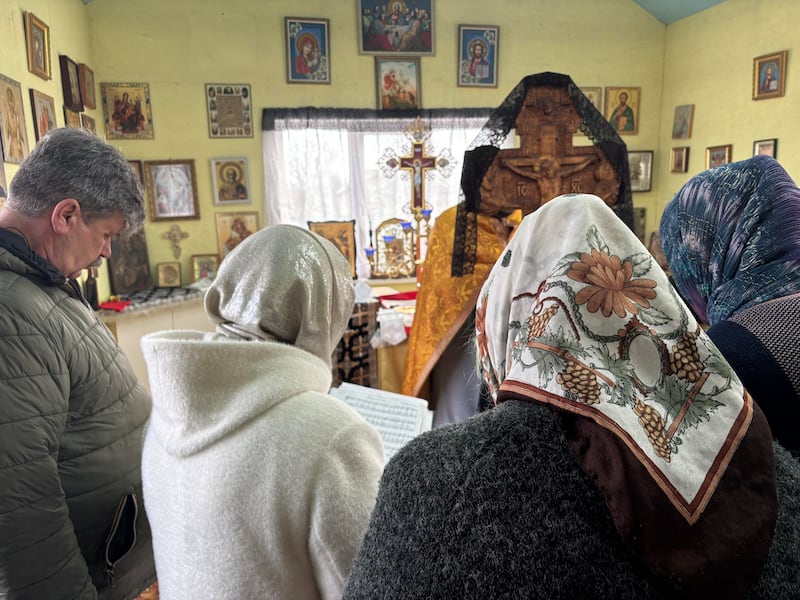
On a Saturday morning in April, four years after the attack, a dozen or so parishioners, all women except for one middle-aged man with a mustache, packed the chapel, standing tightly next to each other. Black lace, in observance of Lent, draped over the wooden cross in the center of the chapel. A woman led the liturgical chanting, clutching a binder full of handwritten markings. Several icons salvaged from the fire adorned the walls.
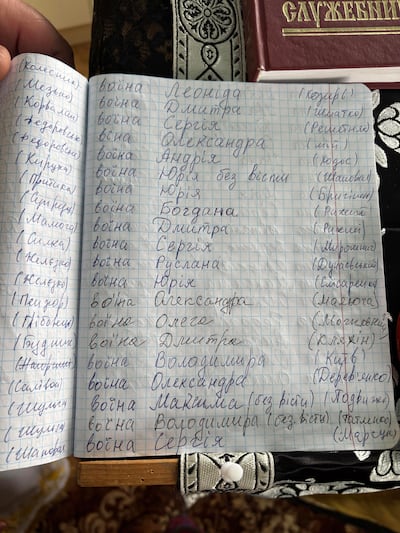
At one point, the priest circled the room, dabbing each person’s face and hands with a brush soaked in sacred oil. A notebook on his lectern listed the names of active soldiers to pray for. If a soldier died, his name was moved to a separate section for the fallen.
“People go to the church carrying their deepest personal struggles,” Father Vasyl Bilynec, the visiting priest and military chaplain who conducted the service in Zavorychi, told me. “More than anything, they bring their fear, because they understand that, sadly, we are now in God’s hands.”
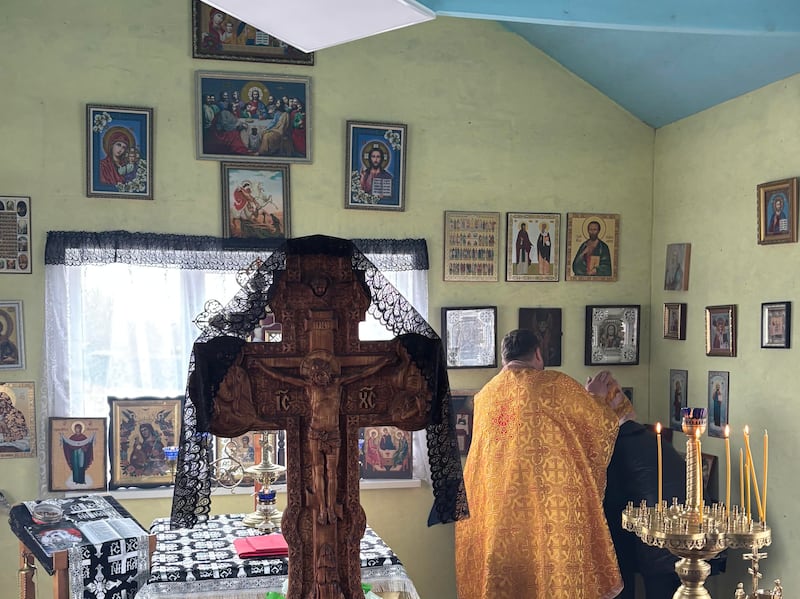
But the fire of the Zavorychi church, and even more its partial rebuilding, also exposed a rift that’s long been simmering in the community. The original St. George Church belonged to the Ukrainian Orthodox Church, historically tied to Moscow. Although the local priest told the residents he had distanced himself from Russia, more patriotic parishioners, including Teslia, still objected to the formal tie. The dispute ultimately split the congregation: some followed the priest, who now holds services in a private home, while others stayed in the rebuilt chapel, now part of the Orthodox Church of Ukraine, which received its autocephaly, or autonomy, from the Patriarch of Constantinople in 2019.
Its new name is St. Yuriy’s Church, a Ukrainian form of St. George.
Olena Lobko feels at home in the chapel even though it’s more modest. She has a set of keys and sometimes comes in to just sit and pray. “It feels different here,” Lobko told me. “It’s so quiet and peaceful.” While we sat in the chapel after the service, a helicopter hovered over the area. The locals know the signs of war too well. “That means the shelling is coming,” Lobko said.
The weight of spiritual and cultural renewal
Until the war ends, church restoration will have to take a back seat. “It’s expensive, dangerous, and can draw … sometimes unwanted attention — it simply significantly increases the risk of being struck again,” said Kateryna Goncharova, Ukraine-based country director at the World Monuments Fund, an international organization that works to safeguard cultural heritage. The war has also created a shortage of skilled workers, trained in architectural restoration.
Yet, conservation projects — treating the “wounds” of structures until full treatment and recovery — are crucial. To help safeguard Ukraine’s wooden churches — the most vulnerable in the conditions of the war — World Monuments Fund, along with other partners, supplied 200 churches with special water-mist fire extinguishers that are sensitive to the frescoes and interior paintings in the churches. There are nearly 2,500 wooden churches in Ukraine — and eight of them are under UNESCO protection.
On a sunny April day, several staff members guided me down a tight stairwell into the underground caves at Kyiv-Pechersk Lavra. With no other visitors, the dimly lit space felt serene and peaceful, like a shelter underneath a battlefield. A dehumidifier hummed in a narrow tunnel that hosts reliquary glass-covered coffins with mummified bodies of monks and saints in elaborately embroidered garbs.
Preserving churches is not enough if they stand empty. To be carried forward, spiritual heritage needs a way of staying alive, of being practiced organically not to lose its meaning.
Once the Russians were pushed away from Kyiv early in the war, the Lavra and the Ministry of Culture officials made the decision not to evacuate its “moveable” heritage — icons and artifacts — but instead store it in secret and secure locations, where they’d be monitored regularly.
This strategy doesn’t work with churches, said Kostiantyn Krainii, the deputy director of the Kyiv-Pechersk Lavra National Reserve, after we emerged from the caves and gazed up to the soaring golden domes. “We can’t pick them up and move them,” he said. “That’s why there is a threat, and we live with this threat all the time.” A system of seismic sensors — some are installed on the Lavra’s belltower — monitors tremors and explosions and helps experts understand more hidden impacts of the jolts. “The only way we can save (the churches) is if we know them perfectly,” Krainii said. He pointed to the digitization of Lavra’s sites, the only reliable way, in his view, to protect churches in the war. With the help of laser scanners and photogrammetry technology, conservators can create a 3D model of a church that encompasses everything from the exterior details to the facial expressions of a saint on an interior fresco. Ukrainian company Skeiron has digitized about 270 cultural sites and churches, including Lavra caves and St. Sophia Cathedral.
But preserving the churches is not enough if they stand empty. To be carried forward, spiritual heritage needs a way of staying alive, of being practiced organically to not lose its meaning. It’s why earlier this year, after a period of war-related closure, Lavra opened up its Near Caves to tourists and pilgrims, part of the effort to restore the tradition of Ukrainian pilgrimage and its historic routes. Krainii and his colleagues are also working to preserve the intangible legacy of the Lavra — rituals and traditions like the distinctive Lavra chant, the sacred veneration liturgy to be considered for recognition by UNESCO.
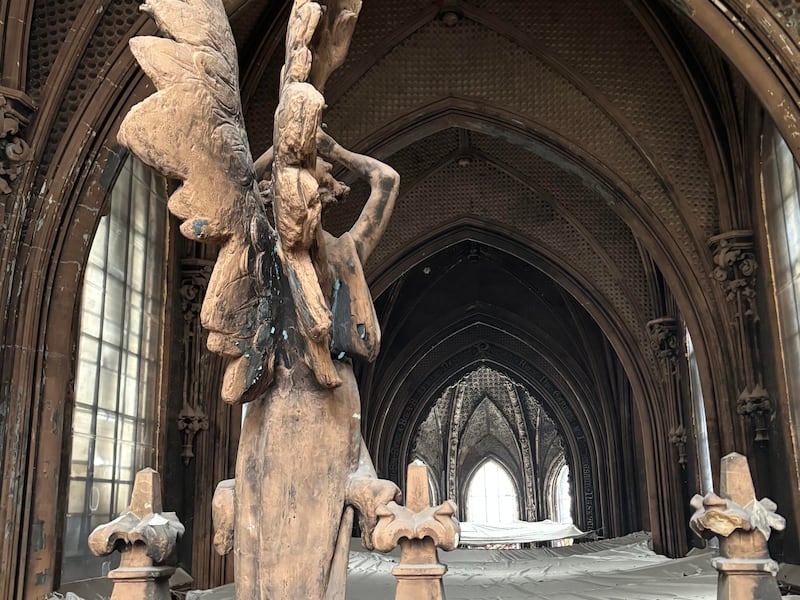
At Lavra, the intertwined work of spiritual and cultural renewal carries the weight of 300 years of Russian influence and the long presence of clergy aligned with the Moscow-linked Ukrainian Orthodox Church. The war has ramped up the efforts to reclaim suppressed histories and to revive Ukrainian devotional life and Christian spiritual ministry at Lavra. For three years, state-owned Lavra has been enmeshed in a court battle to evict the monks with alleged lingering ties to Moscow, who still reside on the territory and who have sued the Ukrainian government. “Ukraine, as an independent state that has found itself in this war, has accepted this challenge and is now carrying out work to cleanse this ‘Russian world’ here, within the walls of this sacred site and to restore Ukrainian tradition,” said Maksym Ostapenko, general director of the Kyiv-Pechersk Lavra National Reserve.
In Zavorychi too, a renewed devotion is taking hold as parishioners chart a new path forward for their community and their church.
Rebuilding it fully now feels like a distant and costly prospect, Teslia told me. The chapel was meant to be temporary, but it’s not likely to be replaced soon. Without a generous funder, Teslia said parishioners will never pool enough money to rebuild the church the size of the old one.
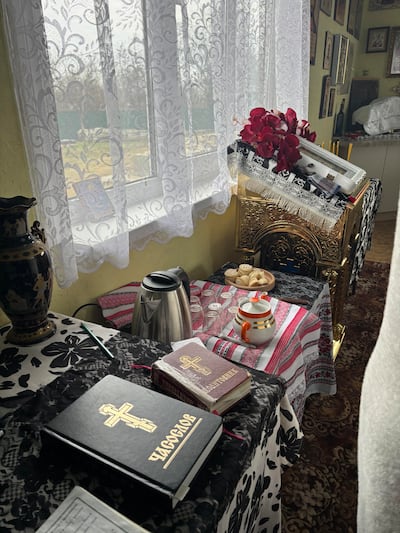
Meanwhile, they plan to create an extension and add a sanctuary with “royal doors,” an ornate golden entrance through which the priest passes between the sanctuary and the nave during services. The expansion would allow more people to attend, especially during holiday worship.
In the summer, Lobko and Teslia plan to take shifts at the chapel, so they can keep it open for visitors to come in to pray. When the time comes to rebuild the church, Teslia’s vision is simple and familiar: the same sky blue color, a medium size, this time built out of brick. She’s been married for years, but never had a church wedding. One day, she hopes to have one: “God willing, in the new church.”
This story appears in the June 2026 issue of Deseret Magazine. Learn more about how to subscribe.