
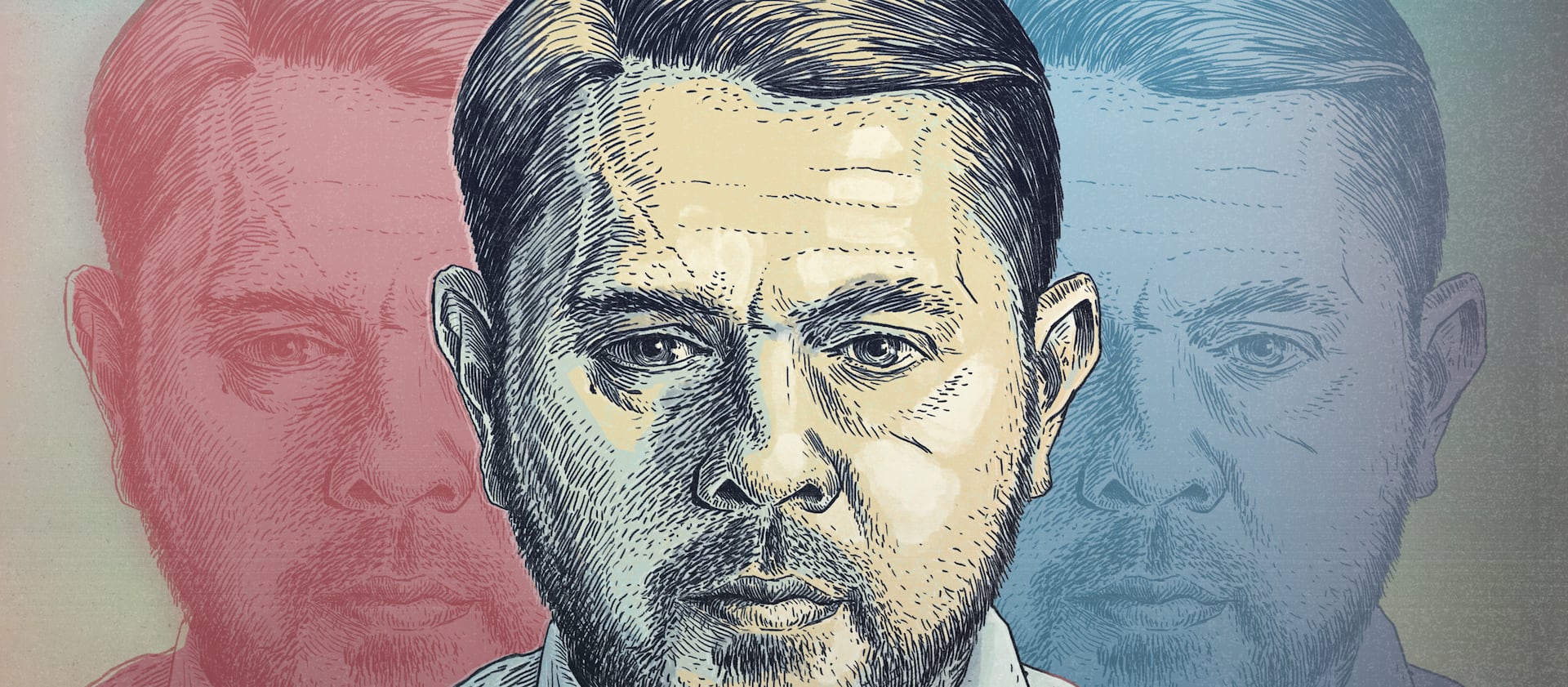


Across from the U.S. Supreme Court building, up a labyrinth of stairs and hallways, behind a plain, wooden desk, sits cherubic Ruben Gallego. Graying beard. Electric-blue eyes. Standing “just slightly above” 5-foot-7, he tells me.
The junior senator from Arizona came up in politics as a progressive darling, but lately, Gallego reads as something else entirely. Not a centrist, exactly. He’s a proud fighter and gets combative with the Trump administration. He’s neither a conservative Democrat nor a leftist.
“He has broken with some of the party orthodoxy on the left,” says Jeff Flake, the Arizona Republican who once held Gallego’s Senate seat. “I think it’s probably genuine on his part.”
Democrats have been losing male voters election cycle after election cycle and desperately need to win them back to remain competitive. With the party seeking a national rebirth, Gallego’s approach offers one path forward.
In 2024, he was the only Democrat to pick up a seat in the Senate in what was otherwise a triumphant cycle for Republicans. He beat his Republican opponent by about two and a half percentage points — even though Donald Trump carried Arizona by nearly six points. He got there, he believes, by hammering issues of affordability; by refusing to embrace party purity tests; and, most of all, his unique appeal to working-class men, the one constituency Democrats have lost to Republicans consistently over the past two decades.
Gallego has openly flirted with a 2028 run for president. And his strategy, so far, has been to meet men where they are. He attended the annual Army-Navy game, for instance, and hosted boxing match watch parties during his Senate campaign. He talks about how Democrats need to create a world where men can be “providers and protectors” and, famously, afford big trucks.
“There’s no other senator like Ruben,” says Rebecca Katz, a Democratic consultant who worked on Gallego’s Senate campaign. “His experience shapes him in a way that is different from any of his colleagues.”
Earning that experience required surviving his own father’s abuse and abandonment; reconciling his Harvard education with his Marine Corps service; and rising through the political ranks, from the Arizona Legislature to Congress to the Senate at 45 years old. Now he’s selling a new future for the Democratic Party, and for American men.
He may not tower over anyone physically, but Gallego’s gamble looms large. He’s betting he can find a sweet spot between the Trump administration’s aggressive machismo and liberal tendencies to label anything overtly masculine “toxic”; that Democrats can inhabit that space without abandoning their core values and alienating their base; and that he can lead Democrats there without getting derailed by his own political baggage.
Which all sounded simple enough when he explained it to me in March, seated in the office building near the Supreme Court. But the challenge — like the man himself — is much more complex than it seems.
A fatherless man
He was born a boy in between.
His father had immigrated from Mexico to Chicago as a teenager, and his mother had done the same, but from Colombia. They married and had four children. He was the second, the only boy, born in 1979 as Ruben Marinelarena.
At two, his family moved to his grandmother’s farm in Chihuahua, Mexico, where he spoke Spanish as his first language. He tended corn and watermelon crops, rode horses, even tamed a coyote. When Ruben was in second grade, the family returned to Chicago, where his father opened a construction firm. He’d still spend summers in Mexico until his parents divorced around the time their only son started middle school.
All the better, Gallego would tell himself later. His father was “not a good man. Definitely not a good father.” He once took Gallego to McDonald’s and asked why he was eating his fries one at a time, then slapped them out of his mouth and called him gay.
Gallego would eventually change his birth name to his mother’s maiden name after his father was convicted of serious drug trafficking charges. “Multiple times over,” Gallego adds, unprompted. “I needed to talk to somebody, needed to actually know what a man looked like or acted like. Because that wasn’t my father.”
He found role models in the many jobs he worked, starting on construction crews and graduating to janitorial staff and short-order kitchens. He sometimes worked at job sites with his cousins. “They showed me the value of honest work, the dignity of bringing home that pay for your family, the pride in being able to do that.”
Some also tried to lead him astray.
“In Latino culture, especially cultures without college degrees, and cultures that have just recently immigrated, there’s this thought that if you are studying, you’re kind of a wimpy guy,” he says. “Some even say you’re ‘acting white.’”
He heard that plenty because he was always studious. But thanks to certain teachers who saw his academic potential, he became a model student. “Learning that intellectual curiosity is still manly was extremely important,” he says.
To the extent that people feel they have to be, as men, crass or crude or vulgar, I don’t buy it. Even if that’s politically advantageous, it’s not worth it.
— Former Sen. Jeff Flake
More important was undoing some of what he did learn from his father, who defined manhood, according to Gallego, as something like “reserved stoicism” with a dash of violence. Luckily Gallego had uncles and, especially, a grandfather who modeled vulnerability and warmth as strength rather than weakness.
His mother encouraged him to seek out male role models, but she also modeled toughness and tenacity by providing for her four kids as a secretary. It wasn’t always enough, but Gallego respected her effort, her willingness to do whatever she could for her children. Despite those efforts, he ended up sleeping on the floor every night, telling himself his life sucked, and that he was going to grow into something better than what he was.
He came up with a plan to get into Harvard, calling up every student there he could find with a Latino last name to ask for advice, and practicing standardized tests during shifts at work. The plan worked; he enrolled at Harvard in 1998. The plan to stay did not.
Too much partying. Too many bad grades. The school asked him to leave, but with an invitation to reenroll after a year. Gallego decided to stay in Boston with a job and an apartment and a new plan to finish what he started (which, in 2004, he did). While waiting, though, he did something unplanned in the fall of 2000. Something he admits he doesn’t fully understand even now.
On a whim, he walked into a Marine Corps recruiting station.
The impulse came, he thinks, from some lingering desire to serve the country. “It wasn’t a macho thing,” he writes in his autobiography. “It was more belonging, and patriotic.”
He told the recruiter he wanted to join the Reserves, and to be in infantry. Later, when he was outed as a Harvard student during basic training, his drill instructor berated him: “Why the (heck) aren’t you an officer?” he’d say. “Are you stupid?”
One thing Gallego did know, however, was that he didn’t want to be an officer, or take some desk job. He wanted to be in the infantry. He wanted to fight on the front lines. “If I’m going to be a Marine,” he told the recruiter, “I want to be a Marine.”
A military man
In May of 2005, Gallego was riding aboard a tank-like amphibious assault vehicle, or “trac,” just one in a convoy moving through Karabilah, Iraq. His group of Marines, Lima Company, had once been dubbed by embedded reporters as “Lucky Lima”; since their deployment in the third week of March, they’d participated in dozens of patrols and complex operations without a single casualty.
That had changed a few days before, when Lucky Lima had lost two men in an operation that became known as “Death House.” Morale was low as Gallego chugged along in the lead trac. Behind him, second in line in the convoy, rode his best friend, Jonathan Grant.
They’d met in New Mexico, where Gallego moved after Harvard to follow his girlfriend, Kate. He’d joined a new Reserve unit, and the group included Grant. “A big guy with endless pockets,” Gallego would remember.
They bonded over training. Gallego had a busted knee — a lingering injury from a childhood car crash. The knee was holding him back from passing a required fitness test, so Grant helped him, leading rigorous run sessions to hold Gallego accountable. Before their deployment began, Gallego had held Grant’s baby and had listened to his wife. “Take care of him,” she’d told Gallego.
He’s dragging the party back to where it started, (back to) when we were the party of the working class. When you could be a man’s man, and be a provider and protector of your family, and be every bit of a Democrat as anybody else.
— Chuck Rocha, Gallego's friend and advisor
Their friendship had deepened as they swept villages in search of insurgents, then returned to base to watch a box set of “Sex and the City.” Grant always had the best snacks. They were always together, except when they had to be apart, like in the trac convoy en route to a new village to sweep.
Gallego liked to keep a clear head as a soldier. In these moments he preferred to listen to the gentle Cuban rhythms of the Buena Vista Social Club or the Otis Redding classic “(Sittin’ On) The Dock of the Bay” on his iPod. And so he was when he heard an explosion.
The trac didn’t have windows, but through slits, his fellow soldiers could see smoke billowing from the trac behind them. The situation became clear: The second trac had triggered an improvised explosive device, or IED, which had detonated directly underneath and ignited its fuel tank. The men trapped inside by a closed door that wouldn’t budge, including Grant, faced a furnace.
Eventually fellow Marines managed to open the hatch. Bodies tumbled out. Gallego’s group waited 20 minutes in their own trac before finally getting out and setting up inside a nearby home. A commanding officer started listing names of the known dead from the second trac, four in all. One of the names was Jonathan Grant.

In the end, Lucky Lima lost 23 Marines during their seven-month tour of duty, making it one of the hardest-hit units of the entire Iraq war. Gallego counts 11 times he nearly died, and he still doesn’t understand why he didn’t. Why, for instance, had his trac seemingly passed over the same IED that killed his best friend?
Some men, he observes nowadays, enlist to prove their toughness. He never felt he had to prove that. What he wanted from the Marines, and what he got in the end, was much more valuable.
“Seeing what other men were willing to do for their country, the sacrifice they were willing to make,” he says, “was a very good role model of what I was already doing but not necessarily understanding.” That’s the world he wants to build for men like his fellow soldiers, and for men like his first son. Born to him and Kate in 2017, his name is Michael Grant Gallego.
A winning man
After his military service, Gallego followed Kate to Arizona, where she’d found work in politics. He found work there, too, first behind the scenes before running for a seat in the state House, which he won in 2010.
He jumped to the U.S. House of Representatives in 2015, just a year after Kate joined the Phoenix City Council (she’s been the mayor of Phoenix since 2019). Flake, the Republican senator whose time in Washington largely overlapped with Gallego’s, remembers him as a reliably liberal member of his party’s progressive wing. Yet, “we always got along,” Flake says, “and I never questioned his commitment to his constituents and Arizona.”
When Flake decided not to seek reelection in 2019, his Senate seat flipped to Democrat Kyrsten Sinema, who became a pariah in her own party during the Joe Biden presidency. Even before she left the party to become an independent and, later, decided not to seek reelection, Gallego announced he would run for her seat.
His Republican opponent was Kari Lake, who The Atlantic has dubbed “Trumpism’s leading lady.” She’s a former TV news anchor who ran for Arizona governor in 2022 and lost.
“(Gallego) was very blessed to run against the worst candidate in the history of Arizona’s Senate politics,” says Chuck Coughlin, a Phoenix-based political consultant. Lake’s aggressive, quip-focused campaign opened the door for Gallego, who stepped through by finding a new voice.
He had left the Congressional Progressive Caucus in 2023, and during his Senate run against Lake broke with mainstream Democratic positions on several key issues — most notably immigration and use of the term “Latinx”— and has spoken out against transgender girls in youth sports since taking office.
“He was very smart about how he ran his campaign given the detriment of the Democratic Party’s identity politics,” Coughlin says. “He sort of ran against that.” It wasn’t just about policy. It was also stylistic.
Gallego admits he’s brash; he’ll drop casual curse words and he isn’t ashamed of it. Right now, that looks like something new for Democrats. “He’s not locked into what’s considered a far-left ideology,” says Matt Grodsky, an Arizona-based Democratic strategist. “I think people know that they’ve got an honest broker when they’re speaking with them.”
Gallego thinks plenty about the current president, and how he’s defined “authenticity” in politics — particularly for men. “Donald Trump really (brought out) some very raw, basic things that do exist within men,” Gallego says. “The idea of dominance, power. And I don’t think there’s been a concentrated effort on the left to give an alternative perspective.”
The answer, he believes, is to match Trump’s authentic machismo with “authentic male role models that aren’t in the same vein.” Men who are committed to civil rights and equal justice and fair elections — but who also like boxing and big trucks.
Many who know him say that instinct is Gallego’s defining feature. “He doesn’t really fit” into a typical liberal mold, says Tony Cani, who has known him since Gallego moved to Arizona. “He’s kind of his own person.” He always has been, Cani says, and so far, it’s worked out.
Gallego has never lost an election, including his surprising Senate victory in what was otherwise a disastrous year for Democrats.
Some, however, wonder whether his recipe for success is really something new and enduring — or whether his “authentic” masculinity is a mask for sexism and misogyny.
A brash man
To Chuck Rocha, a friend and adviser who has been involved in Democratic politics since the early 1990s, Gallego’s approach is nothing new or radical.
“He’s dragging the party back to where it started, (back to) when we were the party of the working class,” he says. “When you could be a man’s man, and be a provider and protector of your family, and be every bit of a Democrat as anybody else.” But that was a long time ago, and as Gallego knows, Democrats nowadays are not known for promoting those ideals.
Plus, die-hard Republicans aren’t fans of Gallego and never will be. Though some have come around.
One of his Senate campaign commercials featured Julie Spilsbury, who sat on the Mesa City Council and opened by labeling herself “as conservative as it gets, a lifelong Republican.” Yet she saw Gallego as the candidate who demonstrated “integrity, compassion and service to others.” Her endorsement, along with her endorsement of Kamala Harris, triggered a recall campaign by Turning Point USA that cost her seat on the council.
The former mayor of Mesa, John Giles, another Republican, endorsed Gallego for much the same reasons. Gallego was the “adult” in the race, he says.
I had wondered whether Gallego’s self-proclaimed brashness — the fact that he curses and drinks and isn’t afraid to jokingly flip people off on camera — would be detrimental among Arizona’s sizable Latter-day Saint constituency at a time when members of the church, according to a recent YouGov analysis of voter data spanning 2007 to 2025, are the only religious group trending toward the left. Giles, a member of The Church of Jesus Christ of Latter-day Saints, doesn’t think so.
“The demeanor of politicians has changed, and I don’t think being brash disqualifies you from getting the vote of the (Latter-day Saint) population anymore,” Giles tells me. “Not to be controversial, but I would say he’s less brash than Mike Lee.”
Former Sen. Flake isn’t so sure.
Gallego, per a recent New York Times analysis, uses the F-word more than any other politician, by a wide margin. Supposed “authenticity,” Flake believes, should not be an excuse to model nastiness.
“To the extent that people feel they have to be, as men, crass or crude or vulgar, I don’t buy it,” he says. Even “if that is politically advantageous, it’s not worth it,” he adds. It sets a bad example for young people. And Gallego, he knows, has sometimes crossed that line. Perhaps most of all within his own party.
In November 2025, messages leaked by a longtime friend revealed Gallego taking serious shots at fellow Democrats. “We look like the not fun party. Always telling and correcting people. Not allowing men to be men. Women to be hot,” Gallego wrote in a flurry of texts to his friend. “We used to be the party of sex, drugs and rock and roll.”
The friend, who identifies himself as a Republican, texted back that Gallego is wise to call out fellow Democrats, and that “it’s time for you to flex and battle your way to the top of that party,” before adding that next time he’s in D.C., he wouldn’t be surprised to find Gallego hanging out with “hot beautiful people” at the National Republican Club.
“Now Dem women look like Dem men and Dem men look like Dem women,” Gallego responded. He never imagined the exchange would become public. But interestingly, he did not apologize, nor did he dismiss his remarks as locker room talk.
Despite widespread criticism from liberal groups, he said the messages reflected what he’s been saying all along: The Democratic Party is getting too small, and it needs to become more welcoming of others to combat Trumpism. But some saw in his glibness a foreshadowing of what was to come in April, with Gallego under a national microscope because of his friendship with disgraced former California Rep. Eric Swalwell.
Swalwell dropped out of the Golden State’s governor’s race following accusations of sexual misconduct by multiple women, and Gallego called a 40-minute press conference to distance himself from a man who once called Gallego his “best friend in the world.”
Gallego had chaired Swalwell’s 2020 presidential campaign committee and ridden camels with him in Qatar. Their friendship was real, Gallego admitted. He said he’d been duped and “betrayed,” and that he had no knowledge of Swalwell’s indiscretions. But soon accusations were flying, including an ethics complaint lodged against Gallego by a Florida Republican House member.
“There’s typical conspiratorial” speculation among members of the hard-right, says Coughlin, the moderate Republican strategist, “trying to fan false flames and fan the smoke into something more than it is.” But from what he knows of Gallego, and from what he’s heard so far, the smoke will dissipate. Everyone else I spoke with who knows Gallego said the same. Despite the smoke, they stuck their necks out to attest for his character. “I could be wrong,” Coughlin adds, “but I’m fairly certain that a year from now we won’t be talking about this.”
Even so, Gallego risks alienating core Democratic supporters for other reasons.
He voted with Republicans on the Laken Riley Act, named for a young woman murdered by a Venezuelan immigrant living without legal permission in Georgia. “It hasn’t actually been that much of an evolution. The Democratic understanding of immigration and illegal immigration has always been pretty basic,” Gallego told The New York Times, “and then it went awry.” That kind of thinking has empowered both detractors and admirers.
“Sen. Gallego has demonstrated that he is willing to swim upstream and that he’s not going to just follow a party line when it comes to the way he votes or the way he governs,” Giles tells me. “He’s open to considering other points of view.”
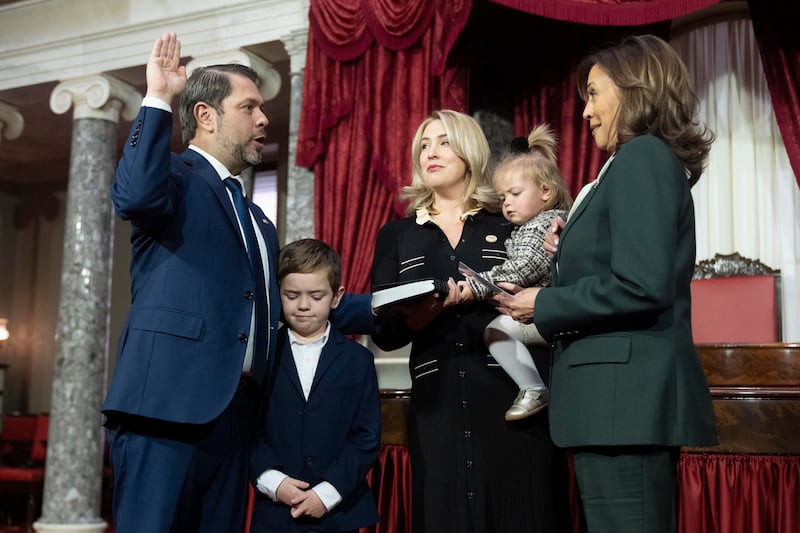
However, he’s also suggested nationwide work stoppages if Trump tries to subvert the 2026 midterm elections, to the delight of Democrats eager to fight, and has used his military experience to become a leading critic of Trump’s actions in Iran.
Walking this particular tightrope is necessary in a purple state like Arizona, where Republicans outnumber Democrats, and where courting independents is mandatory. It could also work well in a national election, where success in swing states can translate to success overall.
But can it win him his party’s nomination?
A genuine man
When I met with Gallego in March, I wanted to know what should hold Democrats, and Americans, together under his big-tent way of thinking.
Gallego has joined forces with Blue Dog Democrats like Rep. Marie Gluesenkamp Perez through groups like Majority Democrats. He’s also defended New York Mayor Zohran Mamdani, a democratic socialist, against attacks from within. Ideally, he told me, Democrats should be able to represent different constituencies — Mamdani’s voter base in New York looks very different from Gluesenkamp Perez’s district in rural Washington, and their policy outlooks should reflect that. But philosophically, they should have two things in common.
First, Gallego said, is standing for “the opportunity to live a real middle-class existence and beyond.”
Second is “a true devotion to civil rights, legal rights.” Within that, there will be plenty of disagreement. “But as long as we are as strong as possible in those two poles, I think it’s possible to have a lot of people under our Democrat tent,” he said.
“The thing that’s most important about Ruben is his broad appeal,” says Sen. Gary Peters, a Michigan Democrat. “And not just to traditional Democrats. He has strong appeal with independents, as well as folks who are Republican.”
I don’t think any conversation about 2028 should happen without Ruben Gallego being a part of that conversation.
— Rebecca Katz, Gallego's friend and advisor
Will the working-class men who’ve flocked to Trump see him that way? It’s going to be an uphill battle, and Gallego knows it. More immediately, left-wing elements of his own party have already started to sour.
In an April Instagram post that framed Gallego as a “Latino Dem who says calls to abolish ICE are ‘ridiculous’ wants to run for president,” commenters called him something like “the next Fetterman,” a reference to Pennsylvania Sen. John Fetterman, a Democrat who has become a Republican darling. Instagram comments are not reflective of the electorate, but they suggest Gallego won’t likely be the first choice among progressives if he chooses to run. Yet through challenges from both right and left, Gallego has proven unwilling to succumb to partisan expectations.
Consider once more his stance on immigration enforcement. He not only backed the Republican-led Laken Riley Act; he co-sponsored it. He was proud to attach his name. “Arizonans know the real-life consequences of today’s border crisis,” he said at the time. “We must give law enforcement the means to take action when illegal immigrants break the law.”
Yet, unlike Fetterman, he also led efforts in January to block additional funding for ICE and the DHS following the shootings of Alex Pretti and Renée Good in Minneapolis. “I cannot vote to give ICE and Border Patrol more money to terrorize our communities,” he said then, “until we see significant changes to how these agencies operate.”
Likewise, consider his stance on Israel. He has supported funding Israeli defense in the past, and as a congressman, he was deemed “complicit in apartheid” by a Palestinian rights group. But in a March podcast interview with The Bulwark, Gallego first reaffirmed Israel’s right to exist “as a Jewish state,” then added, “We can’t say we don’t think this is in our national interest without being accused of being an antisemite? Then what kind of relationship is this?”
Will Gallego’s maverick tendencies please everyone — or no one? Perhaps his current view of manhood — the one he’s arrived at through bitter experience across Harvard, the military, his divorce from Kate, his second marriage in 2021 and the two kids who’ve been born since — offers a hint.
“One thing I’ve finally realized is that I think that’s just an ever-growing thing,” he told me of defining what it means to be a man. “I’m not perfect, but I want to be more, become more and more perfect for my kids and my family.”
Gallego sees manhood, in other words, as a state of mind more than a destination. As something that exists in constant flux, much like his political worldview. “You never know what to predict with Ruben Gallego, because he doesn’t operate the way other politicians operate,” Katz, the Democratic strategist, told me. “He goes with his gut.”
That could have interesting implications for the 2028 presidential race. When we spoke, Gallego was adamant about Democrats casting as wide a net as possible for their future nominee — even if that means embracing someone unconventional, like the ESPN pundit Stephen A. Smith, who has hinted at a 2028 presidential run.
“Whoever wants to take a crack should take a crack. Let’s see what works,” Gallego told me. “A Stephen A. Smith, or a Mark Cuban … everyone who has something to say should take the opportunity.”
Then, about two weeks after he told me that, Gallego openly floated a run of his own in an interview with NBC. He didn’t commit to anything but said he’d “have to look at it,” with an emphasis on his ability to win back Latinos. That delighted Katz.
“I don’t know what the future holds,” she told me. “But I don’t think any conversation about 2028 should happen without Ruben Gallego being a part of that conversation.”
Katz admits she often finds herself to his left, but she likes that he’s hard to fit into a predictable box. Gallego is still learning to become his own man. A good man, Katz says. And right now, more than any ideology, that’s what the country needs most.
But she’s a friend and already a fan. What about someone less inclined to be supportive?
Flake, for example, considers Gallego much too liberal on policy questions like abortion and taxation, and he’s skeptical that Gallego’s brand of “authenticity” is good for anything aside from Gallego’s own political fortunes.
Yet Flake also remembers that even though they served Arizona from about as far across the political spectrum as possible, Gallego “was always kind to me.”
In fact, when Flake’s brother died last year after a 37-year military career, Gallego reached out and offered to help however possible with funeral arrangements and securing a military burial plot. He checked in multiple times, and Flake hasn’t forgotten. “That speaks a lot for somebody,” he says.
Flake is profoundly concerned about the direction of the country. Polarization is deepening. Nastiness is becoming mainstream. “We see where politics have gotten,” Flake told me, “with a president that uses that kind of language.”
He isn’t sure whether Gallego will become an antidote or an aggravator, but thinking back on Gallego’s outreach last year, he knows this much: “It was very kind of him to do,” Flake said, “and it was genuine.”
This story appears in the June 2026 issue of Deseret Magazine under the headline “Middle Man.” Learn more about how to subscribe.