

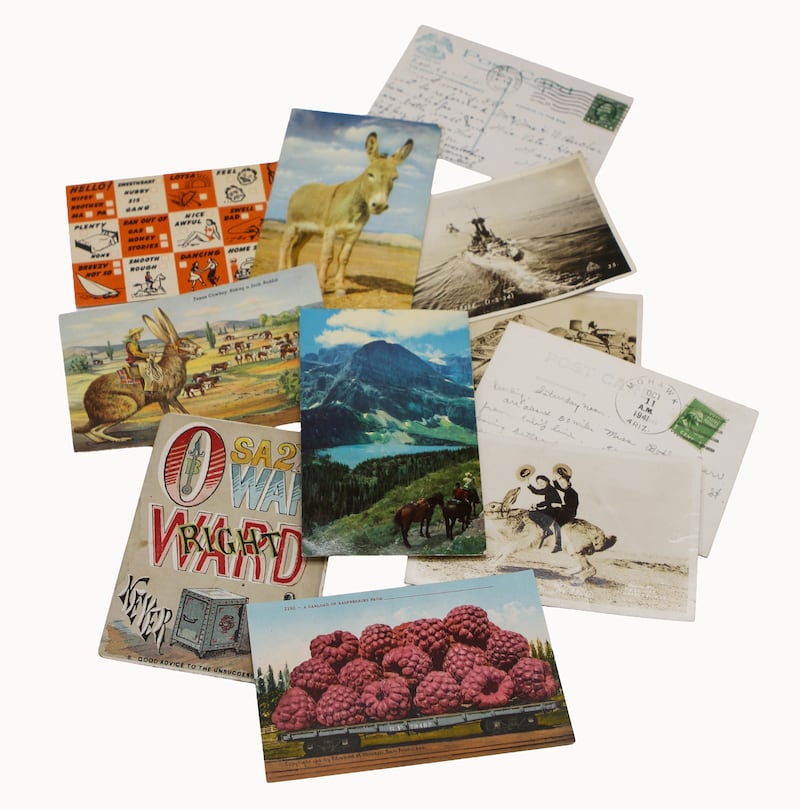

A shallow drawer hangs open from a neatly labeled metal cabinet in a rather modern-looking bookstore. There’s a world outside the plate-glass windows, past wooden shelves and a coffee shop, lush with green lawns, blue skies and stately old buildings. But there’s another world here, hidden in the trove of small images that pack this drawer. Each is printed on cardstock, about 4 by 6 inches in size. Some are yellowed or faded with age. Hunched over, I thumb their ruffled edges, one by one, making my way past the “M” tab, through Missouri and into Montana.
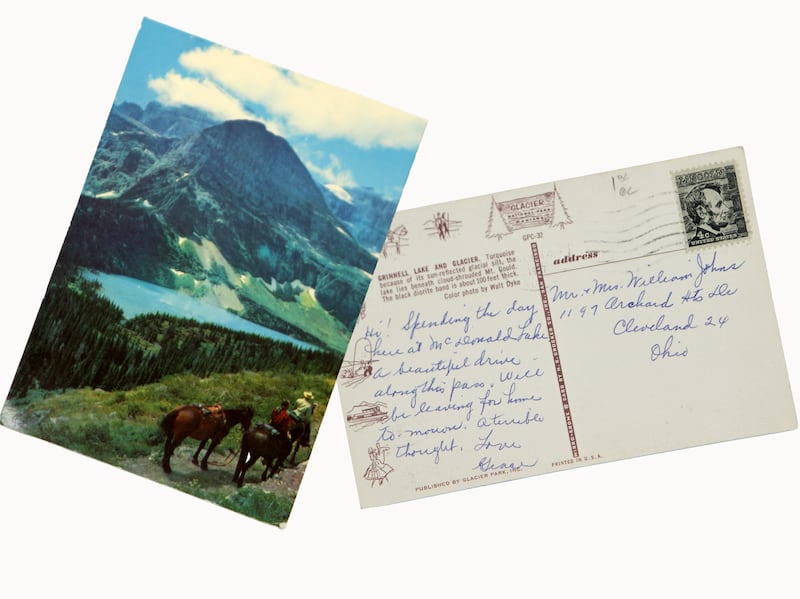
One image stops me. Three horses stand on a trail over a turquoise lake ringed by pine trees, carrying a man in a cowboy hat, a woman in a red flannel, and an empty saddle that I imagine belongs to the photographer. Beyond Grinnell Lake, tinted blue by glacial silt, a sheer limestone peak identified in the caption as Mount Gould rises toward cottony clouds. Faded handwriting and a grainy postmark trace this postcard’s first journey, from Glacier National Park to Cleveland, Ohio.
Postcards were made to be sent and forgotten, much like social media posts today, but time has changed that. Rarely mailed anymore, they have become precious. To hobbyists and dealers, they are unique collectibles, like coins or stamps. On occasion, they have even become historical artifacts and objets d’art, showcased at institutions like the Tate galleries in London, the Museum of Fine Arts, Boston, and The Metropolitan Museum of Art in New York City. But this cabinet at Ken Sanders Rare Books in downtown Salt Lake City holds the kind of pieces that I, personally, am looking for: postcards that tell human stories.
Some collectors chase pristine, mint-condition postcards to complete a set. Others search for rare postmarks, historically significant dates or eccentric themes, like submarines, embroidered landscapes or political satire. Hundreds of millions have been printed, but no two are exactly alike. Each is a moment suspended in time. You could say that about any photograph, but a postcard is different because the moment it captures is when somebody saw that image for sale in a gift shop or a hotel lobby and decided to share it with a loved one somewhere far away.
Postcard Mania
Postcards were initially created as a cheap alternative to sending letters. The first one, issued by Austria-Hungary in 1869, was blank, but people sent 2.5 million of those little rectangles within three months. By the time the United States emulated that idea four years later, European postcards had been printed with lithographs or illustrated as souvenirs, advertising and political commentary. Picture postcards grew in popularity along with the rise of the Eiffel Tower in Paris, which they helped to document. That spawned a golden age, which arrived in America in 1893 via the World’s Columbian Exposition in Chicago, where visitors could buy two official “view cards” of the fair’s gleaming but temporary White City for a nickel, postage included.
The U.S. cut the postage rate in half five years later, then in 1907 authorized separate spaces on the back for the address and a message. Americans mailed 668 million postcards that year, and nearly a billion by 1913. A Midwestern salesman designed the revolving postcard rack to showcase holiday greetings, jokes and scenic vistas. Major publishers like Raphael Tuck & Sons and the Detroit Publishing Company dispatched photographers to distant landmarks while independents like Merle Porter, “postcard king of the West,” roamed the country with wagon-mounted darkrooms, capturing small-town life. New cameras even allowed amateurs to create “Real Photo Postcards” from postcard-sized negatives.
The trade journal American Stationer called the phenomenon “postcarditis” — an irresistible urge to mail a photo of wherever you happened to be. People were also starting to collect. In homes across the country, postcard albums sat beside family Bibles, stuffed with souvenirs and notes from loved ones. One subscriber to The Post Card World, the first magazine devoted to the pastime, claimed that she added a hundred new cards to her collection every week.
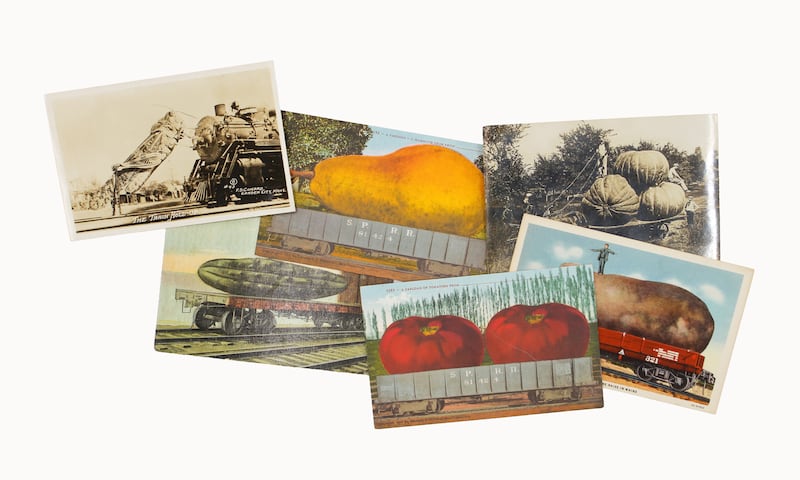
The industry survived two world wars and a depression, in part by reinventing postcards themselves. “White margin” postcards were cheaper and easier to produce. Chicago publisher Curt Teich introduced textured and vividly tinted “linen cards” in 1930. Glossy, full-color “chrome cards” dropped in 1939. In the postwar era, as roads stretched westward, postcards depicting highways, motels, national parks and neon cities became quintessential souvenirs. There were cowboy silhouettes etched onto copper, tiny bags of salt stitched to images of the Great Salt Lake, and “exaggeration postcards” showing a giant Idaho potato driving a tractor or the quintessential Western “jackalope.”
As telephones and rising postage costs made postcards less practical, more people started collecting them. In 1945, Ohio scholar Rendell Rhoades coined the term “deltiology” — from the Greek for “small illustrated card” — to describe the practice. The Metropolitan Postcard Club of New York City, now the oldest of its kind, was founded the following year. Other clubs, fairs and dealers sprang up, fueled by nostalgia and leftover stock from shuttered publishers. In 1979, The New York Times called deltiology “perhaps the fastest-growing hobby in the world.”
And it’s still going strong. Clubs meet to buy, trade and sell postcards that are carefully preserved in albums, archival boxes and acid-free sleeves. They work together to investigate cards, deciphering damaged postmarks, publisher numbering systems and visual clues like clothing styles, automobiles or the number of stars on a flag. Online, “Postcrossing” links more than 800,000 collectors across 245 countries, many of whom gathered at 163 meetups on World Postcard Day last October.
There are different ways to assess a postcard’s value. Some prize unmailed specimens for their pristine condition. Others pursue rarity, which depends on age and the limits of a print run, but different collectors chase postcards of every kind and subject. Most sell for a few dollars, but some have fetched staggering sums. In 2002, a hand-painted caricature sent by British writer Theodore Hook to himself in 1840, considered the world’s oldest postcard and the first to bear Britain’s Penny Black stamp, sold for $45,000 at a London auction. Others derive worth from association — a 1926 postcard signed by Mahatma Gandhi sold for over $8,000. But to some collectors, even a tattered, random find at an antique store, scrawled with a personal message between strangers, can be priceless.
Picture Perfect
A gray battleship cuts through dark water, the USS Tennessee churning white foam in a black-and-white photograph. “Dear Tenney,” the sender writes, “went aboard the new air-craft carrier ‘Ranger’ today. The government is kinda strict about taking pictures on their property tho. There are a lot of destroyers in the harbor and two or three light cruisers. We start home Thursday via Boulder Dam. Say hello to dad + mom.” It’s postmarked in San Diego, 1935, sent to Vernal, Utah, and signed, simply, “Bob.” Bob’s note is on a real photo card — one of the most prized finds in deltiology — and it’s in my own tin box.
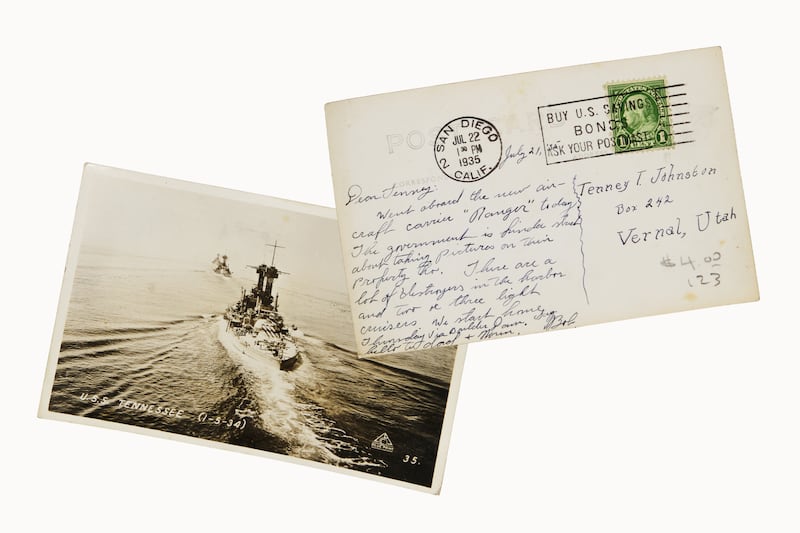
Most postcard prints are mass-produced lithographs. But in 2022, the Museum of Fine Arts, Boston, showcased hundreds like this one in an exhibit called “Real Photo Postcards: Pictures from A Changing Nation.” Drawn from the archive of Leonard A. Lauder, an heir to cosmetics tycoon Estée Lauder, the selection featured people living everyday scenes: women hanging laundry, swimmers at Saltair in Utah, fairgoers in Indiana, suffragists wearing fur shawls. Together, they formed a moving portrait of America in the early 20th century.
History is often told through powerful individuals whose decisions shape the world. But glimpsing the lives of postcard creators, subjects and correspondents reveals something about ordinary folks. Historian Lydia Pyne, a visiting researcher at the University of Texas at Austin and author of “Postcards: The Rise and Fall of the World’s First Social Network,” compares them to “different pieces of broken pottery” — fragments that, when assembled in the right sequence, bridge history and art. “Why do you choose to display some pieces or some entire ceramic vessels?” she asks. “It depends what the story is that you want (the audience) to take away.”
Pyne came to postcards by accident. She inherited a shoebox from her mother filled with postcards sent by Pyne’s great-grandfather between 1905 and 1920. Curiosity about her family’s past gave way to an archeologist’s instinct to study “material culture,” what an object’s tangible qualities reveal about society at large. In the archives of the New York Public Library, she grasped the scale of early postcard correspondence, a near-instant messaging system as revolutionary then as social media is today.
Much like Instagram, postcards were never private, but often contained details that weren’t meant for public view. “You flip over the postcard and it’s from 1914,” she says. “You think, I have no connection coming or going to this, but you realize how intimate and personal it is.”
A burro stares into the camera, comically earnest, ears perked, head framed by desert scrub and an overcast sky. The Barker family picked up this postcard on a family road trip in 1956, somewhere between Seven Falls in Colorado Springs, the Royal Gorge Bridge near Cañon City, the Painted Desert in Arizona and Las Vegas, Nevada, where they dropped it in the mail. “Dear Grandma and Grandpa, we’re taking care of Daddy and Mama, in the meantime enjoying ourselves. Don’t be surprised if we should ride up on this pretty pony. Isn’t he cute? Love, Chippy and Sugar.”
Each postcard is a moment suspended in time — when somebody saw that image in a gift shop and decided to share it with a loved one far away.
Large publishers often relied on small regional studios for images, their names credited in faint type along the back divider. This one was printed by the H.S. Crocker Company, once California’s largest postcard publisher, using a photograph from Fronske Studio in Flagstaff, Arizona. Robert Fronske, a local who studied photography in New York, started the business with his wife Theresa in 1939. She kept it running and taught herself portraiture when he joined the Navy during World War II. Today, Northern Arizona University preserves more than 130,000 of their prints and negatives, documenting weddings, railroad workers and Navajo ceremonies across four decades.
For most photographers, postcards were a sidelight, but their work has become raw material for some modern artists. In 2008, New Yorker Zoe Leonard debuted an installation involving 3,851 vintage postcards from Niagara Falls, arranged along 142 feet of white wall. Collected from the second-hand market, the postcards were grouped by vantage point, juxtaposing views from the American and Canadian shores of the river. From a distance, they blurred into a cascade of rushing water. In 2018, it was displayed in her career-spanning retrospective at the Whitney Museum of American Art.
I never saw Leonard’s installation in person, but after encountering it online, I kept thinking about what was on the backs of those cards. Over half a century, thousands of people — some at the falls, others in gift shops far away — chose to send a card, marking a small proof of their existence. At some point, Leonard herself must have turned a few over. The title of her installation, drawn from a single postcard’s message, captures the sentiment they all seem to share: “You see I am here after all.”
A Collector’s Quest
Looking over the postcard from Glacier, I realize I’ll need help to decipher the blue cursive text with smudged ink. Still, it’s a beautiful image, and the postcard tells the kind of story I’m drawn to, so I add it to my stack and keep going. I’ve got nearly half the alphabet left to go, and if there’s one thing I’ve learned about collectors, it’s that we can be rather obsessive. That’s what brought me here in the first place, visiting Ken Sanders Rare Books on the main floor of The Leonardo museum in downtown Salt Lake City. But this card — this stack — is coming home with me.
It’s only later that I meet the owner, a stocky man with a thundering voice, long gray hair and an Old Testament beard. Ken Sanders is an antiquarian bookseller known nationally as an expert on the “Antiques Roadshow” television series. In his shop, more than 100,000 volumes spill over the shelves, from Latter-day Saint history to African politics and Beat poetry, across three floors. There’s a rare book room and a basement cluttered with maps, paintings and paper ephemera. The postcard cabinet fits right in.
Sanders’ father, Harold “Stan” Sanders, had quite the postcard collection himself, much of it purchased from renowned Utah collector Dennis Goreham. Stan collected nearly everything — stamps, rocks, even tropical fish. In the 1960s, he opened Utah’s first “bottle museum,” where he would host meetings of the Utah Postcard Club, which he led for decades. Ken inherited a lot from his father, perhaps including the collecting gene. He started early, selling comics at school and declaring himself a “serious book collector” when he was 14 years old.
There’s a white shoebox in Sanders’ basement office that holds his own personal stash of postcards. This side quest began when he discovered a few real photo cards of people posing with books. Over the ensuing decades, he accumulated a vast collection of postcards related to literature. He sold most of them at the New York International Antiquarian Book Fair five years ago, but he kept a few favorites: a portrait of Mark Twain, a promotional card for a Harold Bell Wright novel, and a leather postcard that quips, “Why The Dickens Don’t You Wright?” beside a cartoon man holding an open red book. “Collecting anything from postcards to books, it’s the holy grail you’re looking for,” Sanders says. “You want to see something you’ve never seen before.” And you want to keep it.
That desire runs deep, its origins debated by psychologists, historians and even artists. A 2024 study by University of Arizona marketing professor Martin Reimann found that collecting gives us a sense of structure and control, especially in uncertain times. Others see it as instinctual, a way to make meaning from abundance, to connect with others or simply to mark one’s own passage through this life. As art critic Holland Cotter wrote in The New York Times, reviewing an art show featuring teddy bears, “It lets us keep the illusion that we can forever embrace, and be embraced by, what is forever fading away.”
Back home at my desk, with some squinting and help from an online cursive chart, I finally make out the message on the Glacier postcard: “Hi! Spending the day here at McDonald Lake. A beautiful drive along this pass. Will be leaving for home tomorrow. A terrible thought. Love, Grace.” The postmark is too smudged to read, but other clues help me to estimate a date — a four-cent Abraham Lincoln stamp issued in 1966 and the card’s vivid photochrome blues and greens, characteristic of 1960s postcards and still popular today. That puts it around 1967, at the tail end of the postcard era.
This story appears in the June 2026 issue of Deseret Magazine. Learn more about how to subscribe.