
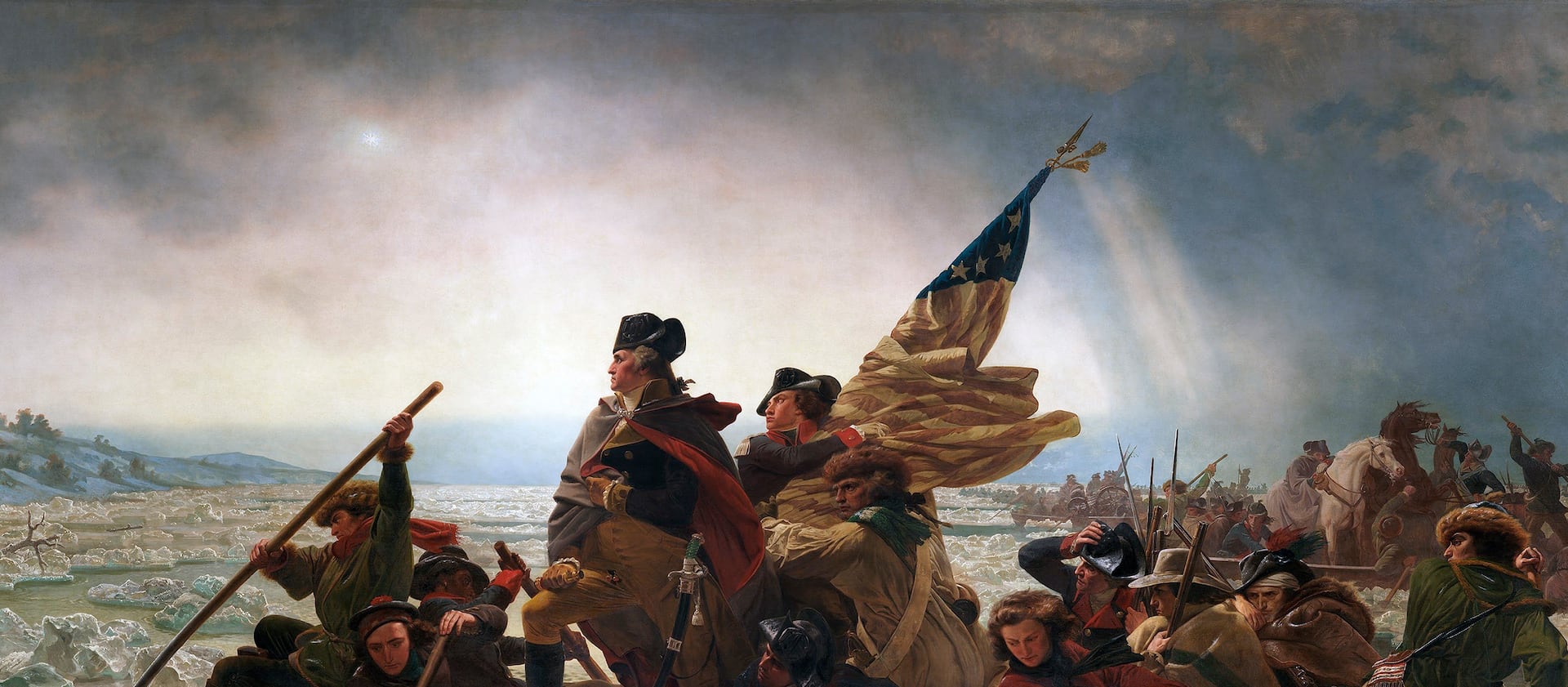


The painting was immense.
Twelve-and-a-half feet tall and over 21 feet wide — about half a racquetball court.
It arrived from Germany in 1851. Hung first in Manhattan’s Stuyvesant Hall, then in the U.S. Capitol rotunda. It depicted Gen. George Washington, knee raised, saber at his side, a determined gaze trained toward the far side of the ice-strewn Delaware River.
His loyal crew of patriots included a Native American in moccasins, a Black man, a frontiersman, possibly even a woman. Two men hoist a heavy-looking American flag toward the cloud-filled sky. It was an immediate sensation.
A reviewer for The Albion newspaper felt “animated by its impulse, and flushed with its excitement.” The review was written in the second person — you felt animated; you felt flushed. These feelings, the writer believed, were universal.
“It gives body and substance to our ideas,” added a critic for the Bulletin of the American Art-Union. He predicted the canvas would define American understanding of Washington’s crossing.
The painting appeared just one year after Congress passed the Compromise of 1850, a law that, among other things, admitted California to the Union as a free state, established the Utah Territory (at a fraction of its original “Deseret” size), and introduced the Fugitive Slave Act. The measure promised stability after years of fraught relations with the South. But this was, of course, an illusion.
Slavery remained and the Civil War was on the horizon. The hope of stability therefore mingled with a sense of foreboding. Many people hungered for a sense of unity, of shared purpose. A national ideal they could cling to.
Emanuel Leutze, who painted “Washington Crossing the Delaware,” was born in Germany but grew up in Philadelphia, steeped in the ideals of a still-fresh sense of rebellion. He moved back to Germany in 1840 to pursue his craft in Düsseldorf, which as a school of painting embraced romanticism.
Leutze, as he explained ahead of the 1851 exhibition, did not believe the moment depicted in a painting should be its subject, but “merely the means of conveying some first clear idea.”
Leutze was also a true believer in the virtues of philosophical liberalism; in “Crossing,” he sought to inspire those same virtues in rebellion-minded Germans and reinforce them among Americans — even if that meant including historical anachronisms, such as the American flag that didn’t yet exist. Leutze was not interested in biographical realities.
His goal was to capture Washington and his crossing as a romantic ideal, a bedrock of America itself: courage, unity and a determination to move forward.
Washington knew morale was low and that his men could not be required to fight much longer. He knew hope for the cause hinged on something dramatic.
Leutze sold the painting to an American industrialist for a then-whopping sum of $10,000 in 1853, and “Crossing” retreated from public view, even if it lived on in public memory via the initial stir it created and a deluge of reproductions and parodies. It still does, though perceptions of the canvas itself have fluctuated, as people project new fears and desires across generations.
In an era of optimism, romantic ideals look aspirational; in an era of cynicism, they appear naive. Today we live in a cauldron overflowing with both: The same hunger for unity that bubbled in 1851, as well as the rank cynicism that reigned a decade later, when the painting was next displayed.
Its new owner, a railroad tycoon, made it the centerpiece of a Philadelphia exhibition in 1864 organized to raise funds for the Union cause. Organizers viewed “Crossing” as “a fitting symbol of patriotic resolve and unity.” According to the exhibition catalogue, “Washington has taught us not to believe in impossibilities.” But, three years into the Civil War, organizers had badly miscalculated the mood, and the reception was downright nasty.
Clarence Cook, writing for The New-York Tribune, said “we should rejoice if the popular verdict, on seeing the picture again after its long period of seclusion, should prove that the day is passing away when a production so essentially commonplace, not to say vulgar, can be elevated to the rank of a masterpiece.”
In this defiant image of Washington, the swashbuckling hero, leaning toward destiny alongside his multiracial collaborators, Cook and other critics of his time saw something fake, something pretentious. They instead wanted to see something much more complicated.
They wanted to see what was real.
George Washington’s actual crossing
It would have been easy to find George Washington’s Continental Army on Christmas 1776. Stationed along the Pennsylvania shore of the Delaware River, with the roads coated in a light snow and the wind beginning to pick up, you could’ve just followed the footprints. They left trickles of blood through broken shoes.
Shoes, blankets, clothes, food — all were in short supply. And in just a week, these men would no longer be required to endure any of it. Their enlistments were up. Washington would need to raise a new army to continue fighting for a cause many no longer believed in.
Despite early victories at Lexington and Concord and driving the British out of Boston, the American war for independence was failing. The British had pushed Washington and his army out of New York in early November and had them on the run. “We should on all occasions avoid a general action or put anything to the risk,” Washington wrote to Congress in the days following the defeat, unless a “brilliant stroke” should arise.
The British quickly chased the rebels into Pennsylvania and set up camp across the river in Trenton, New Jersey. Among Washington and fellow American leaders, their end-game plan was obvious: British Gen. William Howe would continue pushing south and move on Philadelphia. With the seat of American power captured, the war would effectively be over. In anticipation, the Continental Congress had already fled to Baltimore.
Then, on Dec. 13, Gen. Charles Lee, Washington’s second-in-command, was captured at a New Jersey tavern by British cavalry — a blow so severe, the American situation so seemingly hopeless, that the very next day, Howe decided to suspend the British campaign and return to New York for the winter. He left a group of Hessians — mercenaries from what is today Germany — to hold the British position at Trenton.
Washington — a physically strong, honor-bound, iron-disciplined, temper-prone Virginia gentleman — did not feel beaten. In fact, according to Gen. Nathanael Greene, he “never appeared to so much advantage as in the hour of distress.” But Washington knew morale was low and that his men could not be required to fight much longer.
He knew hope for the cause hinged on something dramatic. If ever a “brilliant stroke” were to arise, the time had come. Striking a surprise blow, he wrote on Dec. 14, would “most certainly rouse the spirits of the people, which are quite sunk by our misfortunes.”
This is one of those moments where it really is David and Goliath at its best, overcoming odds that should be insurmountable.
— Lindsay Chervinsky, executive director of the Washington Presidential Library at Mount Vernon
He began working on a plan in strict secrecy. He was prepared to risk it all.
The plan involved three separate river crossings. Washington’s own force of some 2,400 men would land and launch the main attack from the north. A force of 800 Pennsylvania militiamen, under Gen. James Ewing, would cross near Trenton and secure a vital bridge to block Hessian escape. And some 1,800 troops, mainly Philadelphia Associators led by Col. John Cadwalader, would cross south of Trenton, near Neshaminy Ferry, to block Hessian reinforcements.
The plan, however, didn’t account for the weather. The wind was becoming more than just wind, spitting a combination of rain, sleet and snow. A full-blown “nor’easter” — a winter storm with hurricane-force winds — arrived just as the men gathered at the riverside.
Cadwalader’s group tried to cross at Neshaminy Ferry, but the river was too wide. Cadwalader instead ordered his troops to march another 6 miles south to Dunk’s Ferry, where another attempt began around 11 p.m. Christmas night.
Some 600 “light troops” made it, per one account, but they found the far side of the river bordered by 150 feet of ice. They braved the ice anyway. Their artillery, however, could not get across. After trying for another three hours, Cadwalader called off the mission and ordered all the men back to Pennsylvania.
The expedition closest to Trenton, meanwhile, found the river impassable because of an “ice jam.”
The Delaware River runs for about 130 miles from Trenton to its terminus in the Atlantic Ocean. This stretch of the river is called the Delaware Estuary because it connects, uninterrupted, with the sea.
On the night of the crossing, the Delaware Estuary was “tidal,” meaning that stretch of river was running in reverse under the influence of ocean tides. It pushed up against the end of the estuary, at Trenton Falls — right where Ewing was supposed to lead his 800 Pennsylvania militiamen into New Jersey.
The result was chaos: icebergs tumbling over the falls, then getting pushed back up against them, seasoned by howling wind, rain and snowfall. Nobody could have crossed at Trenton that night. Which left Washington’s force of 2,400 to attack alone — if they could make it.
Early on, his group wasn’t doing much better. His plan called for an attack before daybreak to catch the Hessians by surprise. With the weather worsening, delays compounded.
The storm blocked out the moonlight. The boats filled with slush. One thing that went right, though, was the boats themselves. Most of them were “Durham Boats,” used to carry cargo for the Durham Iron Works. These boats looked something like large canoes. The Continentals likely used other craft as well, really any craft available, in their crossing. Ferries were deployed to transport about 50 horses and 18 cannons.
Washington put future Secretary of War Henry Knox in charge of managing the operation. An immense man of some 300 pounds, Knox had a booming voice that many soldiers remembered thundering through the din of the nor’easter, without which the attempt likely would have failed. The endeavor also included future Treasury Secretary Alexander Hamilton, who despite illness made the crossing and led his artillery unit; and future President James Monroe.
Washington also deployed the expertise of several seafaring regiments, most famously the “Marblehead Men” under Col. John Glover. This group from Massachusetts was battle-hardened and forged in the winters of New England. Washington put them at the oars to row him and his men safely across the ice-strewn river, in the middle of a blizzard.
“That’s something that Washington did several times,” says Lindsay Chervinsky, executive director of the Washington Presidential Library at Mount Vernon. “He was really good at finding regiments that had specialty and figuring out how to deploy them.”

Washington himself rode across early. Nobody knows exactly who was in his boat, although the Continental Army at that time — particularly the Marblehead Men — did employ Black and Native soldiers. He watched the crossing unfold from New Jersey, with some accounts saying he sat pensively atop a wooden frame that had once been a beehive box. He doubtless would have felt some despair as his plan fell several hours behind.
Surprise, he feared, would be impossible. His troops would never reach Trenton by daybreak. He thought about calling it off, but as the boats continued landing, he decided it was too late. A retreat was sure to be discovered by enemy forces. “I determined to push on,” he would write later. Or, as he put it in the operation’s secret passphrase, which allowed units to identify each other in the darkness, “Victory or death.”
Most of the infantry had made it by 2 o’clock in the morning. The artillery couldn’t get across until 3 a.m. It wasn’t until 4 a.m. that Washington’s force began marching toward Trenton, about 10 miles south. The wind, rain, snow and sleet continued to pound the already-dilapidated force.
Washington nearly fell from his horse on the icy road but, per one account, miraculously regained his balance by grabbing hold of the horse’s mane. Despite a few men falling overboard during the crossing, all had survived. It was only then, back on the march, that two soldiers are known to have frozen to death.
By 7:30 on the morning of Dec. 26, the Americans were just a few miles from Trenton. The sun had risen but remained obscured by the storm. What had been a great liability became an advantage: the Hessians couldn’t see the Americans’ approach until they were already very close, about 800 yards from the first guard station.
Washington himself led three columns of soldiers straight ahead, through the still-raging blizzard. A Hessian guard opened the main door of the outpost. The Americans opened fire.
When it was all over, 22 Hessians, including their commander, were dead; about a hundred were wounded; and some 900 were taken prisoner. Remarkably, aside from the men who’d frozen, the Continentals suffered no casualties. Maj. James Wilkinson delivered Washington the news of the Hessians’ surrender.
“Major Wilkinson,” Washington told him as the men shook hands, “this is a glorious day for our country.”
None of Washington’s many achievements looms as large as the night he gave the fledgling nation a reason to maintain hope in the revolutionary cause.
The war, of course, didn’t end there, and would rage for nearly five years more, through the Battle of Saratoga that would convince the French to ally with the Americans; the winter at Valley Forge, when the Continental Army would lose thousands to sickness and exposure but become a disciplined fighting force; and the fateful Battle of Yorktown in 1781, when Washington would trap the remaining British forces in a no-win situation that would force their final surrender.
Washington would become the country’s first president, step down after his second term to establish a tradition of peaceful transfer of power, and remain a national hero, his face on the nation’s currency and his name on its capital. But perhaps none of his many achievements looms as large as the night he gave the fledgling nation a reason to maintain hope in the revolutionary cause.
A moment so important that, 75 years later, a German American artist would try to capture it on a canvas, and that canvas would end up defining the event more than the event itself.
A painting’s legacy
Today, you can find “Washington Crossing the Delaware” hanging in New York’s Metropolitan Museum of Art. It’s been in The Met’s collection since 1897, and to this day the museum’s website calls it, somewhat ambiguously, “an unavoidable highlight” of its American wing, in which Leutze sought to paint our nation’s “better angels.”
Yet the nation’s foremost art museum hasn’t always been interested in these “better angels.”
“The Met had not always embraced that painting,” says Jochen Wierich, curatorial director of the Brinton Museum in Big Horn, Wyoming. Wierich published a book in 2012 framed around Leutze, “Crossing” and history depicted in painting. While he was working on the manuscript, The Met finally decided to display “Crossing” in a prominent place after many years of loaning it out and otherwise ignoring it.
It was a big deal in the art world at the time, and Wierich believes it reflects yet another evolution in perception. “More than ever, I think the painting resonates,” he says. “It speaks to the American public, to the historical consciousness of the country. ... And yet, I would say that maybe there’s still an underlying question about how we want our leaders to be represented.”
Washington, after all, had many sides beyond swashbuckling hero. He’s perhaps best known for his discipline and restraint — qualities mostly absent from the famous painting that has helped define his legacy.
Yet David Hackett Fischer, the Pulitzer-winning historian of 2004’s “Washington’s Crossing,” the definitive account of what actually happened that night, writes that while Leutze’s painting abounds with historical inaccuracies, it ultimately matters little. Leutze captures the romantic, idealistic, perhaps naive notion that a diverse nation can unite under a shared banner of freedom, and fight together to preserve it against a rigid, disciplined behemoth that demands submission to its authority.
“The larger ideas in Emanuel Leutze’s art,” Fischer writes, “are true to the history that inspired it.”
That history can be difficult to appreciate. Even to make sense of. Ahead of the country’s 250th anniversary, Leutze’s painting reflects that. Because recognizing our “better angels” isn’t always easy.
Leutze’s celebration of Washington’s heroism can be nitpicked to death. It can also tell a sinister story, if viewers let it — one that celebrates imperialism and conquest. But it resonates 250 years later because it embodies a different story, too.
“This is one of those moments where it really is David and Goliath at its best, overcoming odds that should be insurmountable,” says Chervinsky, the Washington historian. “Americans made a lot of it in 1776 and early 1777 because they needed the moral victory. They needed the symbolic gesture in order to survive. From the beginning, it was part of our national myth — a way to continue to build up support for this new nation.”
Two hundred and fifty years later, that remains true. We live in an era of rabid polarization and few unifying symbols. “Any republic needs citizen buy-in in order to survive. If we want to survive for another 250, we need Americans to believe in this experiment,” Chervinsky says. Washington’s crossing offers a map.
“All hope seemed lost and despair was imminent, and yet, a small, ragtag army fought to overcome incredible odds and give the American people a reason to believe in tomorrow.”
In “Crossing,” Leutze brought forth an immense image to define that idea more than any man or what he did.
The initial sensation reflected how well he captured it.
The later criticism reflected discontent with the very idea of idealism.
And today, looking at the magnificent canvas on the wall of The Met or in history textbooks, it’s up to all of us to decide what story “Crossing” really tells.
This story appears in the June 2026 issue of Deseret Magazine under the headline “River of Destiny.” Learn more about how to subscribe.