


Abbey Carlson yawns, and not for the first time this morning.
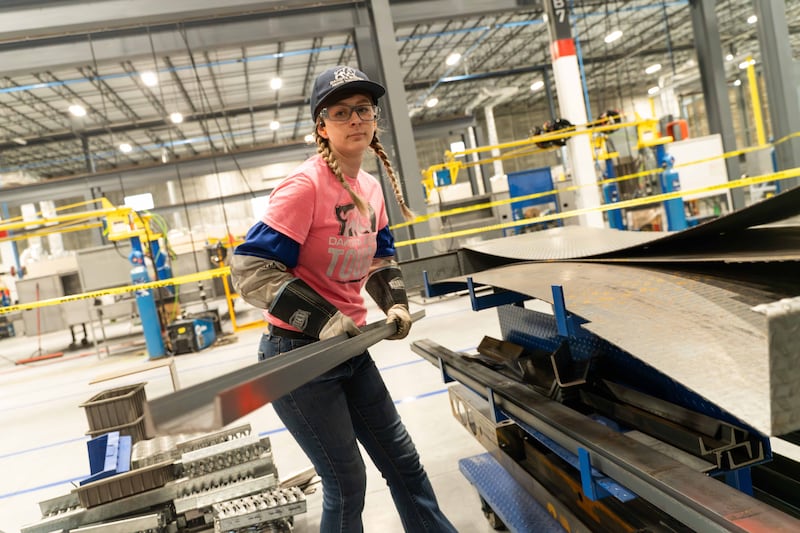
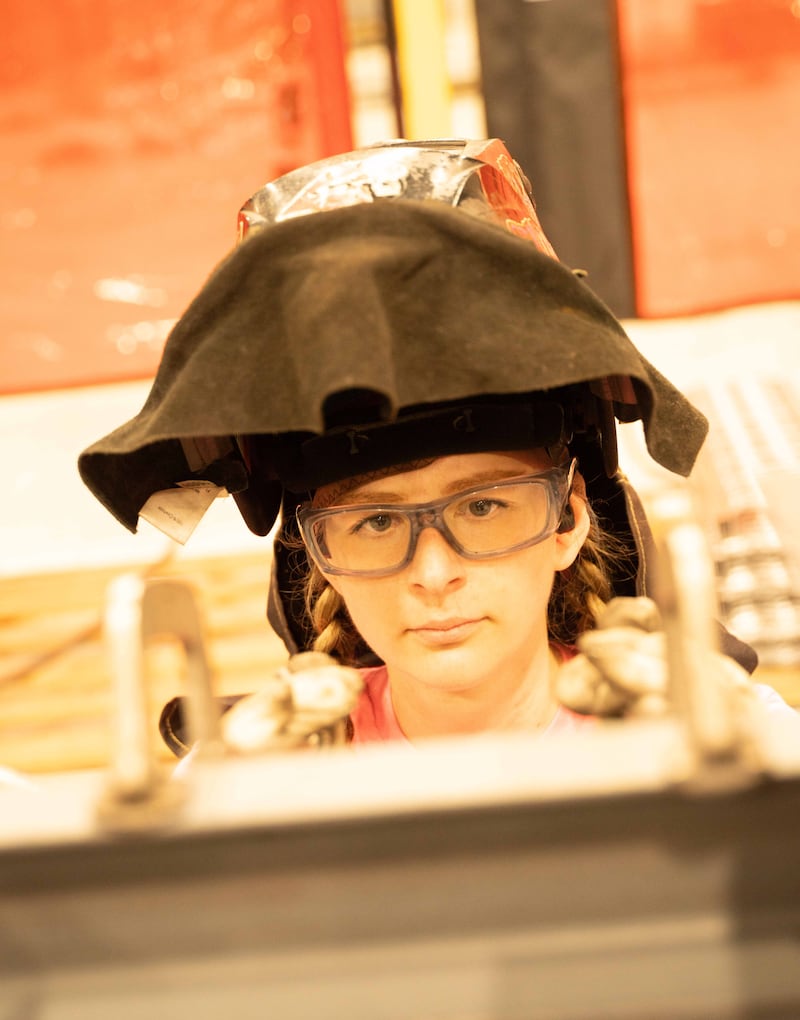
She’s been up since 5:10, when her alarm’s snooze button was finally defeated. She’d then shifted into her blue Carhartts, laced up her steel-toed boots, filled in her eyebrows, tied up her hair and downed a half-can of Red Bull. All of this before 6 o’clock in the morning, when she was due at Dakota Bodies, a utility truck bed manufacturer near Kansas City. Abbey likes working at Dakota Bodies.
Mostly.
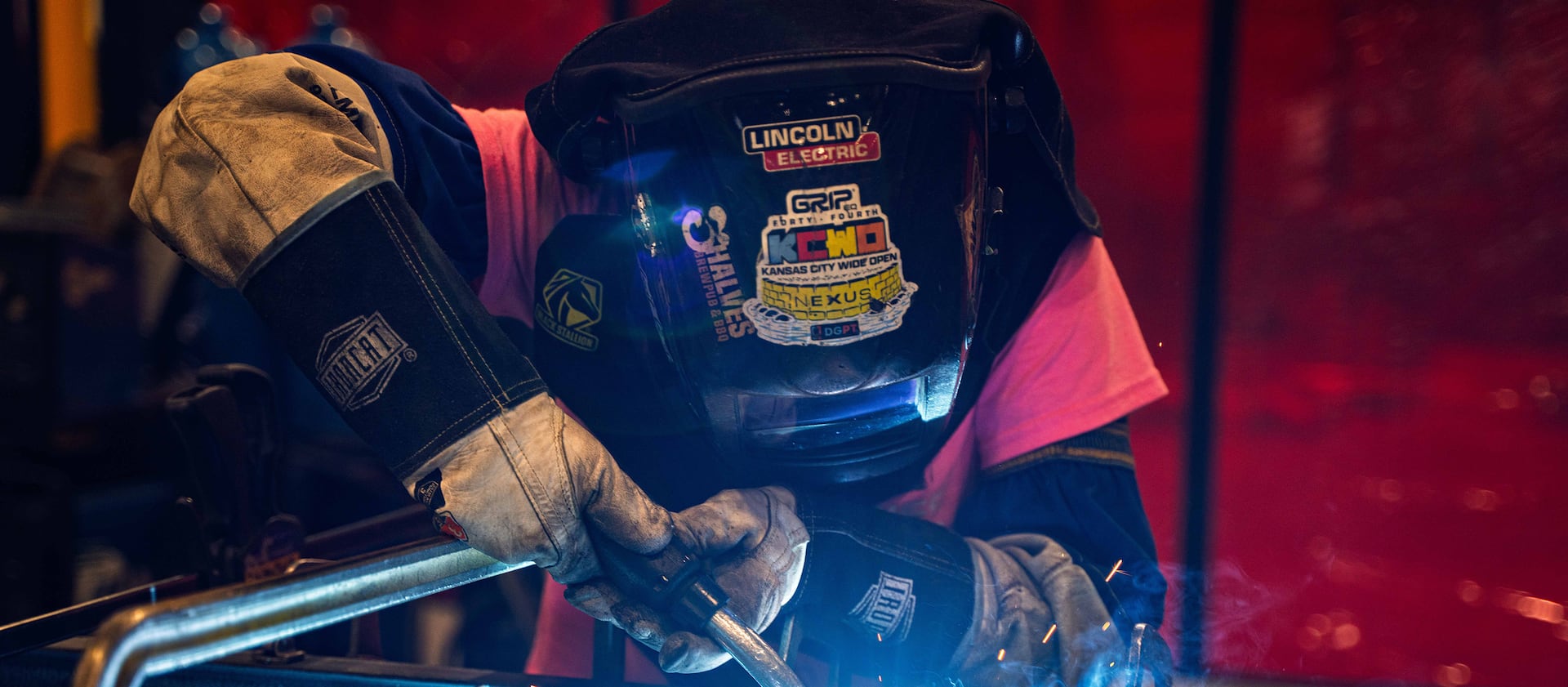
But nobody likes a 6 a.m. start. So she yawns as she fastens her welding hood and grasps her welding gun. Then the hood comes down.
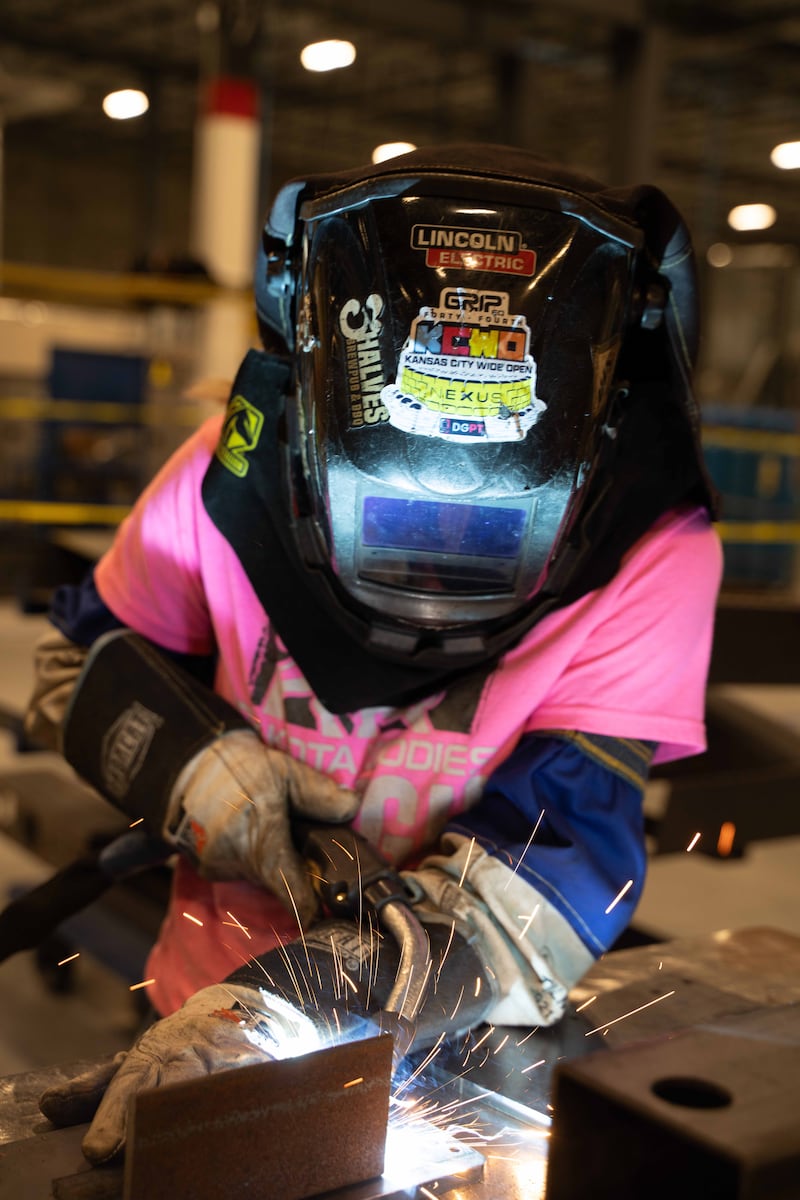
Hidden behind the hood’s visor, Abbey can still see — until she ignites a metal nozzle at the end of a black hose, dispensing a jet of blue electricity. Her hood registers the ultraviolet light and darkens to protect her retinas.
Abbey “tacks” together two pieces of carefully cut metal, essentially using a quick weld to hold them together. The torch hisses in short bursts. When the pieces are secured, Abbey lowers her torch, flips up her hood and reaches toward the steel desk behind her.
Among medieval-looking metal clamps, a bucket filled with fat screws and a half-open jar of black goo called “nozzle gel,” she retrieves a pink tumbler speckled with roses, then takes a swig.
Abbey could tell different stories about her career in welding. One would position her as the triumphant hero who battled abandonment, addiction and aimlessness to work hard, roar into Dakota Bodies and make this world her own.
That’s the story many people would like her to tell, at a time when fears about affordability, unemployment and artificial intelligence are pushing a surging number of young Americans into the trades. Many people would also like to believe this version of the story, Abbey included, and for good reason.
All of it, more or less, is true.
But there’s another version of the story, one centered on someone who hasn’t so much as found a calling or a purpose but a means to survive.
Someone who, though grateful to have risen beyond what she was, still yearns for a life free from inevitable workplace injuries, reliable sexism and 6 a.m. shifts that make her yawn repeatedly even after gulping Red Bull.
This story too, more or less, is true.
Abbey, at 28 years old, knows all about the immediate benefits of welding and trade school. They’re what sold her, as well as many fellow young people.
They offer stability amid uncertainty, and opportunity at a time when the value of a college degree is in question. They offer a chance to contribute and to build a life. That’s what Abbey wants, and what she thought welding would provide.
But amid 10-hour shifts of spraying metal spatter and hoses spitting fire at over 10,000 degrees Fahrenheit, her career sometimes feels more like a tack weld, holding things together until the full weld comes. Abbey doesn’t believe she’s finished.
Not with the challenges before her in life, and not with today’s work.
She flops her hood back down and returns to her fetal hunk of metal, no yawning this time. Sparks fly, sweat beads, and behind her, that pink tumbler sprouts from the steel.
‘Learn a trade’
News outlets across America have written a version of the same story over the last few years.
It starts with a headline like, “While some students skip college, trade programs are booming.” Or “Why this 26-year-old skipped college and took up a skilled trade.”
The stories share a common thesis. Amid fears of AI’s potentially apocalyptic impact on white-collar office work, skyrocketing tuition costs, student debt and growing unease about socioeconomic mobility, hands-on professions have taken on a new appeal. Jobs such as welding, plumbing, electrical work and auto mechanics — which prioritize practical skills over bachelor’s degrees — are increasingly seen as the most promising path to a hopeful future.
The narrative has since migrated from media into politics. Online, “learn a trade” has become a rallying cry — sometimes earnest, sometimes an insult lobbed at traditional universities. In May 2025, President Donald Trump proposed rerouting $3 billion in federal grants from Harvard to trade schools, framing the move as both a rebuke of elite academia and a bet of his own on the country’s future educational needs.
We’ve spent so long encouraging college degrees that the consequence, though rarely stated outright, has been to discredit trade schools as somehow lesser.
Enrollment at trade schools is indeed rising. The most recent data from the National Student Clearinghouse Research Center shows that between 2022 and 2025, enrollment at public two-year schools with a high vocational emphasis had increased by nearly 40%.
“All of those majors have really seen some growth in recent years,” says Hee Sun Kim, a senior research associate with the center, about programs like repair technology, culinary services and construction. At public four-year schools, meanwhile, enrollment has basically flatlined. The shift has coincided, she adds, with “a steep decline in computer and information sciences.”
That snapshot could actually be underselling the rise of trades, as trade school isn’t the only way to enter these professions. Some might take the union apprenticeship route, or perhaps attend a career-focused community college. In June, Meta announced a bootcamp-style initiative called “America’s Workforce Academy” to train the electricians and other contractors who will build the nation’s data centers.
Enrollment at traditional four-year institutions still dwarfs two-year vocational schools, so the suggestions that trade schools are ready to devour traditional higher education are probably premature. But the shift underway — nearly 40% growth versus flatlining — is still telling.
The real question is whether a four-year college degree will continue to offer the most assured path to middle-class stability, as it has in decades past.
“The problem isn’t that college isn’t worth it,” says Matt Sigelman, president of the Burning Glass Institute, a research center that tracks employment trends. “It’s worth it to too few people.”
Most people don’t go to college, he explains, and for too long, our education system has tried to force too many into that box. “Instead of a substitute for a degree,” adds Sigelman, “(trade schools) may be better thought of as a way of helping those kids who graduated high school and either didn’t wind up with a degree or didn’t go to college.”
The statistics on that can be sobering. Sigelman can quote them off the top of his head.
“Of every 100 kids graduating high school, 66 will enroll in college,” he says. “Of them, 42 will finish, and of them, 23 will wind up in a job they needed to go to college to get.”
Which leaves 77% of those who enroll in college not getting much out of it. Yet another study of Sigelman’s offers hope.
He’s found that the top 20% of earners who skip college outearn median college graduates. “We found literally millions of people who were making in the six figures 20 years after high school without going to college,” he says. “That’s pretty good news.”
And how were they doing that?
“A lot of the jobs — certainly not all, but a lot of the jobs — that were these kind of launchpads,” Sigelman says, “were trades.”
Back in 2023, as a welding student in Nashville, Abbey spoke with The Associated Press. She was looking for a launchpad of her own, she said then, and she felt like welding could provide in a landscape that, thanks to the unanticipated disruption of AI, had pivoted from “learn to code” to “learn a trade” seemingly overnight.
“Finally,” she told the reporter, “I feel like I’m going to accomplish something in life.”
The door she could afford
She was scared of the torch at first.
“Terrified,” actually. “I can’t do this, I can’t do this,” she thought.
She asked her teacher to go away and come back. She asked him not to look. “I can’t do this,” she thought once more. But she did. And it quickly got easier.
Soon enough, Abbey passed her “bend tests,” when instructors purposely tried to snap her handiwork in half. It would bend, but it wouldn’t break.
Abbey aspires to be a well-rounded person who knows things beyond how to perform different kinds of welds. “What I missed out on in college was all that learning,” she adds. “I feel like there’s more I want to know.”
By the time Abbey enrolled at the Tennessee College of Applied Technology in 2022, she had been running in place for years.
Her parents’ divorce when she was about 10 set off a chain reaction — her mom’s drinking, then Abbey’s; diagnoses of bipolar disorder and OCD; multiple rejections from the military; a scholarship to the University of Missouri, Kansas City, that lasted three months before chemistry, advanced calculus and whatever bottle she was using to numb the pain forced her out.
She’d worked on a paint crew and at Marshalls, Home Depot and a gas station while still in Kansas City. She worked at a breakfast restaurant, a credit union and the Italian chain Carrabba’s after she moved to Nashville.
None of it stuck.
“I knew I needed to go back to school,” she says. “I knew I wouldn’t be able to get very far unless I did, but I never had enough money or the time or the support.”
Newly sober and living in a rent-controlled apartment, she socked away her serving tips month after month. When a member of the credit union told her about trade school, and her sister’s husband started sending her welding TikToks, Abbey finally saw a door she could afford to walk through.
Trade school was nothing like what most Americans picture when they think of higher education. There were no dorms, no quad, no football Saturdays. For Abbey, it looked like class every weeknight, Monday through Thursday, after a shift at Carrabba’s.
There weren’t separate courses — just one continuous program that worked through all the welding disciplines. Students learned every process in pursuit of certification by the American Welding Society. Textbooks existed but were rarely opened. Almost everything was hands-on.
That suited Abbey. “If you go to trade school, you’re going to learn a lot, and everything you learn you will use. Everything,” she says. “It’s not overwhelming. It was just very attainable.”
But she doesn’t see that as entirely a good thing.
Her college-graduate friends would complain about having to take classes they’d never use in their careers. Abbey doesn’t buy that complaint.
“The pursuit of knowledge is something that I really care about,” she says. She aspires to be a well-rounded person who knows things beyond how to perform different kinds of welds. “What I missed out on in college was all that learning,” she adds. “I feel like there’s more I want to know.”
But many people, it turns out, yearn to know what she knows. For five weeks in the summer of 2023, Abbey drove an hour each way to Camp Boxwell, a Boy Scouts summer camp outside Nashville, to volunteer as a welding instructor.
Every week brought a new batch of kids, most of whom had never touched a welding torch. “Day one, I’d teach them safety,” she says. “Day two, they’d start welding.” She watched them flinch at the sparks, then light up when their first bead held.
“They were so intimidated at first,” she says. “And then they were like, ‘(Heck) yeah!’” She’d love to go back to Boxwell every summer. But trade school was almost over, and five weeks off isn’t something any entry-level job offers.
The tack weld had held. Now came the real thing.
What the brochure left out
A door swings open into a hive of sound. Hammering. Sawing. Grinding. Crackling. Beeping. Abbey leads me through the noise, pointing out the broad cross section of humanity hard at work. “Anything with trades is very diverse,” she says.
With one glaring exception. It’s noticeably male-dominated.
“I like to drop big words around them,” Abbey says, inserting a “feasible” and an “askew” as she leads me toward the welding station in the back of the warehouse. The stagnant air smells like a metal block freshly pulled from a hickory smoker.
She’s been with Dakota Bodies since January 2025. It’s her second welding job since finishing trade school, and her third job overall. She started with a “job shop” in Nashville, welding from 2:30 in the afternoon until about 11. When she couldn’t afford to live in Nashville anymore, she moved back to Kansas City, where her dad agreed to rent her a house for $900 a month.
She couldn’t find a job in welding right away, so she sold door-to-door roof inspections. To survive, she figured she needed to make at least $25 an hour. At Dakota Bodies, finally she found a place willing to pay $26. But the work is real work. Hard work. Sometimes dangerous work that’s left her left arm scarred by burns. Taking another swig from her rose-specked tumbler, Abbey prepares to get back to it.
Normally, she’d listen to an audiobook. She especially loves Stephen King novels. They help to distract from the tedium, and to quiet her mind, which can run wild with so much time to think.
Sometimes, that takes her to a dark place. She dwells on what she’d rather be doing despite how far she’s come. But Abbey’s ambivalence isn’t hers alone. It reflects a tension that permeates the conversation around trade school, higher education and the divide between them.
Sigelman, the employment researcher, maintains that for too long, the country has been on a “bender” of funneling everyone toward college. “We set a college degree as a default course,” he says. “And it just doesn’t fit a lot of students.”
Abbey is one of those students. She tried college and it didn’t take. Trade school did. And yet, she often feels she’d be better off having gone to college.
That could be internalized stigma talking. We’ve spent so long encouraging college degrees that the consequence, though rarely stated outright, has been to discredit trade schools as somehow lesser.
“I think it’s true that higher ed has enjoyed a sense of prestige and sometimes elitism,” says Michelle Van Noy, director of the Education and Employment Research Center at Rutgers University. But that could be starting to change. “I think maybe,” Van Noy says, “that’s kind of coming under attack.”
The uptick in trade program enrollment and the political resonance of “learn a trade” at the highest levels of government suggests as much. Yet Van Noy suspects some of the news coverage is overstated.
“Everybody wants a good story,” she says. “A dramatic story that says, ‘Everything is changing! Higher ed is falling apart!’” But trade schools are nowhere near catching up with higher education in terms of sheer numbers, nor are they on course to do so.
“We don’t really have the data to tell us that,” Van Noy says. “It’s true that people are more interested in these programs. There’s more conversation about it, more openness to it and the environment makes sense for it. But people are definitely still thinking about college.”
That’s especially true for women, who earn about 60% of undergraduate degrees today. Meanwhile, Abbey is one of very few young women at Dakota Bodies. On a typical day, that’s not a problem. But the group dynamics of such a male-dominated space sometimes work against her.
Sexual harassment in the industry is not unusual. She’s had to report incidents in the past. “It takes a lot to be a woman in this world, and it takes a lot more to be a woman where the whole attitude is, ‘Women can’t do this job.’”
There are some parts of the job that are particularly difficult for women. For example: Eventually, Abbey would like to get married and adopt — but suppose she did get pregnant.
“I couldn’t work as a welder,” she says. “If I wanted to breastfeed, I probably wouldn’t be able to be around those fumes. I would have to immediately get another job.”
She takes another drink from her pink bottle. I point out how unusual pink looks surrounded by all this hardware. She smiles. From the same desk, she proudly pulls out the blade of her pink tape measure, then lets it snap back into place.
For all her concerns, there are real advantages. The trades aren’t for everyone, Abbey says, but they’ve been good to her. She loves the reliable pay, the flexibility. She loves to feel needed. The work, however hazardous, is usually fun. And Dakota Bodies has great matching options for her growing 401(k).
“The fact that I was able to save money, stay sober, and then go to school and work — the fact that I was capable of that — was just really astonishing,” she explains.
But often Abbey’s upset that she didn’t see through the bluster of promises about big money, which is most often made by traveling to job sites for monthslong contracts. Abbey has two cats and a life in Kansas City. Plus she’s worried about getting injured; about long-term health consequences; about becoming the older guys she sees limping around.
She wants to become a welding certifier, or perhaps an instructor. Maybe even a project manager or an engineer.
At 28, she has time.
But in the daily trenches, it doesn’t always feel that way.
A guaranteed job
Abbey calls over her supervisor to inspect her finished weld. “It’s easy to forget things,” she says.
Sure enough, she’s missing three tacks. After a quick 30-minute lunch break, she returns to add them. Her welding gun dispenses a thin metal wire, which is melted by 16.5 volts of electricity and a 75-25 mixture of compressed argon and carbon dioxide gas. From a distance, she appears to be bathing in bursts of sparks. It looks noble, even romantic.
Up close, though, the heat is oppressive. The sparks burn holes in her battered two-piece green smock. The physical toll is obvious. Which recalled a conversation I’d had with Abbey the day before.
It was about a post I’d seen on Facebook featuring a snapshot of Robert F. Kennedy Jr.’s son’s recent graduation from Harvard — the same school the Trump administration has threatened to deprioritize in the name of boosting trade schools. Someone had captioned RFK’s post with a note about how it’s always other people’s kids who should go into the trades, rather than their own. I’d wondered what Abbey would make of that observation.
She wasn’t surprised, it had turned out, that people who don’t actually work in the trades are often their loudest supporters. Not that they’re wrong. “These are important jobs that are crucial to keeping the world running,” she says. “When your power goes out, there’s a truck that’s able to get to you because we built it.” She’s grateful for her ability to contribute.
But these aren’t fantasy jobs, either.

Even with the best intentions, people in power will emphasize the employment opportunities, the steady paychecks. But they’ll neglect the trade-offs. The physical toll, the long hours.
“It’s a guaranteed job,” Abbey says. “Is it a job you want? Probably not.”
Stability feels great for a while, but it quickly becomes less than enough.
Back at her station, she uses a dangling remote to call down a crane and evacuate the finished piece using heavy metal chains. The piece disappears into some other station in the warehouse.
Abbey takes a sip from her pink tumbler, then plants it back on her steel work bench. There it will wait as a new piece arrives and sparks begin to fly.
This story appears in the September 2026 issue of Deseret Magazine under the headline “Trade off.” Learn more about how to subscribe.