

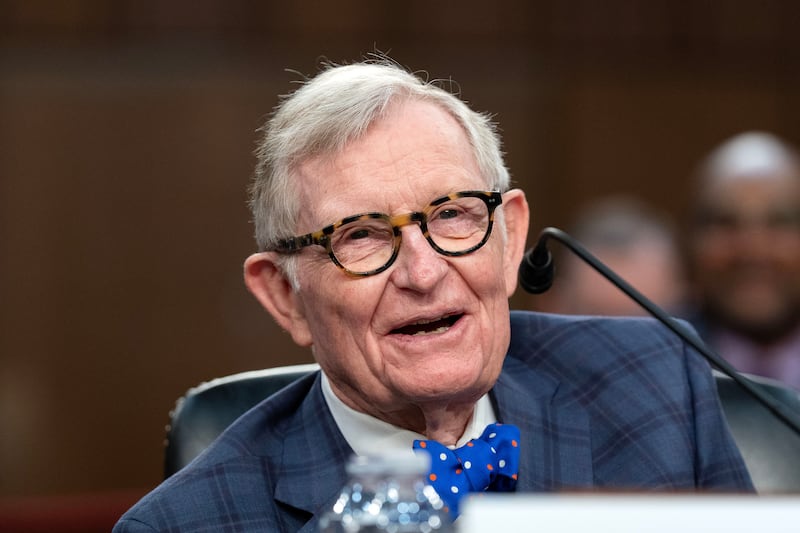

Before Gordon Gee became one of America’s most recognizable university presidents, he was a bow tie-wearing, 4-H-attending Boy Scout from Vernal, Utah. But this past year he hung up the proverbial bow tie after leading five major universities — and serving twice as president of two of them. Forbes gave him the apt descriptor “dean of university presidents” and Time magazine called him the “big man on campus.”
He’s led large public and elite private universities — including Ohio State, Vanderbilt and Brown — and during his tenure he’s navigated moments of extraordinary institutional change with a front-row seat to the evolution of the American college campus. He’s also been an architect of change. Even now, without the perch of a presidency, the 82-year-old remains heavily influential in conversations surrounding the academy’s future, especially seeking to stabilize college athletics after what has seemed like a decade of tectonic shifts that include transfer portals; name, image and likeness (NIL); and revenue sharing with student-athletes.
As higher education looks to rebound from a precipitous, decade-long decline in public trust, Deseret Magazine spoke with Gee to reflect on civic education, intellectual diversity, the role of sports on campus and the enduring mission of higher education. After stepping down from his final presidential post at West Virginia University in July 2025, Gee is a hopeful voice about higher education’s future but doesn’t pull punches regarding needed reforms. He has advice for college students and for new university presidents. And he tells us what prompted him to start wearing bow ties in the first place.
This interview has been edited for length and clarity.
Deseret Magazine:
You’ve led the University of Colorado, Vanderbilt, Brown, Ohio State (twice) and West Virginia (twice). Your early years as an academic administrator were spent at Utah and BYU. What memories stand out?
Gordon Gee:
My late wife, Elizabeth, and I had to laugh because we had been waiting for about three years to adopt a child through The Church of Jesus Christ of Latter-day Saints. I’m in a faculty meeting at BYU’s law school, and I got this call and they said, “We have a baby girl for you.” I said, “Oh, how wonderful. When can we pick her up?” And they responded, “Well, we close at 5.” It was about 3 in the afternoon. And so I had to find my wife, who was, at the time, working on a graduate degree. I’m up in one of those stadium classrooms that seats hundreds in the Eyring Science Center searching around for her. And the faculty member looks up and says, “Well, can I help?” I said, “Yes. I wanted to tell my wife we just had a baby.” We got a standing ovation. From that day forward my daughter knew nothing but growing up on a university campus.
Deseret:
How do small-town life prepare you for what came next?
Gee:
I was with a group of students last year and one kid asked me where I grew up. I responded, “Where do you think I grew up?” The kids said, “You’ve been president of these big universities, you grew up in Los Angeles or New York or Chicago.” And I said, “No, I grew up on the Utah-Colorado border in a town of 2,000.” And we had no television. We had no movies there. And I look back on it, and it was just this wonderful growing up period. We had the church, of which I was very active. We had Boy Scouts and 4-H. And interestingly enough, I maintained great relationships with all three, and I’m on the executive committee of the National Boy Scouts. I was the chairman of the National 4-H Council for a long time. So all three of them continue to be very much fixtures in my life. They prepared me for service as did higher education.
Deseret:
How do institutions like the ones you’ve mentioned, including higher education, shape and build people?
Gee:
First of all, I believe very strongly that there’s no substitute for good homes, good churches, good families, synagogues and community-building activities. I think that really has always been the fundamental nature of the American psyche itself. We’re losing a lot of that right now, which endangers us in many ways. And I think that growing up in a small town, I had every advantage that one has in that notion of having strong faith, strong organizational programs, a high school; that was really the center of our world. And that’s how I’ve always felt the university should operate: not just simply as teaching-learning institutions but creating purpose for those who are there. In fact, in West Virginia, I had a four-pillar approach. First, education. Throughout life, the university really needs to impact the whole educational system. Second, healthcare. The third is prosperity, creating jobs and opportunities for people. And fourth is purpose. I believe that we have lost in the higher education system a responsibility that goes beyond the classroom. It goes into the hearts and minds of these young people in so many different ways.
Deseret:
Public trust in higher education is in a multidecade decline. Drawing on your experience, how does higher education restore trust?
Gee:
I was asked to speak to the Gallup organization a year and a half ago. So I pulled up the year I first became a university president, and trust in American universities was at about 95 percent. When I gave the speech, it was 35 percent, according to Gallup. Now, a lot of institutions have lost the public’s faith and trust. But for a university or college to lose it is devastating because the public land grant institutions are built on the basis of trust. This includes faculty trusting each other; faculty trusting students; students trusting the institution; staff, alumni, friends all trusting each other as well. And when we lose the trust of the American public, we really have diminished ourselves, and for that reason, college ratings have been going down. So what do we do to build that trust? It starts in a very personal way. So many institutions have become very isolated, very arrogant and really do not spend much time thinking about the people they serve. Institutions that capture the hearts and minds of the people are those that make a difference in their lives. I’m a big believer in land grant universities. If you go back to 1862, when Abraham Lincoln signed the Morrill Act, creating land universities, the bill’s sponsoring congressman, Justin Morrill, wanted people to have access to the American Dream, to education. That built trust that can be restored by reasserting the notions of the Lincolnian admonition that we need to make sure every citizen in our country has access to education, that they are able to be educated and that education focuses on communities, culture and civic responsibility.
Deseret:
When did you start wearing bow ties?
Gee:
When I was 15, my dad brought me to Salt Lake City to go get my eyes examined. I sat next to a guy in the Boston building downtown. He had a bow tie, and I was very curious, so I said to him, “What is that? How does it work?” He untied it and then tied it back for me, and I was fascinated. So I begged my dad after we got through the eye examination to go buy one. I just started wearing them, and I kept getting them. I have over 1,000 active bow ties. And then I have another 1,000 that I put in retirement and we’ve made them into quilts for my granddaughters.
Deseret:
There was a moment early on in your career where you tried to stop wearing them. What happened?
Gee:
Six months into my first presidency, things were horrible and these guys came in to see me. I thought they were old, you know. I’m 36 at the time. It was the chair of the Department of English and the head of the library. They said I didn’t look, act or talk like a university president. I asked what they meant, and they said, “Well, you wear bow ties, you wear argyle socks, you go out late at night with the students, to their parties. You could be more dignified.” So I started wearing long ties, three-piece suits and so forth, and two things happened. One is the fact that I was still not doing very well and the second thing was that I was miserable. So I went back to wearing bow ties and argyle socks. And, you know, here it is 45 years later.
Deseret:
You are a longtime supporter of college athletics. What needs to be done legislatively or otherwise to bring college athletics back into order?
Gee:
I’m really the poster child for a lot of the problems. After I fired football coach Jim Tressel, or I would have lost my job at Ohio State, I hired Urban Meyer and paid him a king’s ransom and that kind of exploded all of these coaches’ salaries and so forth. In some ways, that motivated the lawsuits because now coaches and others were making astronomical sums. We’ve made a lot of mistakes; probably the number one mistake is that we should have been more cognizant to treat student-athletes like our band students, like our theater students, who were able to do a variety of things and not be so limited. Additionally, presidents should have remained in charge. What we really did is we abrogated our responsibilities to athletic directors and to commissioners. That needs to change.
In 1961, we should have joined the Sports Broadcasting Act, which allowed for a pooling of resources and gave an antitrust exemption in the NCAA. So now what we’re trying to do is correct that missed opportunity through this College Sports Protection Act. It’s not perfect by any means, but it will provide structure for such things as NILs, transfer portals, conference structure, and most importantly, it will provide a new revenue source, because whether you’re BYU or whether you’re Ohio State or Utah or any institution, you’re discovering very quickly that many of your donors are giving money to athletics and moving away from academics.
The reason I believe it’s important to preserve college athletics is the fact that I think that’s one of the unique characteristics of the American higher education system. It provides a way to gain spirit and enthusiasm for the institution. It also allows the university, and BYU does this very well, to tell a story about the institution.
Deseret:
You’ve called your role as a university president a kind of ministry. What is the role of a university president and the university more broadly in ministering to young people, integrating them and launching them?
Gee:
Perhaps the number one characteristic of Generation Z is loneliness. The net result is the fact that our mental health issues have soared. Universities cannot be substitutes for families or churches or synagogues, but they can be a catalyst for building a sense of purpose, as I talked about earlier, and that’s where I think that we have become unhinged. Colleges should not be in place of the parents, but we should be partners with everyone to create a way for students to succeed and know that they are being valued. The role of a university is to be a weaver, weaving students into the elements of a fruitful life on campus and beyond.
Deseret:
Do you think that ideological diversity on college campuses is out of balance?
Gee:
There are three answers to that: Yes, yes, yes. It’s a very serious problem when you take a look at some of the institutions you know very well, and you take a look at the College of Arts and Sciences, and there is only one conservative or Republican on faculty. That’s off. This happens slowly when faculty hire and tenure people who have a similar point of view rather than widening the circle. So we have to figure out a way to break that. There’s a reward and recognition system that we really do need to understand. I joke about the fact that if you go to the College of Arts and Science, you can’t find a Republican, but if you go to the medical school, you can’t hit a Democrat. Universities are complex organisms, but those loud voices that come from those fundamental areas in humanity and social sciences, they are out of balance.
I’m very committed to the fact that we need to have multiple voices within an institution. Ideas should be celebrated. Good ideas, bad ideas, irritating ideas, irrational ideas, but they should all be welcome. Let the marketplace of ideas prevail. Don’t try to put your finger on the scale, which is what has happened in so many institutions. And so that’s the reason that we get out of balance. Balance is brought about by really creating that kind of open environment, and we have strayed away from that.
Deseret:
What’s one piece of advice that you’d give to university students today?
Gee:
It’s really what I talked about earlier, when those guys came and told me I needed to start wearing long ties and so forth, and I was miserable. Students need to learn to feel comfortable about who they are. But in today’s social media world and in today’s hypersensitive world, people are constantly being told in order to be cool, you have to do this, or to be accepted, you have to do that. No, no, no, no, no. We need to learn to live with ourselves and be comfortable with the time and space that the good Lord has given us.
Deseret:
Do you ever think about getting back into business — one more presidency?
Gee:
They’d have to carry me in on a stool or something. I loved every minute of my 45 years of being blessed to be able to serve. But it’s time to do what I’m doing now.
This story appears in the September 2026 issue of Deseret Magazineunder the headline “A Marketplace of Ideas.” Learn more about how to subscribe.