

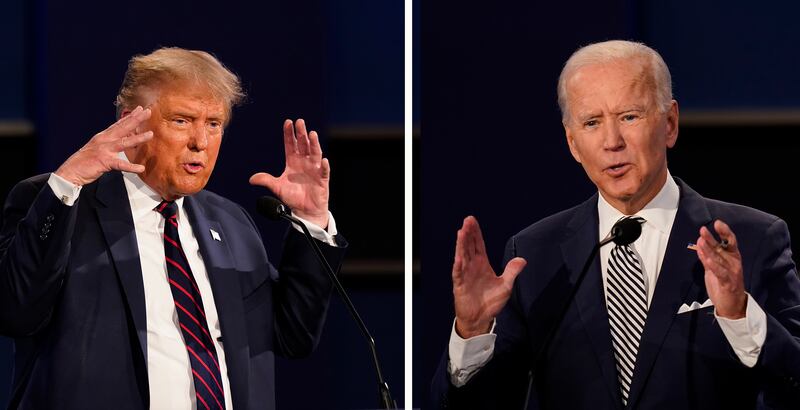
One fact needs to be clear. A virtual presidential debate would not be without precedent. On Oct. 13, 1960, the third debate between Richard Nixon and John F. Kennedy took place with Kennedy in New York and Nixon in California, each in television studios.
Such a debate today would not have to resemble a Zoom call, as President Trump insinuated when he rejected the idea on Thursday. The candidates would not have to be in a home office, in front of a computer with a low-resolution webcam, with campaign minions coaching their answers. It could be done carefully in studio settings, with people on hand to ensure debate rules are followed, and with proper medical precautions in place.
But the bigger question is whether any more debates between President Trump and former vice president Joe Biden would be worth the time, for the voters or the candidates.
Our answer would be a qualified yes.
Without any more debates, voters would be left with nothing more than campaign commercials, rallies and social media posts, each of which are filled with exaggerations and inaccuracies.
But if future debates between Trump and Biden resemble the first one, they would add little of value. If they resemble Wednesday’s vice presidential debate in Utah, they would add little of substance.
The Cleveland debate was marred by constant interruptions and insults. Viewers were left with little chance of discerning answers to questions. On Wednesday, Vice President Mike Pence and Sen. Kamala Harris, D-Calif., made an art form out of dodging questions, sometimes veering in directions that bore little relation to what was asked.
Another Cleveland-like shouting fest would hardly justify the expense of another debate, virtual or not. But a stronger moderator on Wednesday could have done more to probe the candidates with direct follow-up questions, and by demanding straight answers.
Civility is important, and the vice presidential debate had that. But civility does little good if it just means the candidates politely obfuscate. Voters today are still wondering whether Harris and former Vice President Joe Biden would attempt to pack the Supreme Court. They are wondering whether Pence and President Trump would peacefully transfer power if the president loses the election.
If another debate is held, it clearly must be held with candidates in separate locations. The president’s recent diagnosis of COVID-19 requires him to avoid human contact for a period of time. The growing list of White House officials who have tested positive suggests a serious outbreak within the administration, involving more than just the president’s inner circle.
Biden suggested Thursday that the next debate be postponed until Oct. 22, and that the originally planned town hall style be followed, in which a live audience asks questions. This format may provide the best chance for a real discussion of issues. However, given the current situation, even a town hall format would need to involve an audience in remote locations.
In rejecting the idea of debating remotely, the president said he didn’t want a situation where the moderator could “cut you off whenever they want.”
American voters, hungry for substantive answers and debate, might find that appealing.
In any event, these extraordinary times call for extraordinary measures. Perhaps this year’s debates have run their course, but that decision should not hinge on any allegations of poor technology.
If people in 1960 worked out the logistics of a remote debate, it certainly could be done today. Whether the result is worthwhile to the American people, however, depends on the candidates, themselves.