



SALT LAKE CITY — The phone call came to me from news director Brian West on July 9, hours after Salt Lake District Attorney Sim Gill ruled that the shooting death of Bernardo Palacios-Carbajal at the hands of police officers was legally justified.
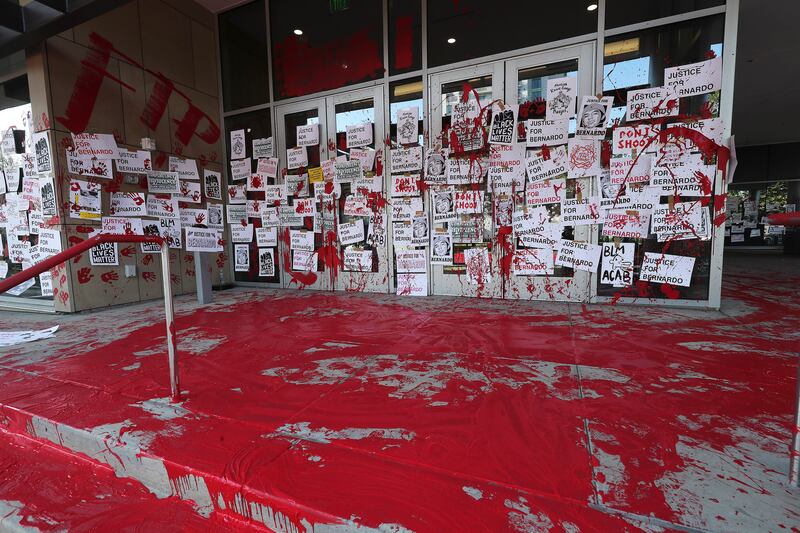
Salt Lake Police and public officials braced for protests from the decision and the protests came. They began peacefully but then turned violent as red paint was used and windows were broken. Our reporters and photographers, as well as broadcast journalists for both TV and radio were on the scene, as they had been week after week for protests of racial injustice that have been a summer constant since the death of George Floyd in Minnesota in late May.
But this July 9 protest was different.
“Our reporters and photographers are being threatened. They’re having to pull back a bit,” West alerted me as the protest of several hundred in Utah’s capital city continued. We then discussed how to balance their safety with the need to tell not just a local Salt Lake story, but its place in the larger conversation of police violence.
Earlier in the day Salt Lake County’s district attorney gave a 45-minute detailed account of how he came to the decision not to charge officers who engaged in a prolonged chase of Palacios before shooting him to death. “I cannot ignore the fact that the urge and the desire and the need to hold onto the gun was greater than the desire to flee away from them,” Gill said of the violent encounter.

Whichever way that difficult decision came down it was clear there would be controversy and protests.
Deseret News photojournalist Jeffrey Allred was on the scene: “We’ve covered these — I’ve covered four or five protests myself — and the organizers were happy to have us out there,” Allred said. “This last one as soon as they started putting paint on Fifth South they just became uncorked. They were prepared to stop the media from shooting it,” he said, reflecting journalism-speak for taking still and video images.
“Some protesters told us that we were going straight out of the protest and taking our photos to the police. They really believe that we’re taking our photos straight to the cops,” he said of the response he was getting that day.
It’s not true. Journalists are not an arm of law enforcement and shield laws are in place to ensure journalists can do their jobs. Which is why a judge’s decision in Seattle last week is so disturbing.
The judge ruled that five media outlets must turn over unpublished photos and video of a May protest that turned violent and resulted in arrests. As the Seattle Times reported, “King County Superior Court Judge Nelson Lee sided with the police department in a morning hearing, ruling that its subpoena was enforceable. He found that the photos and video were critical for an investigation into the alleged arson of SPD vehicles and theft of police guns.”
He put some limits on what police can do with the images, but the Times editor and others strongly objected to the reasoning that there was no other way to get the information, particularly in an age of cellphone video, police bodycam video and the actions of police departments themselves taking video of protests.
Journalists aren’t seeking public sympathy here; journalists are criticized every day for not being objective, for putting forth a point a view, for promoting a liberal agenda and more. To be sure much of that criticism is justified.
But in this case violating shield law principles for a case of damaged property or because guns were taken has an unnecessary chilling effect on journalists’ ability to represent the public.
“There is a great danger to a free press, and the free flow of information to the public, if law enforcement is allowed to co-opt the news media and compel them to turn over unpublished newsgathering material,” said Jeffrey Hunt, one of the foremost First Amendment attorney’s in the country with Parr Brown Gee & Loveless in Salt Lake City.
As Salt Lake’s protest and our journalists’ interaction with protesters showed, the threats are real. Covering an event does, in fact, shine a light on the behavior of both protesters and police so the public can make determinations. Public policy changes often follow. To turn over unpublished material, potentially for fishing expeditions of wrongdoing, impacts the public trust in media.
So what’s the law in Utah? Hunt replied:
“David Reymann and I led the effort to enact Utah’s reporters’ shield law, which actually is very similar to Washington’s. Like Washington’s law, and that of nearly every other state, Utah’s reporters’ privilege is qualified, meaning the state has the ability to overcome the privilege. But the standard is high, and properly so,” he said.
“Utah’s rule gives the highest protection to confidential sources. Unpublished newsgathering information (such as photographs taken during riots) is also strongly protected, but may be overcome if the material sought cannot be obtained elsewhere, is of central relevance to a criminal or civil proceeding, and the state’s need for the information substantially outweighs the interest of the free flow of information to the public.”
In Salt Lake City on July 9, television journalists carrying cameras sought out higher vantage points to tell the story, in one case going live on air from the balcony of a nearby hotel.
Sometimes journalists can work behind police lines. But in this case, police were a block away from where the paint was being used and the windows broken. That changed after the violence and police declared it an unlawful assembly.
Our reporters and photojournalists were there from beginning to end and gratefully, they were not injured.