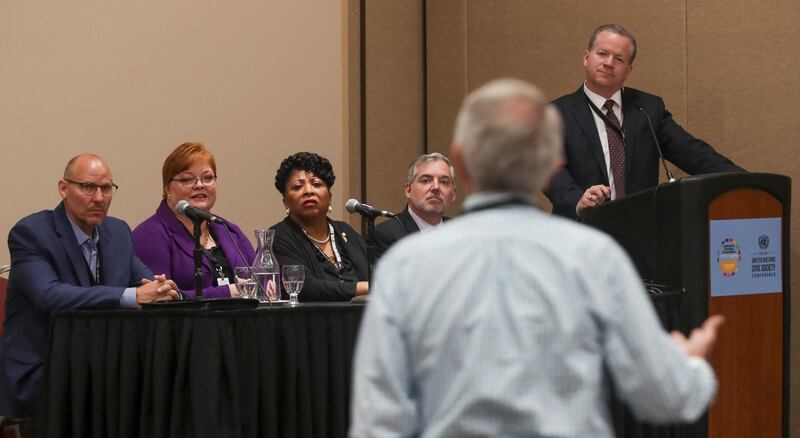

In August 2019 the United Nations Civil Society came to Salt Lake City. Utah is a model of upward mobility and a service-oriented, volunteer-driven culture and was ready to share its story with a worldwide gathering, the first such conference in the United States to be held outside of New York City.
Unemployment was near its lowest-ever levels. Rental housing occupancy locally was high. Construction was booming. And as summer drew to a close, coronavirus was a word only scientists and the health care class were concerned with. Certainly pandemic was not on the radar of a nation and world that only months later would be brought to its knees.
It left time to Think Big Thoughts and conference-goers were here to learn about “Building Inclusive and Sustainable Communities.”

Gérald Caussé, presiding bishop of The Church of Jesus Christ of Latter-day Saints, spoke of one measure of successful societies:
“Together we seek to reach across barriers and boundaries in the great work of creating a world in which we include, sustain, serve, and more importantly love one another,” he said. Others joined that call, including the need to work together to feed the hungry and provide safe havens for both personal growth and community building to occur throughout the world.
Boyd Matheson, Opinion Editor of the Deseret News, led a panel discussion that included, among others, Jeanetta Williams, the head of the NAACP in Utah. She honed in on a key to building sustainable communities: service and appreciation of others. As I related in a column at the time, she recounted a conversation she had with a senior leader of The Church of Jesus Christ of Latter-day Saints, with whom she developed a relationship.
She said he would not just ask her how she was doing. He asked, “How are they treating you here? Respect. Care for others. Both are needed if sustainable communities are going to be created and upward mobility achieved.
So it was with great excitement this week that we reported and wrote about the amazing reach and success of BYU-Pathway Worldwide, as described in the article appearing in the Deseret News today under the headline: “Uncovering the groundbreaking secrets of BYU-Pathway Worldwide.”
Deseret News reporter Tad Walch describes the innovative, remarkable path carved by this unique worldwide education program, which has grown to 51,583 students within 12 years..
It’s growing in Africa, the Philippines, South America and yes, North America, where Utah itself has an enrollment of 9,486 students.
What’s the key to its success?
You’ll need to read the story for all the innovative details. But love and respect for individuals is among the main drivers of educating the world through the Pathway program.
“If you look at a distribution curve, lots of universities have the students we serve on the left-hand side of their distribution curve, but for us they’re not a population we accommodate, they’re our center-cut focus,” Clark Gilbert, president of BYU-Pathway Worldwide, told Walch.
“That’s our main student profile. We built the program for them to be successful. We don’t view them as remediating students, and we don’t leave them out on an island. Too often in higher education, you’re either treated like a remediation student or you’re left to sink or swim.”
In May 2015: “The Equality of Opportunity Project involved the tracking of millions of families over a period of years and uncovered a direct link between a child’s future earnings and the specific place where he or she grew up. In short, some neighborhoods are conducive to upward mobility while others, for a variety of reasons, are not.”
BYU-Pathway Worldwide is meeting people where they are, providing an affordable online education with the respect and support to not just advance individuals, but to help them serve within the communities they live in.
Following the United Nations conference in Salt Lake City, the Deseret News editorial board wrote:
“Globally, building strong civil societies faces steep hurdles. More than 6 billion people reside in places with high restrictions on religious freedom. Despotic governments limit freedoms of the press and individual speech. ‘Outsiders’ are persecuted for their cultural, ethnic or sexual identities.”
Pushing for the ability for individuals across all societies to get an education is one key to improving the world. And its progress is not slowed by a pandemic when the opportunity for education can come directly to your home.