

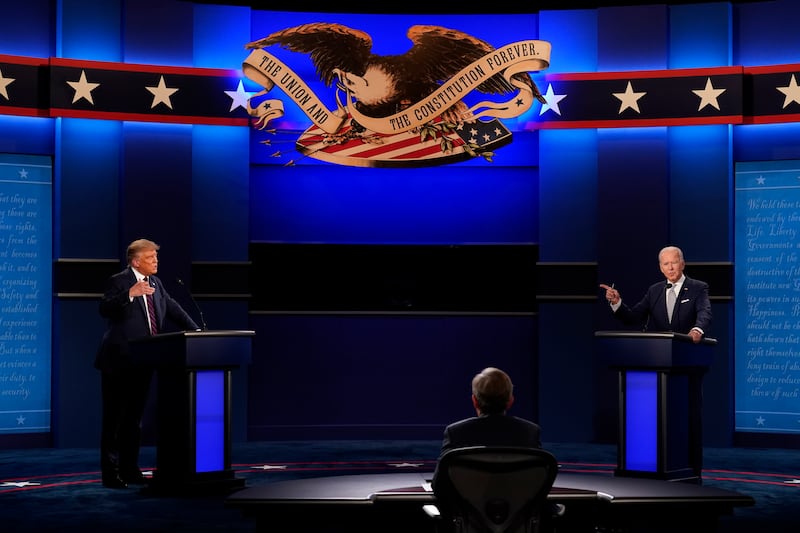
With electoral college delegates having certified their votes to Congress, we know Joe Biden will be the next president. Most members of Congress and other politicians can now start evaluating their prospects for the 2024 presidential election. This quadrennial phenomenon raises the question of candidate debate usefulness.
Recent presidential debates have not seemed to give voters much of an in-depth picture of candidates’ positions. The debates’ main value is entertainment. Their format’s allotment of two minutes to respond to long moderator questions leaves candidates less time to address complex issues, like taxation and foreign policy, than the time one would spend talking to city hall about pothole repair.
Further, insertion of television news personalities as moderators and sometimes biased interveners, as in Candy Crowley’s interruption of Mitt Romney in 2012 to argue over his opponent’s Benghazi fiasco, eats up response time and reduces citizen respect for the debates.
Recognizing the campaigns agree on event rules with help from the private Commission on Presidential Debates, it is time for a format allowing citizens to hear how candidates really intend to govern. As a starting point, we can look to the first televised debate between executive hopefuls in 1960. During the Nixon-Kennedy debate, a journalist panel asked questions. Each candidate had 21⁄2 minutes per question to respond. The speakers largely answered the questions and stayed in the response time including the final three-minute closing summation. (They were friends).
We have strayed from that territory, with contestants continuing to speak on themes from previous questions, ignoring questions, running overtime and going to unasked subjects, even though their campaigns approved some of the moderator’s subject matter.
This is no surprise, because the present format forces short, sound-bite responses. There seems to be no genteel way to keep debaters from going overtime or interrupting each other to explain and re-explain their positions. So the Nixon-Kennedy model’s extra half minute response time likely would not solve much.
A better example for facilitating the debate commission’s stated goal of giving candidates more time to present positions would be the original Lincoln-Douglas debates in the 1856 Illinois federal senate contest. Republican Abraham Lincoln and Democrat Stephen Douglas debated seven times in seven weeks. The opening candidate spoke for 60 minutes followed by the next candidate’s 90-minute response. A 30-minute rebuttal by the opener concluded each event. Of course, the roles were reversed in the next debate. Voters loved it and followed the performances around the state.
Like today, there was plenty of rancor surrounding the contestants in the press and the public, including statements that Lincoln should join a circus and Douglas was a “steam engine in britches.” But no media celebrities interrupted, took part in or otherwise interfered during the actual debates. An audience member occasionally shouted out, and Lincoln stood up three times to interrupt in the first debate but was pulled down by his friends.
Would a similar process nowadays allow candidates time to address issues they choose in a more thorough manner, show they are capable of thoughtful analysis and permit voters to get a better view of what each side stands for? Yes. In fact, with certain safeguards in place, a speaker could cover topics in more depth without the excuse of too little time or interruptions by anything but the time clock.
Taking into account modern attention spans and network programming, time limits would probably have to be along the lines of a 45-minute opening, a one-hour response and a 15-minute rebuttal — each speaker would cover one hour total. Participants would have a better opportunity to develop what they wanted to say without interruption by the other party or a “moderator.”
Candidates who thrive on memorizing lists of bumper-sticker phrases may not like this. However, they could be called out by the press and social media to prove their ability to be as thoughtful as Lincoln and Douglas in taking time to develop rational points. The response and rebuttal periods would provide especially valuable proof and show ability to answer the opponent’s serious questions.
At the end of each period the camera and sound would shift automatically to the opponent’s microphone — period. Someone experienced in announcing “time’s expired” like an NFL referee could say the time, sound and spotlight are shifting; the other contender will take over until his or her time runs out.
Newscasters could participate by broadcasting from a location other than the stage. As for town hall meetings, candidates could conduct their own and bring broadcasters if they want.
Sam McVey is a retired trial judge and an attorney in Salem, Utah, providing pro bono mediations and assistance with veterans claims.