

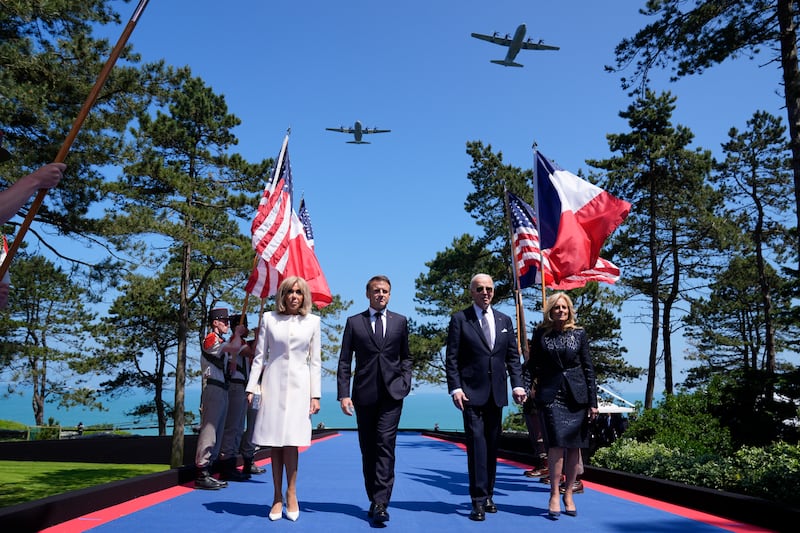
In 2007, I directed BYU’s program in France and accompanied my students to the Normandy D-Day beachheads and the serene American Cemetery overlooking the Omaha and Utah beaches assigned to U.S. troops on June 6, 1944. Decades earlier as a missionary in nearby Caen, I heard many personal stories of the German occupation and eventual liberation highlighted by D-Day. Within a year of the Normandy invasion, Germany had capitulated and Adolf Hitler was dead.
The Second World War began officially in 1939 and ended in 1945 after Japan’s unconditional surrender. Many Americans were reluctant to enter the war. They argued that Europe was far from the U.S. and of no great consequence. They took comfort in their nation’s propitious geographical position of friendly countries to the north and south and mammoth oceans to the east and west. If necessary, a Fortress America could be self-sufficient and go it alone.
Meanwhile, most of Europe had succumbed to Hitler’s military onslaught by the end of 1940, and the continent was in danger of being absorbed into the brutal Third Reich dedicated to dictatorial rule, territorial expansion and the extermination of Jews and other groups. And yet, the U.S. remained on the sidelines.
Two pivotal events in 1941 changed the course of human history. Stalin had supported many of Hitler’s atrocities, but Hitler got greedy and launched a surprise attack on the Soviet Union. The German military penetrated the outskirts of Moscow but was eventually bogged down. Over 20 million Soviet citizens were killed in the war, but the Soviet counterattack was massive and did not end until Berlin was captured in 1945.
The second event was the sneak attack on Pearl Harbor by Germany’s Axis partner, Japan. Washington declared war on Japan, but Hitler then declared war on the United States, his second colossal blunder within six months. Instead of focusing solely on Japan, the United States embarked on an ambitious two-front war in the Atlantic and the Pacific. Over 16 million young Americans were eventually mobilized, and the industrial might of the U.S. was transformed into a vast war machine.
In 1939, the U.S. army ranked 39th in the world with a smaller force than Portugal’s. However, by the end of the war, the U.S. emerged as a military and industrial superpower. It possessed the most advanced military arsenal and a monopoly on atomic weapons. It also accounted for half of global industrial production. On the other hand, more than 400,000 American combatants had died and over 80 million people worldwide perished.
What about today? Europe is now embroiled in its most disastrous war since 1945. Russia has ruthlessly invaded Ukraine, and Putin’s goal may be to restore the Soviet Union dismantled in 1991. Ominously, his long-term ambition may be to replicate Hitler and assert control over most of the European continent.
Globally, a new Axis has emerged consisting of Russia, China, Iran and North Korea, all led by brutal men who view themselves as dictators for life. The chances of protracted war in Europe, Asia and the Middle East are at the highest level since 1945, and the potential threat posed by the new Axis may be far greater than the Hitler-led Axis of the 1940s.
At home, divisions over U.S. international involvement mirror some of the same discord in American society prior to the attack on Pearl Harbor. Certain prominent political actors are now calling for the end of military aid to Ukraine, the abrogation of NATO’s Article 5 collective security provisions and even total U.S. withdrawal from NATO.
The United States is powerful, but visions of Fortress America and isolation are more nonsensical today than they were in 1940. Interdependence is a fact of life, with many developments such as climate change, diseases, migration and conflict largely originating abroad and having a growing impact on the daily lives of average Americans.
International cooperation, unity at home on key issues and enlightened bipartisan leadership provided the foundation for success on D-Day in 1944. A similar formula will be needed to solve the vexing challenges confronting the United States in 2024.
Earl Fry is an emeritus professor of political science at BYU. He also served as a Fulbright lecturer at the Sorbonne in Paris and the Fulbright Bicentennial Chair at the University of Helsinki in Finland. He is the author and editor of more than 20 books.