

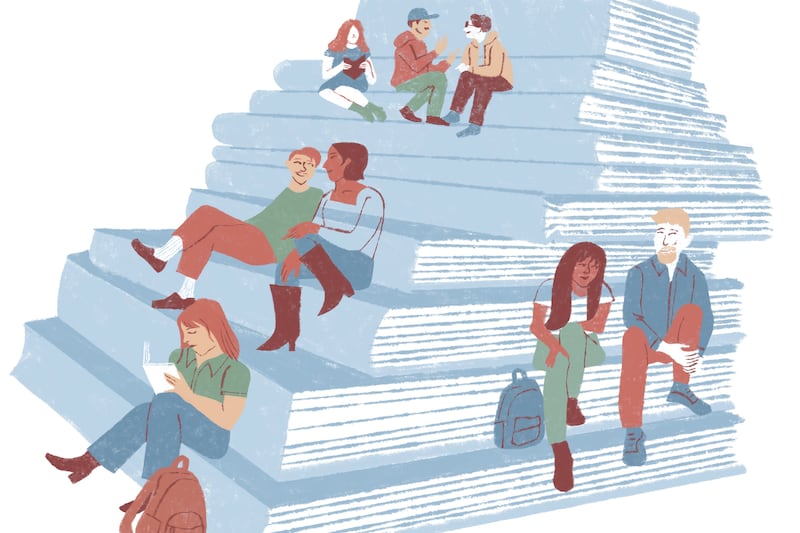
There is a common misconception about college; it’s not the parties, lectures or even tests. It’s that people actually do assigned readings. Typically buried in the “required content” section, textbooks and assigned readings stay relatively untouched for most students. Recent articles from news outlets, such as The Atlantic’s “The Elite College Students Who Can’t Read Books,” paint a grim picture for the future of America’s literacy and comprehension. However, as a current university student, I have a different story to tell.
We’ve reached a point where students no longer care to read their textbooks. This is why 30% of students reported reading their textbooks compared with 85% of faculty expecting students to read the textbook. The disconnect between academics and their pupils is growing due to a lack of understanding on what a student needs in order to learn and absorb information. New forms of media such as podcasts, videos or articles should not be considered as less valuable than a book or textbook. Visual learning is in itself a form of comprehension, and data shows that the majority of students are visual learners. In order to understand students' needs and how they can best learn, we have to accommodate, not criticize. The use of tools that emphasize speaking and listening over reading don’t signal the end of literacy; they signal a change in how students want to learn.
This is why academics who talk about a rise in shallow reading, the practice of students reading to gain information fast and efficiently, need to understand where students are coming from. The issue is college students are designed to be that type of learner, the fast learner. In order to keep up with massive textbooks assigned daily or weekly, the college student has no choice but to revert to the shallow reader. When in reality, faster learning is not better learning.
The difference in expectations and reality between the student and the professor can be seen in data. According to the 2018 Faculty Survey of Student Engagement, 97% of professors think it’s “important” or “very important” that students come to class having finished their reading, however, a minuscule 3% believe that students actually do their readings.
The straightforward takeaway that many have mistaken as the death of books and literacy is simply a caricature of the truth. The modern college student prefers information that is efficient and respects their time, which long readings have notoriously not done. While higher education is meant to be both mentally and academically challenging in order to grow skill, forms of media that fail to help students learn quicker should not be the primary content we use to learn. Students that prefer to be assigned Youtube videos do so because it opens up flexibility for studying and takes less time.
This is why podcasts being utilized as a form of supplemental content is a learning innovation. Podcasts used for learning can improve literacy and expand curiosity. Considering the popularity of podcasts among young populations like myself, there is no reason not to use them.
But new media is not the only solution — facing dwindling literacy rates, The University of Texas at Austin implemented an innovative solution. Their class Analytical Reading and Writing aimed at helping students learn how to absorb and understand knowledge from long readings and textbooks. Courses like UT Austin’s help ease students into being able to comprehend academic texts; because if the student is confused by their reading, they won’t do it. Colleges can also incentivize reading among students through voluntary book labs — something I’ve found helped reignite my interest in reading. Faculty submit books that they like and meet with students weekly to open discussion about the book.
At the core, one thing students have not lost is their desire to learn and the ability to be curious. Teaching styles should use this to their advantage by allowing for independent studying and leaving room for creativity. My classes have taught me to be analytical and efficient. Creativity can’t be supplemented, and in order to engage students again, we have to bring back curiosity.
This need for engagement comes at a time when college students are increasingly under scrutiny and examination. Fortunately, issues such as the worsening student mental health crisis has increasingly been recognized and researched. The modern students of my generation faced variable workloads during the COVID-19 pandemic and have consistently been met with shifting expectations of what an education should look like. Today, education is no longer just about reading, and that’s OK — sometimes it’s about listening to what students have to say.