


A version of this article was first published in the Right to the Point newsletter. Sign up to receive the newsletter in your inbox every Wednesday morning.
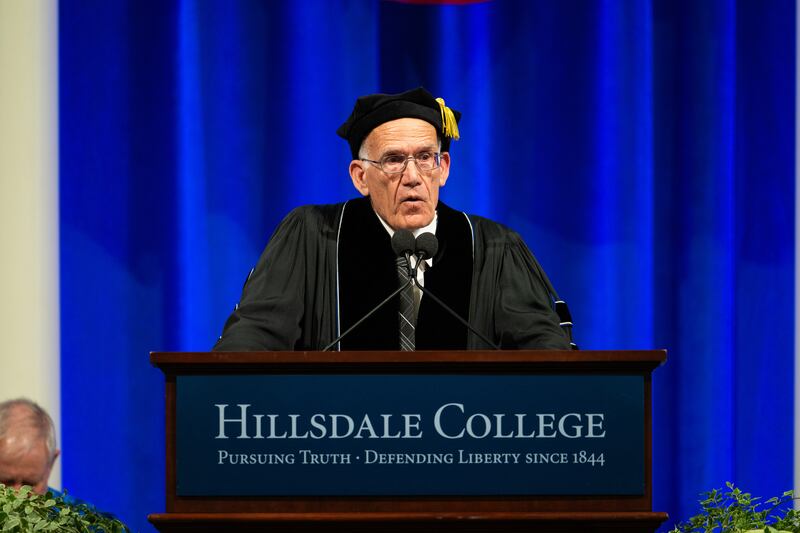
When Hoover Institution scholar Victor Davis Hanson gave the commencement address at Hillsdale College in May, he described the conservative Christian school, which doesn’t accept federal money, as “the nation’s 21st-century example of what higher education should be — and might still become."
Hanson has long been affiliated with Hillsdale, having been a visiting professor of history and classics at the Michigan school for more than two decades. So it’s no surprise then, that his lectures are among the offerings of Hillsdale’s free online courses — available to anyone in exchange for registering with an email address.
“Our courses are created for every American who wishes to embark upon a life-changing education in the greatest ideas and texts of Western Civilization. The only requirements are a desire for truth and a love of liberty,” the Hillsdale website says.
Course offerings include economics, philosophy, religion, history, literature, and — new this fall — American paintings, with deep dives into, for example, C.S. Lewis, Aristotle and Winston Churchill, the Constitution and the Federalist Papers, as well as overviews of ancient history and cultures.
Jordan Peterson’s Peterson Academy advertises that it offers higher education at 1% of the price — it’s currently $399 a year. There’s no doubt great content on that website, but for anyone itching to go back to school with the kids, you can’t do better than free.
Forever William F. Buckley Jr.
Say what you want about the U.S. Postal Service — and I have plenty to say about the holiday surcharges starting Oct. 5 — but the USPS has done an admirable job of staying out of the culture wars over the years, even walking a fine line on religious versus nonreligious stamps during the holiday season.
The USPS has also carefully navigated the minefield of who gets featured on a stamp — you can buy stamps featuring Barbara Bush or Ruth Bader Ginsburg, Nancy Reagan or the late Washington Post publisher Katharine Graham.
So don’t read anything into the fact that William F. Buckley Jr. is about to be on a “forever” stamp, even as Donald Trump is ruminating about privatizing the Postal Service (something he actually can’t do on his own — that would require the authorization of Congress).
The Buckley stamp will be issued Sept. 9 with appropriate fanfare at WFB’s alma mater, Yale. Speakers at the ceremony will include Washington Post columnist George Will (back in the day, Buckley gave him a job at National Review) and Buckley’s son, the novelist Christopher Buckley. The master of ceremonies will be Hoover Institution fellow Peter Robinson, host of the public affairs show “Uncommon Knowledge” and once a speechwriter for Ronald Reagan. (He wrote the famous “Tear Down This Wall” speech.“)
Buckley would certainly approve of the lineup, and also likely wouldn’t let the honor go to his head. After all, SpongeBob SquarePants has his face on a stamp, too. You can order both on the USPS website, and also register to attend the event if you’re anywhere near New Haven next month.
Rufo, Rufo everywhere
August has been a very good month for Christopher Rufo, the man that Rod Dreher once called “the most important conservative in America.”
The Manhattan Institute scholar best known for his anti-DEI crusade was a guest on Bill Maher’s show, there’s talk of a forthcoming debate with Jonah Goldberg (which both Bari Weiss and Hugh Hewitt have volunteered to moderate), and he’s been one of the principal drivers of the Cracker Barrel boycott (“The Barrel must be broken,” Rufo wrote on X.)
Rufo also showed up in The Free Press this week with a moving story about traveling across the country by train with his two young sons.
An excerpt: “Most families travel by car, where they are all alone, or by air, where they fight through terminals and bristle at any intrusion. But the train is a social affair,” he writes, with fellow passengers happy to share their stories as the miles go by.
”The rail lines are the archetypal American way of travel. They conquered the continent, and everyone who rides the train carries with them a small residue of that destiny. They are going somewhere, chasing something."
I’ll be thinking of this essay the next time I’m standing in the airport security line.
Recommended Reading
I love this story by Mariya Manzhos about the surprising friendship between two intellectuals who could not be more ideologically diverse: conservative Robert P. George (a Deseret contributor) and progressive Cornel West.
An excerpt: “What began as a planned half-hour interview in George’s office turned into a four-hour debate on philosophy, politics, literature and faith. The spirited exchange and the mutual intellectual affinity led to the pair co-teaching a freshman seminar called ‘Adventures of Ideas’ based on 12 great books.”
Find the full piece here: How conservative and progressive Ivy League professors became best friends
The Wall Street Journal recently highlighted a handful of conservative women who seem to be “having it all” — children, marriage and high-powered careers. But their lives are not representative of what most women want, according to Autumn Zeoli, Brad Wilcox and Ken Burchfiel.
They write: “The data show that most married mothers would much more prefer a less strenuous work-life balance — either not working for pay at all, or engaging in part-time work.”
Read more here: Are conservative women really embracing the “Supermom” ideal?
End notes
The soul-searching continues in the Democratic Party, and many Democrats seem to be taking the advice of firebrand James Carville who thinks the party should be speaking more like people you meet at a state fair, and not an Ivy League coffee shop.
Politico last week published a Third Way memo that advised Democrats to drop 45 words and phrases from their “public-facing” vocabulary and to talk more like normies.
View the list here, and notice what’s not on the list: Nowhere do the authors suggest that Democrats stop cussing like sailors in an attempt to sound more authentic and tough.
To me, this seems a lost opportunity. With Republicans growing increasingly profane, Democrats had a chance to stake out an increasingly bare territory: one in which people use language that conveys dignity and respect. So sure, let’s get rid of “microaggressions,” “chest-feeding” and “existential threats” to everything. But also maybe a few other words that I can’t mention here.
And if there are any words that you wish Republicans would quit using, please let me know, and I’ll share them next week.
As always, thank you for reading and being part of the Right to the Point community. You can email me at Jgraham@deseret.com, or send me a DM on X, where I’m @grahamtoday.