


The very first live Nativity scene, it is said, was created by St. Francis of Assisi, who staged a reenactment of the birth of Jesus Christ in 1223, using a doll as the newborn Jesus and a few live animals to gather around townspeople playing Mary and Joseph.
Today, there’s a chapel at that site in Italy, with a painting that depicts the familiar scene, which is ubiquitous this time of year, showing up not only at churches and homes, but in Nativity merch, to include chocolate, pajamas and even a “Peanuts” themed Nativity set with the bird Woodstock in the manger.
It’s unclear if Charles Schulz would appreciate Woodstock in the manger, since the “Peanuts” creator was a devoted Christian who famously preached “the true meaning of Christmas” in the Charlie Brown Christmas special.
“I preach in these cartoons, and I reserve the same rights to say what I want to say as the minister in the pulpit,” Schulz reportedly said.
Actual ministers have been doing their own preaching in Nativity scenes in recent years, with some taking their message beyond the reason for Christ’s birth. Most recently, a Catholic church in Dedham, Massachusetts, has made headlines with a Nativity scene that has neither the Christ child, nor his parents, but a sign that says “ICE was here,” suggestive that they had been taken away by federal immigration agents.
An American Baptist church in Illinois also has political messaging in its Nativity scene, depicting a baby with his hands bound with zip ties, Mary and Joseph wearing gas masks, and centurions dressed as ICE agents. The pastor of that church, the Rev. Michael Woolf, was arrested at an immigration demonstration earlier this year, and the church website is promoting a prayer vigil on Dec. 10 for “all victims of immigration enforcement terror.”
The Rev. Woolf told Richard Requena of The Chicago Tribune, “Christians have to look at the birth story — not just a sort of a rosy sort of tale that we can just read in scripture — but actually sort of wrestle with its coming into being in context.”
He added: “We don’t speak for all Christians, but we certainly speak for a certain strand of community that’s trying to take that message and say, ‘If Jesus were born in America right now, what would this Nativity set look like?’”
Two years ago, the church’s Nativity scene had the infant Jesus surrounded by rubble, in a statement about Israel’s war with Hamas, modeled after a similar display at a church in Bethlehem.
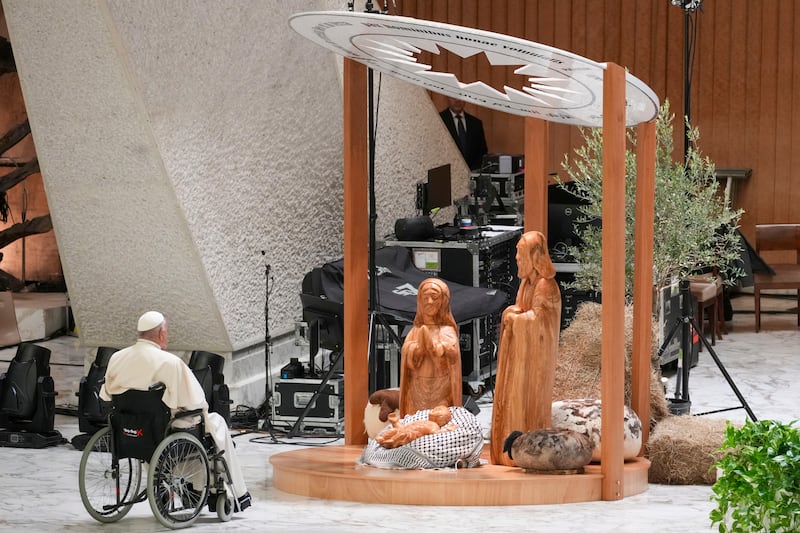
That so-called “rubble Nativity” showed the Christ child wrapped in a keffiyeh, a black-and-white headscarf associated with Palestine supporters.
Similarly, eyebrows were raised worldwide after Pope Francis was photographed in front of a Vatican Nativity scene where the manger was covered with a keffiyeh. The keffiyeh was later removed, after objections from Jewish leaders and groups.
There is no shortage of Nativity scenes to protest. In Belgium this year, some people have been complaining about a Nativity scene in which the characters have no eyes, noses or mouths. According to Crux, the artist made the figures out of cloth, “in hopes the faithful from Japan to Namibia would see themselves in the soft fabrics lacking any identifying features.” One person, however, compared them to zombies. The baby Jesus has since been stolen.
Even in more traditional Nativity scenes, fault can be found, as when Mary and Jesus are blue-eyed blondes that look like they belong in a Pottery Barn catalogue. Or, take the universal presence of donkeys, which frequently appear in the Bible, but are nowhere to be found in the Gospel accounts of Christ’s birth.
In 2013, one enterprising person decided to create a minimalist Nativity set that consists of nothing but small wooden blocks bearing the names of the characters involved: Mary. Joseph. Sheep. Angel. Caspar (one of the Wise Men). It was a joke, perhaps no more blasphemous than a Nativity scene made of chocolate, but still, enough to give people of faith pause.
At what point does a Nativity scene leave the space of “very powerful art” — what one person said of the Lake Street Church display — and cross into blasphemy?
For many, these scenes do just that.
“The purpose of a Nativity scene is to remind us of the purpose of Christmas, not to remind us of current political issues,” the executive director of the Catholic Action League of Massachusetts, C.J. Doyle, told a reporter for WCVB in Boston. He called the ICE-themed scene at St. Susanna Church in Dedham divisive and disrespectful.
The priest at St. Susanna’s, who in years past put the baby Jesus into a cage to protest Trump policies, thinks otherwise. “What is the objective by doing this?” the Rev. Stephen Josoma said. “To help people recognize the plight of people who are really in dire need, and how are we treating them. We’re supposed to bring out the best of people in Christmas.”