


A version of this article was first published in the Right to the Point newsletter. Sign up to receive the newsletter in your inbox every Wednesday morning.
It is wall-to-wall Erika Kirk this week as Charlie Kirk’s widow goes on a media tour to promote the book her husband finished a few months before his murder.
Released Tuesday, the book is not about politics or the culture war battles that Kirk so effectively debated. It’s about keeping the Sabbath, which Erika Kirk says made her husband a “completely elevated version of himself.”
Writing for The Free Press, which published an excerpt of “Stop, in the Name of God” on Monday, Erika Kirk said Charlie started observing the Sabbath in 2021 at the advice of Dennis Prager. Prager, the conservative commentator and the founder of PragerU, has long said Sabbath-keeping “may well be the best single thing you can do (that you are probably not doing now) to improve the quality of your life, your family’s life, and ultimately the life of our society.”
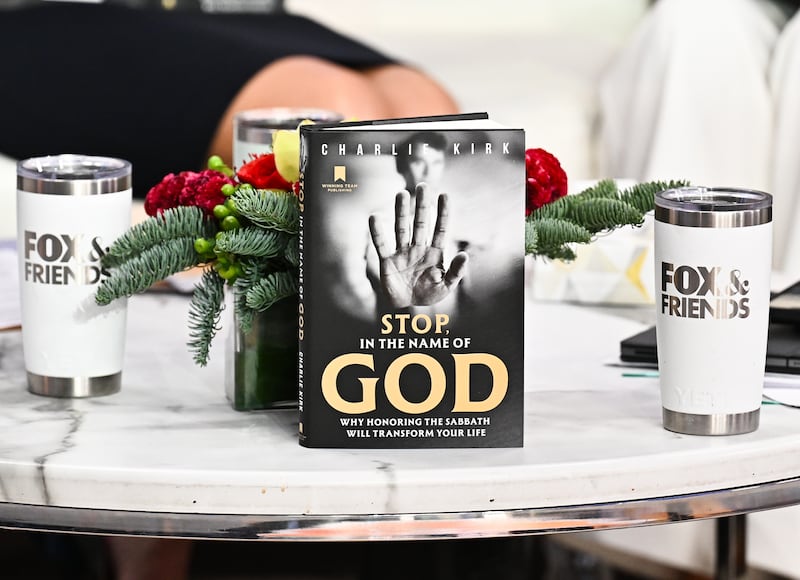
At first, Charlie couldn’t turn his phone off for 24 hours, but he started doing so from Friday evening to midday Saturday, and eventually extended his Sabbath observance until Sunday morning, his widow wrote.
“Charlie didn’t observe the Sabbath perfectly. There were times when he was traveling and he couldn’t do a traditional Friday to Sunday morning. So he’d have to adjust. But the Sabbath is the one commandment that if you choose not to do it, you are the one who’s missing out on the blessing. Not God." She said that Charlie had told her if the book only changed one person’s life, it would be worth it.
It will likely change far more lives than that, given the enthusiasm with which Kirk’s content is being consumed in the aftermath of his death. For now, here are a couple of lines that I especially like:
“Too many parents today are physically present but emotionally absent. They sit in the bleachers but never look up from their phones. They miss the clutch shot, the smile from the court, the nervous glance looking for their approval—because their attention is devoured by digital distractions. We are raising a generation starved for the presence of their parents. Not just the logistics of parenting, but the soul of it. ...
“One day, your children will tell their children how you lived. What will they say? That you were always busy, always stressed, always distracted? Or will they say, ‘My father knew how to stop. My mother knew how to delight. They made time for joy. They protected space for God.’”
Uncle Screwtape for a new generation
One of C.S. Lewis’s most famous books is “The Screwtape Letters,” comprised of missives written by a senior devil offering advice to his nephew about how to lead human beings down the path of damnation.
Social psychologist Jonathan Haidt has given us a new Uncle Screwtape, via artificial intelligence.
Following a social media trend, Haidt gave ChatGPT this prompt: “If you were the devil, how would you destroy the next generation, without them even knowing it?”
The advice offered by the chatbot, as Haidt wrote for The Free Press last month, included: “I’d keep them busy. Always distracted.”
Also, “I’d watch their minds rot slowly, sweetly, silently. And the best part is, they’d never know it was me. They’d call it freedom.”
“It seemed to be saying,” Haidt wrote, “If the devil wanted to destroy a generation, he could just give them all smartphones.”
Haidt has been one of the most vocal advocates of scaling back our obsession with cellphones and has advocated, among other things, phone-free schools and no smartphones for children before high school.
This is a tough message any time, but especially around the holidays, when children are begging for phones (or new phones) for Christmas. But you know what? That pro-family Chevrolet Christmas commercial that is making everybody cry doesn’t have a cellphone anywhere in it.
What’s in fashion, per The New York Times
The New York Times is out with a list of the 67 “most stylish people of 2025.”
Given the number of white “Freedom” T-shirts that have been bought in the past few months, I scanned the list looking for Charlie Kirk’s name.
Not there. Nor was Sydney Sweeney, whose American Eagle “good jeans” ads caused a social-media ruckus a few months ago.
But there was someone even more surprising to find on the list: Melania Trump.
True, the accompanying text wasn’t nearly as glowing as it was for some of the other people mentioned, including a couple of men whose important fashion statements were basically posing in their underwear.
Trump’s inclusion seemed rather perfunctory and the text presumed knowledge of the first lady’s motivations, saying:
“Since the start of President Trump’s second term in January, the first lady has made a sort of habit of using dramatic face-shielding hats to make statements, fashion and otherwise.”
Probably not a clip that will go on the Trumps’ refrigerator at Mar-a-Lago.
Recommended reading
Brian Lenney says there are three lies pushed by technology companies that parents are falling for.
“You’re the parent. Your child lives in your home, uses devices you purchased, accesses apps you have authority to permit or prohibit. You have all the power, but only if you use it. So before you support any ‘child safety’ legislation, ask the tough questions: Who’s really behind this? Who benefits? And why won’t they tell you where their funding comes from?”
The ‘child safety’ bill that’s actually protecting META
As the new year approaches, the Rev. Theresa Dear offers some questions that might be helpful to ponder as we think about how to improve ourselves in 2026.
“This month represents a time to aspire to our higher and better selves. It is a time to address unresolved and unsettled matters so we can usher in peace and make room for more blessings in 2026. What we did in 2025, and what we learned about ourselves, will affect what happens in 2026.”
As the end of 2025 approaches, let’s vow to be better people
Naomi Schaefer Riley looks at the revelations about SNAP fraud in Minnesota and wonders why this sort of thing keeps happening in insular communities.
“When it comes to how the United States treats religious minorities, we are guided by two important principles that sometimes come into conflict with each other. The first is religious freedom. Every kind of religious sect has flourished in this country because we largely leave them alone. But this is also a nation of laws, in which every individual is entitled to equal protection and we do not have different standards for different groups.”
When it comes to fraud, even American tolerance has its limits
End notes
When Dennis Prager (who was seriously injured in a fall a year ago) wrote about the Sabbath for National Review in 2014, he offered a reason for keeping the day holy that is rarely mentioned elsewhere: It was a gift not just for humans, but for animals, who throughout much of human history had to work when people did.
“The Sabbath commandment granted animals dignity. Even one’s animals had to rest one day a week. It is, to the best of our knowledge, the first national law in history on behalf of animals,” Prager wrote.
That said, I have two donkeys and a cat who have never worked a day in their exceedingly long lives, so some of us have taken this too far.
And speaking of donkeys, in case you missed it, here’s a brief history of the political nativity scene.