

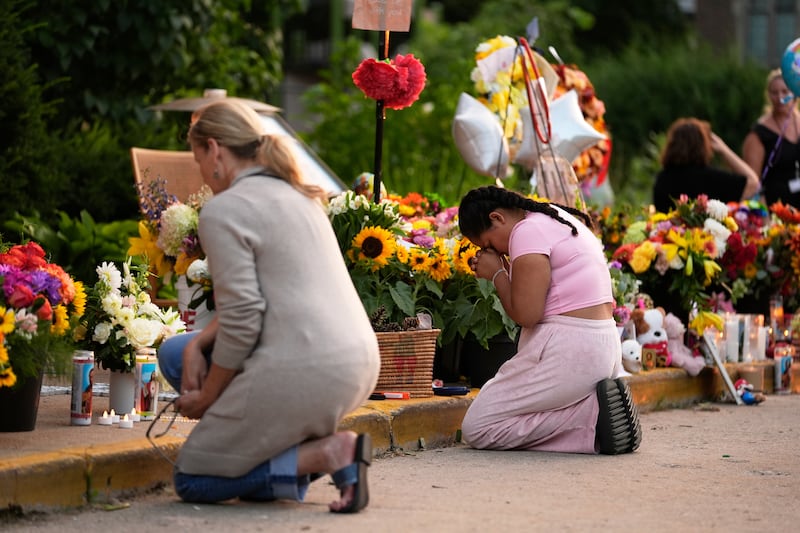

This weekend, as news spread of gunfire at Brown University and at a Hanukkah event at Bondi Beach, I immediately directed my “thoughts and prayers” to the victims, their families and society at large.
But I also paused, recalling recent expressions of anger and sadness and calls for political action in the wake of tragedy —especially in response to the use of the phrase “thoughts and prayers.”
Mass shootings, and in particular, school shootings have been part of the backdrop of my lifetime. Major milestones — graduating, starting teaching, sending my own children to school — are shadowed by memories of another community mourning lives cut short.
I was 9 years old at the time of the 1999 Columbine massacre. I don’t remember understanding much of what happened. I just knew something terrible had happened at a school very far away, and that our school was running a “Coins for Columbine” fundraiser to help.
The first school shooting I remember in more detail was the 2005 Red Lake tragedy. I was 15 — the same age as most of the victims. Over a decade later in 2018, my first year as a high school English teacher in rural Arizona, a 19-year-old opened fire on students and staff at Marjory Stoneman Douglas High School in Parkland, Florida, killing 17 people and injuring 18 more.
In 2022, my oldest daughter entered kindergarten. Just months before she started, an 18-year-old gunman entered Robb Elementary School in Uvalde, Texas, killing 21 people. The following year, as I returned to teaching elementary school after a few years as a stay-at-home mother, I watched news of another attack — this time at the Covenant School in Nashville, where three children and three teachers were killed by a former student.
Over the years, I’ve come to accept dystopian safety protocols like gun-wielding security guards, apps that track shooter locations in real time, and monthly lockdown drills as a normal part of my and my children’s life. But sometimes it gets to me.
Each time a new school shooting occurs, the national response follows a script. Politicians offer condolences, saying their “thoughts and prayers” are with the victims. Almost immediately, someone goes viral insisting “thoughts and prayers are not enough,” followed by others declaring that we must “DO SOMETHING!” — with “something” nearly always meaning gun law reform.
I am not personally opposed to further gun law reform. But I’m concerned that over the last two decades the cycle has become so predictable and so bitter that the phrase “thoughts and prayers” has itself unfortunately become shorthand for inaction. It even has its own Wikipedia page. Somewhere along the way, those two words — once inoffensive, if sometimes insincere — became the rhetorical opposite of gun control.
When California Gov. Gavin Newsom and Minneapolis Mayor Jacob Frey pointed out following the recent Minneapolis shooting that some victims were praying when they were shot, the implication was clear: if prayers worked, these children wouldn’t have died.
That response, however, betrays a fundamental misunderstanding of what prayer is for.
As people of faith, we know prayer does not insulate us from all tragedy. People who pray still lose jobs and marriages, get cancer, and yes — are sometimes victims of violence. If the only point of prayer were to ward off suffering, humanity would have abandoned it millennia ago.
Religious leaders and thinkers across traditions have always been clear: prayer is not meant to change God’s will, but to change us. Rabbi Jonathan Sacks described prayer as a partnership with God in shaping a more just world. Mother Teresa said prayer deepens our capacity to love. Søren Kierkegaard wrote, “The function of prayer is not to influence God, but rather to change the nature of the one who prays.”
Prayer does not guarantee safety. But it does give us the strength to face danger, to mourn with those who mourn, and to rise to action. Prayer humbles us; it reminds us that we are not in complete control, that we are a small part of something much bigger than ourselves. Prayer is also unifying — it allows people of differing perspectives and backgrounds to start to find each other again.
It is deeply unwise to dismiss prayer as mere partisan posturing, because doing so deprives many of the healing they need after tragedies like these. As the Psalmist wrote: “The Lord is close to the brokenhearted and saves those who are crushed in spirit. The righteous person may have many troubles, but the Lord delivers him from them all.”
Last year my daughters and I experienced our first real lockdown. There was no actual emergency — the jewelry store next to our school had accidentally tripped its “armed robbery” alarm. But at the time we knew only that there was potentially a gunman next door.
Huddled in the dark, I looked at the innocent faces of terrified children — some sobbing quietly, others bravely comforting their friends — and I realized there was absolutely nothing I could do except remain calm and pray. Prayer, in that moment, was not an excuse for doing nothing. It was the only thing I could do. And it was enough to steady me so I could be brave for those children.
Prayer has always been difficult for me — quieting my thoughts is not my strength. But in moments like that lockdown, I glimpse why humanity has always been drawn to prayer in one form or another.
We are blessed to live in an age when so many afflictions that haunted our ancestors have been conquered. And yet we are cursed to live in an age where every affliction is broadcast instantly on all the screens we are surrounded by, overwhelming our hearts and minds with the weight of the world.
In any of these moments, it is easy to be angry, to scream into the void. But it is harder to come together in the spirit of humility to solve problems facing our nation and world.
We do need action. We should discuss reasonable policies — on security, mental health, and yes, gun laws — to minimize these sorts of tragedies. We need vigilance, compassion, and courage. But prayer is not the opposite of action. It is the beginning of it.