

We write as people of many different religions who do not share identical theology, ritual or scripture. What we do share is a conviction that public profession of faith must be welcome and protected in any pluralistic society. When that is threatened in deeds or words, anywhere, it is a warning to every other faith that silence today invites vulnerability tomorrow.
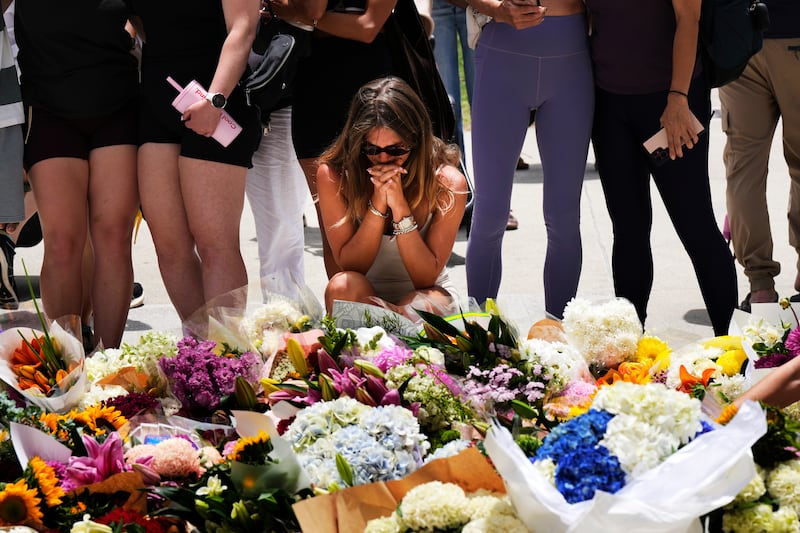
The attack on Jews at Bondi Beach this past weekend was an act of horrific violence. Jewish people were murdered for no other reason than that they were Jewish. They were targeted for choosing to celebrate their religious identity in public.
In a world plagued by rising violence, hatred and fear, Hanukkah itself commemorates a refusal to abandon one’s faith under threat. Of course, that history resonates beyond Judaism. Members of every faith tradition represented among us have known what it means to feel they must hide their light.
Faith is sometimes regarded as a purely private matter — something to be confined to home, church, synagogue, mosque or temple. But integral to the faith of many believers is the conviction that faith is something suffusing our lives. We live out our faith — in a visible way — in public as well as in private: a head covering worn in public, time set aside for daily prayer, food prepared according to religious law, a symbol worn openly on the body, a holiday celebrated in public.
None of these are political statements; they are meaningful expressions of one’s religious faith, identity and humanity. When these expressions become reasons for prejudice or violence, it is not just a belief that is being challenged. Rather, it is the fundamental right to appear peacefully in public as oneself without fear. When bigotry escalates into what we witnessed at Bondi Beach, where Jewish families were violently attacked while observing a religious holiday, it is terrorism.
The temptation in moments like these is either to retreat into silence or to blur distinctions. It can feel safe to speak in generalities or to universalize grief so completely that its particular source disappears. We reject both. This was an antisemitic attack: an act of violence against Jews for being Jewish and living out their faith in public. Describing it as such is not exclusionary; rather, it is a starting point for embracing commonality. Solidarity that cannot truthfully acknowledge what happened, and to whom, is tenuous at best.
A civil society in which people feel compelled to hide or confine religious practice to private spaces is not safer; it is more fragile. Recent events make this painfully clear, including the hateful response to Muslim gatherings in Michigan and the tragic shooting at a meetinghouse of The Church of Jesus Christ of Latter-day Saints. These atrocities are symptoms of the same disease – a cancer of conscience that spreads when left untreated and that people of every faith have a responsibility to confront.
This week, Jews around the world will gather each night to light Hanukkah candles, and while they often do so in their private homes, it is forbidden to keep that light to themselves. Central to the religious tradition is the commandment to share this miracle of light, the supernatural — and sometimes unfathomable — triumph of faith over fear. While recent events might encourage Jewish families to close the blinds as they light their candles, to shift their celebration of faith solely to the private domain, Jewish tradition mandates just the opposite. The Hanukkah menorah is placed in a window, serving to illuminate the lives of those outside the home just as it does for those inside.
In response, we call for neither retreat nor abstraction. We call for affirmation from and for one another. We affirm the dignity of public professions of faith. We affirm the right of people to confidently, publicly practice their faith. To be seen without fear. And we affirm that pluralism is not maintained by sameness but by the vigorous defense of difference.
Across traditions of faith, we can choose to be each other’s miracle, protecting every individual light. In that spirit, we stand with our Jewish neighbors around the world and call on you to do the same.
Asma T. Uddin is a professor, author, and lawyer specializing in religious liberty. Uddin is currently a research fellow at Georgetown University’s Center for the Constitution, and previously taught law at Catholic University and Harvard Law School.
Craig Detweiler, PhD, is a filmmaker, author, president of the cultural investment organization The Wedgwood Circle, and dean of the College of Arts and Media at Grand Canyon University.
Rabbi Elan Babchuck is executive vice president at Clal, the National Jewish Center for Learning and Leadership, and founding director of Glean Network.
Elonda Clay is the library director at the Methodist Theological School in Ohio. She is also a founding member of the Technology, Ecology, Religion, and Art (TERA) Collective.
Katrina Lantos Swett is president of the Lantos Foundation for Human Rights and Justice, founded in 2008 to honor the legacy of her father, Congressman Tom Lantos, the only Holocaust survivor elected to Congress and former chairman of the House Foreign Affairs Committee. She is also the co-chair of the International Religious Freedom Summit.
Lipi Roy, MD, is a physician, international speaker, media personality, entrepreneur and host of the YouTube series Health, Humor and Harmony. She currently practices at Greenwich House Center for Healing and is a clinical assistant professor at Albert Einstein College of Medicine.
Lynn Swain is a TEDx speaker, master neuroplastician, and respected expert in authentic leadership and corporate transformation. She is the founder and CEO of Symbiota Leadership Institute.
Simran Jeet Singh, Ph.D, is an assistant professor of interreligious histories at Union Theological Seminary and a senior advisor for the Aspen Institute’s Religion & Society Program, where he previously served as executive director.
Angela Nielsen Redding is the executive director of the Faith and Media Initiative and the executive director of the Radiant Foundation.