

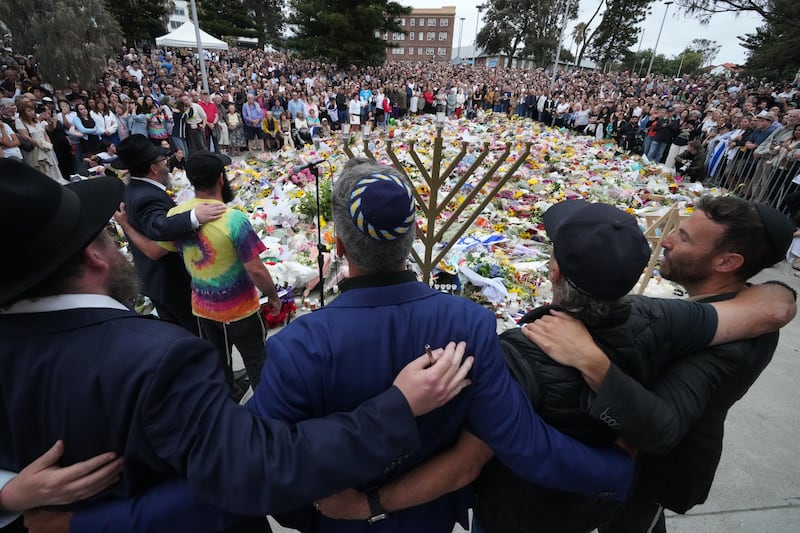
The tragic terrorist attack on a Chanukah celebration on Bondi Beach happened on the other side of the world, but it could have happened here. In the United States, a nation founded on the promise of religious freedom, houses of worship were long viewed as special and sacred places. That is no longer true.
Violent New York City protestors swarmed Park East Synagogue last month, protesting an event at which Jews gathered to discuss moving to Israel. The city’s mayor-in-waiting could not even bring himself to issue a full-throated denunciation of the protest.
This month, anti-Israel protestors infiltrated and interrupted a Jewish-Korean event at L.A.’s Wilshire Boulevard Temple. It remains to be seen whether anyone will be prosecuted.
These events are not aberrations. They are becoming a new normal.
These attacks are more than assaults upon religious freedom. Synagogues, much like churches, lie at the heart of what forms a community. In my own community in suburban Maryland, synagogues are family spaces, overrun with children of all ages. Many synagogues have children’s programming and play groups during Sabbath services. It is a place for prayer, but also religious milestones from circumcisions, bar and bat mitzvahs, weddings, and even funerals. It is a place for friendship and comfort, spiritual growth and safety. It is the beating heart of communal life.
An attack on a synagogue is an attack on that life.
The latest protests outside synagogues in the name of anti-Zionism is a symptom of a larger malaise. It reveals a breakdown in societal norms, an evisceration of religious centers as a sacred and public good. A society that values religion as an essential part of public and private life must protect these sacred places.
There is only one way to heal this illness, and it requires decisive actions from the federal government down to local officials. Prosecutors must punish the perpetrators and make clear that the right to “free speech” is not absolute.
Courts have recognized a meaningful difference between speech intended to communicate an idea — even a despicable idea — and speech intended to coerce or threaten. The latter is not protected.
Determining a protester’s intent can be tricky, but today’s antisemitic protestors make it easy. Standing outside the Park East Synagogue in Manhattan yelling “Death to the IDF” and “globalize the Intifada” is unambiguous. Their goal was to intimidate and prevent Jews from entering the event. Certainly, when protests turn violent and trespass on private property — like the Wilshire Boulevard Temple — we should not hesitate to throw the book at the hooligans.
Second, one person’s right to free speech does not take precedence over another person’s right to freedom of religion. Courts have historically upheld narrowly tailored laws creating buffer zones around houses of worship and time limitations on protests in order to find balance between protecting both rights. But the fact that we even need these laws should be a five-alarm warning about attitudes towards religious life today.
It is crucial that society be honest about who and what we are dealing with. The “protestors” are not genuine proponents of free speech. Their vile and violent chants are clear: They seek to dismantle, disrupt and deny Jewish religious life. They want to use their absolutist claim on free speech to annihilate the equally important right to freedom of religion.
We are witnessing the natural consequence of two years of refusing to hold bad actors accountable. The vast majority of campus protestors and rioters were given a free pass by local politicians and prosecutors even though they assaulted students, destroyed private property and clearly violated Jews’ civil rights. They were essentially told society doesn’t care enough about those rights.
The United States was founded for the purpose of providing freedom of worship to people of faith. Freedom to worship is worthless without freedom from fear. If we want to preserve this national purpose, we must protect all houses of worship as sacred places. That requires public leaders with the courage to go beyond statements of sympathy and act.