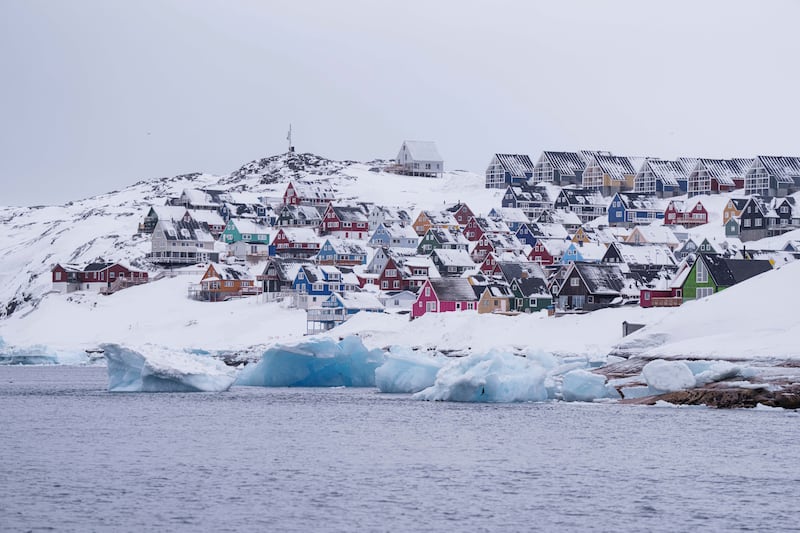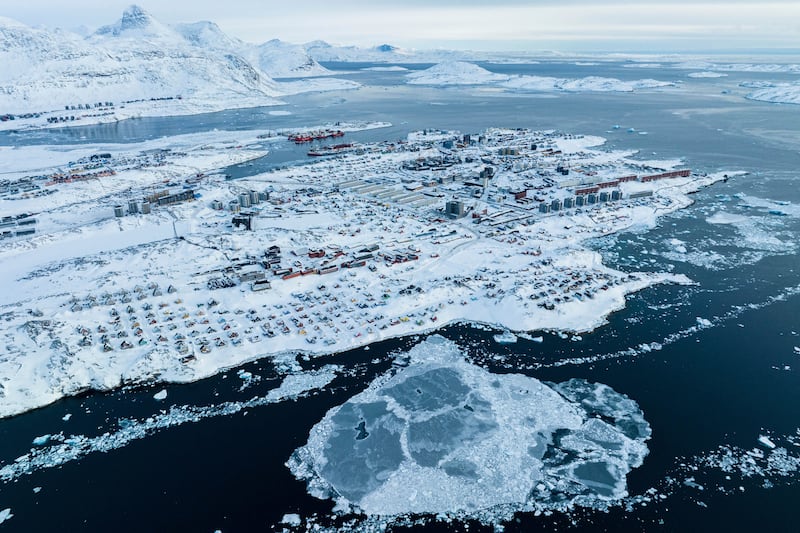

Seventy-nine years ago, a Republican California congressman named Bertrand Wesley Gearhart introduced a resolution in Washington that would have urged the United States to buy Greenland from Denmark, and to make Iceland the 51st state.
If you think today’s headlines sprang to life without any historical context, you are mistaken.
“Iceland and Greenland lie on the line of march of any marauding empire which might be bent on world conquest,” Gearhart said. (I’m quoting newspapers of the day available at newspapers.com.) “In the face of an onslaught, Iceland would, standing by herself, be helpless. In any world war that might involve us, she is indispensable to our defense. Her strategic value cannot be ignored longer.”
He also called the state department “weak and vacillating to the point of timidity” for not looking to expand U.S. territory for defensive purposes.
Gearhart could be excused for those opinions, expressed while the horrors of the second World War remained fresh and at a time when the emerging Cold War was taking its own frightening baby steps.
In any case, he wasn’t alone.
A secret offer
In 1991, the Associated Press revealed that the administration of President Harry S. Truman had, in 1946, secretly pitched the idea of offering Denmark $100 million in gold or, alternatively, to swap oil-rich portions of Alaska’s Point Barrow district in exchange for parts of Greenland that the U.S. felt it needed for military purposes.
Denmark could extract all the oil it wanted, provided it sold it all to the United States.
The AP said Secretary of State James Byrnes met with Danish Foreign Minister Gustav Rasmussen in New York on Dec. 14, 1946. He told Rasmussen that it might be best to just sell the island to the United States.
According to a telegram Byrnes sent to the U.S. Legation in Copenhagen, Rasmussen seemed shocked by the suggestion. He did not reject it outright, but said he would study the offer.
The AP said the archives contained no indication that the matter was discussed further.
Two things are important to note here. One is the privacy of both the meeting and the offer, which was kept secret for 45 years. The Truman administration was not interested in humiliating, publicly pressuring or threatening a valued ally.
Second, the establishment of the North Atlantic Treaty Organization in 1949 provided a mutual defense pact to protect all member states, including Greenland. In 1951, the U.S. and Denmark built a military base in Greenland to allow long-range bombers close access to the Soviet Union and China. That continues to operate today.
And one more factor is important here. As the New York Times reminded its readers this week, the U.S. has almost unfettered access to the island because of a Cold War agreement that remains in effect. It was signed in 1951 and updated in 2004 to give Greenland’s semi-autonomous government a nominal say in what happens.
The Times quoted a Danish researcher at the Danish Institute for International Studies saying, “The U.S. has such a free hand in Greenland that it can pretty much do what it wants,” adding, “If it just asked nicely.”
So far, President Trump is being anything but nice.
Taking Greenland by force
After the U.S. military successfully invaded Venezuela and captured President Nicolas Maduro, President Donald Trump and other White House officials have made threats to the governments of Colombia, Cuba, Mexico, Iran and Greenland, warning that similar things may be in store. In Greenland’s case, that would affect not only the island’s government but also Denmark, which still holds Greenland as a self-governing territory.

The current president is not as concerned as Truman was about being discreet with an ally.
Doug Bandow, senior fellow at the Libertarian Cato Institute, has called the idea of a takeover of Greenland “nonsense.”
“There are legitimate security issues at play in … Greenland, but none require U.S. control,” he wrote last year, adding, “In 2018 Washington was concerned over a plan for China to construct three airports on the island, but worked with Denmark and Greenland to generate alternative financing. Even without ownership, proximity gives the U.S. a major advantage in dealing with Greenland.”
Climate change
Greenland’s place in the world may change in the future. Writing in Foreign Affairs, University of Chicago political science professor Michael Albertus said climate change may improve Greenland’s livability in the future, setting off a land grab.
“As major powers try to position themselves for success in a warming world, many will rush to secure access to vital territory and resources — ushering in an era in which blatant land grabs are a recurrent theme,” he said.
All that aside, Denmark’s prime minister, Mette Frederiksen, is as unimpressed as her predecessors were with Truman’s offer in 1946. A hostile takeover of Greenland, she said, would mean the end of NATO.
Which would bring us back to the postwar world of the late ‘40s, only with the complication of a potential new AXIS-like alliance known in some circles as CRINK — for China, Russia, Iran and North Korea — forming on the horizon in opposition to Western influence. They would no doubt be happy with the breakup of NATO.
Is that what Washington wants?